It is difficult to imagine Harry Potter without the towering silhouette of Hogwarts, the long tables of the Great Hall or the strangely crooked shops of Diagon Alley. Today, these places feel as familiar as the characters themselves. But twenty-five years ago, none of them had ever appeared on a cinema screen. When Harry Potter and the Philosopher’s Stone arrived in 2001, the filmmakers were not simply adapting a successful novel. They had to decide what an entire magical world should actually look like.
In 2026, the first Harry Potter film celebrates its 25th anniversary. The film originally premiered on 16 November 2001, beginning a movie series that would eventually consist of eight films. Looking back after a quarter of a century, one of the most remarkable things about Philosopher’s Stone is how much of the visual language of the later films was already there from the beginning.
One of the most important people behind that look was production designer Stuart Craig, who worked on all eight Harry Potter films. Craig and his team faced an unusual challenge. Millions of readers already had their own versions of Hogwarts in their imagination. The filmmakers therefore needed to create something spectacular without making it feel like a colourful fantasy theme park.

Craig’s approach was to make the magical world feel surprisingly real. When designing Hogwarts, he deliberately avoided creating a light, fairy-tale castle. Instead, he wanted the school to look old, solid and permanent, as if generations of students had really lived and studied there. His team looked at Oxford and Cambridge universities as well as medieval European cathedrals. Elements from different real buildings were then combined to create something new.
This decision became one of the secrets of the film’s visual success. Hogwarts is magical, but it also feels as if it could exist somewhere in Britain. Stone corridors, Gothic arches, enormous staircases and dark wooden rooms give the school a sense of history. The magic seems to grow out of the real world rather than replace it.
The exterior of Hogwarts was another enormous project. A highly detailed physical model of the castle was created for the first film and then combined with digital effects. A large team of artists and crew members worked on the original version. The landscape took inspiration from the Scottish Highlands, while parts of real locations such as Alnwick Castle and Durham Cathedral influenced the miniature architecture. Thousands of tiny lights were placed inside the model to create glowing windows, lanterns and even the impression of people moving through the castle.
The result can be seen in one of the most memorable moments of the film: Harry and the other first-year students crossing the dark lake and seeing Hogwarts for the first time. The castle rises above them, enormous and mysterious, with lights shining from its windows. For Harry, it is the beginning of a new life. For cinema audiences in 2001, it was their first real look at a place they had previously only imagined.
Inside Hogwarts, perhaps no set became more famous than the Great Hall. It was one of the first major sets constructed for the production in 2000. The room was large enough to seat hundreds of children, and the filmmakers used real stone for the floor because they knew the set might be needed for years of filming. It eventually appeared throughout most of the series.
That physical reality mattered. Much of what looks magical on screen was actually built. The long tables, stone walls, teachers’ table and hundreds of carefully designed objects helped the young actors feel as though they had entered a real school. Digital effects added elements such as the enchanted ceiling and floating candles, but underneath the magic was a solid, detailed environment.
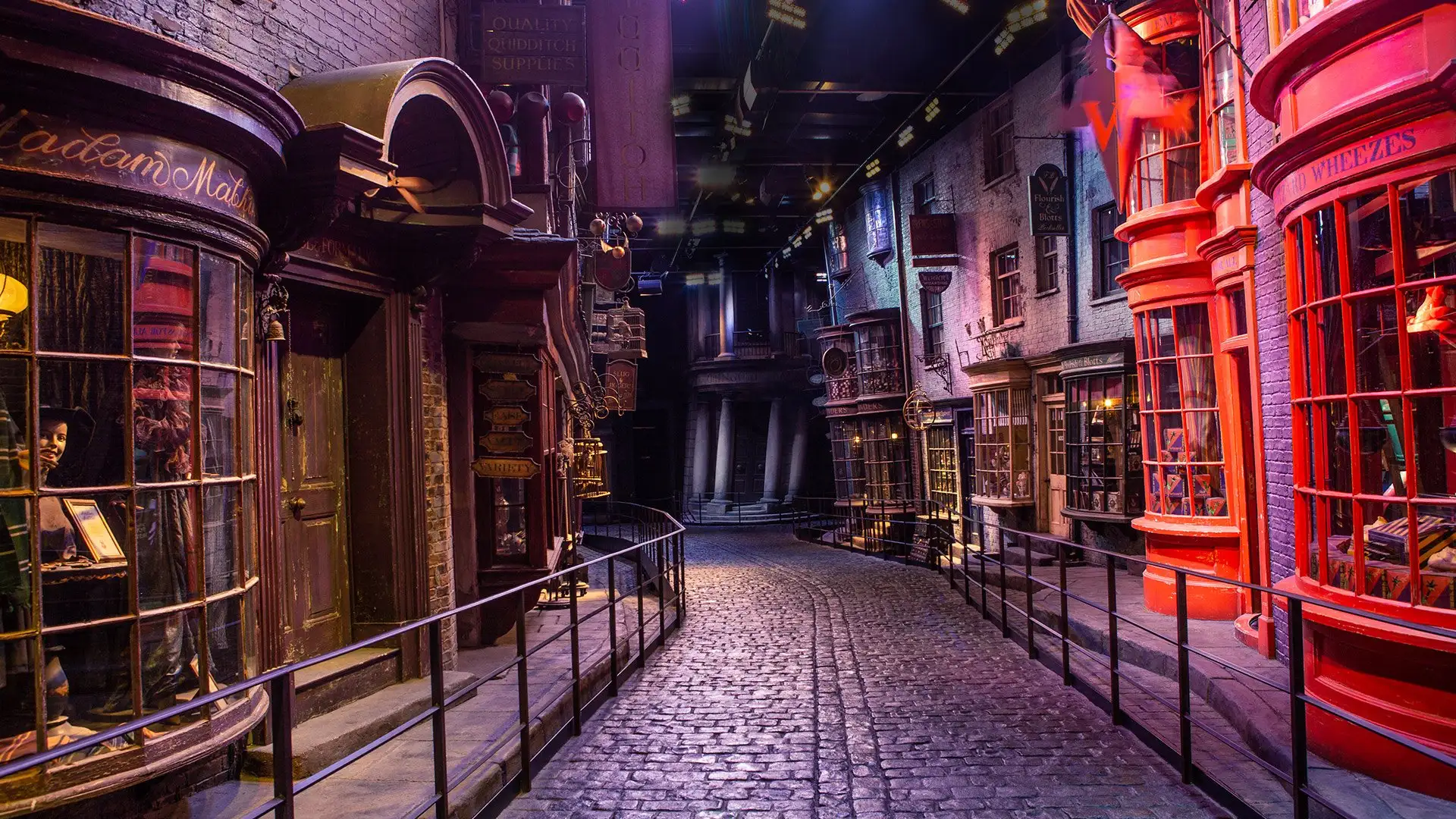
The same philosophy shaped Diagon Alley. Instead of finding an existing London street and simply decorating it, the filmmakers created their own. The design team drew inspiration partly from the London described in the works of Charles Dickens. The buildings were deliberately narrow, uneven and slightly strange. Shop fronts leaned at unusual angles, while windows were filled with magical objects and mysterious signs.
This was especially important because Diagon Alley is the audience’s first large-scale introduction to the wizarding world. We discover it with Harry. Until that point, his life has been dominated by the painfully ordinary Dursley home. Then a brick wall opens, and suddenly there are owls, cauldrons, robes, spell books, broomsticks and witches and wizards everywhere.
Even the Dursleys’ world was carefully designed to strengthen this contrast. Their clothes, furniture and surroundings were made to feel controlled, old-fashioned and ordinary. The difference between the two worlds is therefore visual as well as emotional. Privet Drive is neat and predictable. The wizarding world is crowded, imperfect and full of unexpected details.
Some locations combined sets with real British architecture. The interior of Gringotts Wizarding Bank in the first film, for example, was filmed inside Australia House in London. Meanwhile, parts of the Forbidden Forest were filmed at Black Park in Buckinghamshire. This mixture of real locations, studio construction, miniatures and early digital effects became one of the defining techniques of the series.
And then there were the smaller objects. A convincing world cannot be built from castles alone. Wands, books, sweets, bottles, newspapers and hundreds of other props had to look as though they belonged to the same universe. Even something as small as the Golden Snitch received careful attention. Its elegant design mixed fantasy with mechanical details, making it feel both magical and strangely believable.
This attention to detail would become increasingly important as the series continued. The art department eventually created hundreds of sets across the eight films, while graphic designers produced everything from textbooks to newspapers and product packaging. But the basic visual rules had already been established in Philosopher’s Stone: magic should feel old rather than futuristic, handmade rather than perfect, and strange without completely losing its connection to the real world.
Of course, the Harry Potter films changed considerably during the following decade. The colours became darker, Hogwarts expanded and new directors brought their own visual ideas. Even the layout of the castle sometimes changed to serve the story. The filmmakers did not know every detail of the later books when the first movie was made, so Hogwarts had to develop together with the series.
Yet the foundation remained remarkably strong.
Twenty-five years later, visitors to Warner Bros. Studio Tour London can still walk into the Great Hall, explore Diagon Alley and see the enormous Hogwarts model that helped bring the school to life. The places created for one film became part of one of the most recognisable fictional worlds in modern cinema.
Perhaps that is the greatest achievement of Harry Potter and the Philosopher’s Stone. The film did not simply show audiences somebody else’s version of a famous book. It created a visual world powerful enough to become part of our own imagination.
After twenty-five years, many of us no longer have to imagine what Hogwarts looks like.

