A billboard usually has one simple job: to sell us something. A new car, a holiday, a mobile phone or perhaps a new lifestyle. But every autumn in Budapest, some billboards do something completely different. They make people stop. Sometimes they make them laugh, sometimes they make them uncomfortable, and sometimes they simply leave them standing there for a few seconds longer than expected.
This is the world of ARC, Hungary’s long-running outdoor poster exhibition. For more than a quarter of a century, it has been using one of advertising’s most familiar formats – the giant billboard – to talk about society, everyday life, fears, frustrations and the changing mood of the country.
And the story began around the turn of the millennium.
From advertising space to public expression
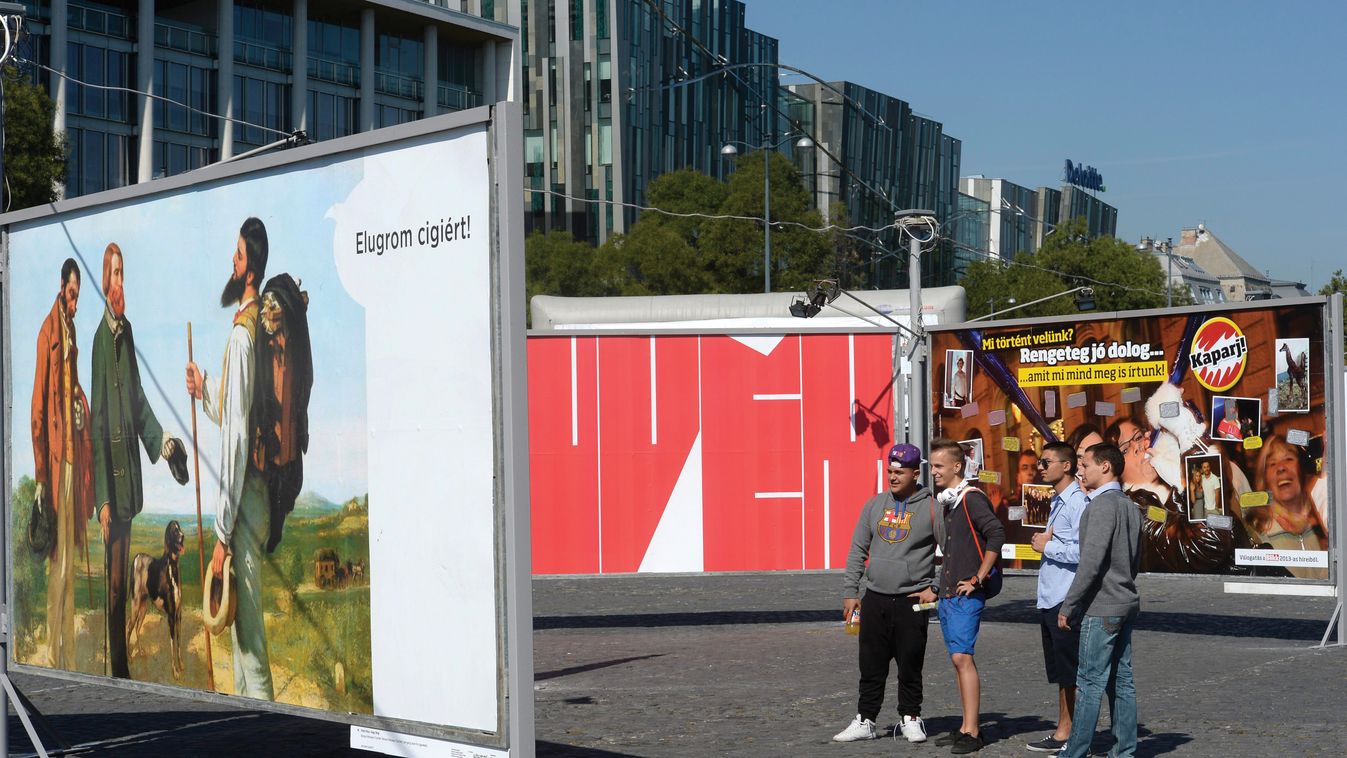
The idea behind ARC was developed in 1999, when Gábor Bakos, Barna Fatér and Péter Geszti founded the organisation behind the project. Their concept was unusual but simple: why should enormous advertising surfaces only be used to sell products? Why could they not also carry ideas, humour, criticism or personal observations about the world around us? The first ARC outdoor exhibition followed in 2000.
It was an interesting moment to launch such a project. Hungary was entering a new millennium, commercial advertising was becoming increasingly visible in public spaces, and giant billboards had become an everyday part of the urban landscape. ARC took that familiar visual language and turned it around. Instead of asking “What should you buy?”, the posters could ask “What do you think?”
The exhibition soon became an annual event. For many years its home was the large open area beside Budapest’s City Park, then generally known as Felvonulási tér and later renamed Ötvenhatosok tere. The large, empty public space was particularly suitable for rows of enormous posters, creating something similar to an outdoor gallery.
The format was also remarkably open. ARC was not designed only for professional artists or advertising experts. Ordinary people could submit ideas too. The selected works were then enlarged to billboard size and displayed in public, with no museum entrance, walls or opening hours separating the exhibition from its audience.
By the early 2000s, ARC was already attracting considerable attention. In 2003, only the fourth edition of the exhibition, organisers received 1,344 entries, from which a jury selected 80 posters. Contemporary reports said that hundreds of thousands of people had already visited previous editions. That year the organisers also tried to turn the exhibition area into what they called a “civil space”, adding concerts, films and discussions about subjects including globalisation, public services, manipulation and the situation of Roma people in Hungary.
This development was important. ARC was gradually becoming more than a poster competition. The pictures were still at the centre of the project, but the exhibition was increasingly connected with public conversation.
Over the years, the questions proposed by ARC changed together with society. Some editions dealt with happiness, national identity, survival, beliefs or the future. The tone could be playful, serious, absurd or openly critical. Politics naturally appeared among the subjects, but it was never the only one. Relationships, environmental problems, social inequalities, technology and ordinary frustrations also became recurring themes.
In this sense, ARC slowly developed into a kind of visual record of its time. Looking through posters from different years can reveal not only changing graphic styles, but also what people were worried about, laughing at or talking about during a particular period.
Not always an easy history
Keeping a free outdoor exhibition alive for decades has not always been simple.
Financial difficulties became a recurring problem. In early 2011, organiser Gábor Bakos told HVG that changes in the costs of using public space could put the future of the free exhibition in danger. Eventually, the 2011 ARC exhibition did not take place. Bakos later spoke publicly about difficulties in finding companies willing to support a project connected with unrestricted public expression. The exhibition returned in 2012.
The event nevertheless continued to survive and change.
Its location also became part of that history. After many years close to City Park and Heroes’ Square, ARC had to leave its traditional location. In 2018 and 2019, the exhibition was organised near Örs vezér tere in Zugló. Then another major move came in 2020, when the twentieth ARC found a new home in Bikás Park in Újbuda.

The 2020 exhibition arrived at an especially strange moment. The COVID-19 pandemic had transformed everyday life, and that year’s question was appropriately simple: “Hova tovább?” – “Where do we go from here?” The posters reflected the pandemic as well as environmental concerns, public life and other anxieties of the period.
Bikás Park then became strongly associated with ARC. Surrounded by grass and trees, the giant posters looked very different from ordinary commercial billboards beside roads and shopping centres. Visitors could walk between them slowly, return to particular pictures and discuss them with others.
By its twenty-fifth edition in 2025, organiser Gábor Bakos described ARC as a mixture of a civil message board, a school of visual culture and a barometer of public mood. After a quarter of a century, this description perhaps explains the exhibition better than the simple term “poster exhibition”.
A new chapter in 2026
And now ARC has moved again.
The 26th ARC exhibition opened on 18 September 2026, but visitors looking for it in Bikás Park would not find it there. This year, the exhibition has moved closer to the Danube, to Goldmann György tér 3, beside the Budapest University of Technology and Economics and close to the Buda end of Petőfi Bridge. It remains an outdoor exhibition and can be visited free of charge, day and night, until 18 October 2026.
This year’s central theme is Idegrendszerváltás.
It is a clever Hungarian play on words that is difficult to translate perfectly. Rendszerváltás usually means a change of political or social system, while idegrendszer means the nervous system. The title therefore combines the idea of major change with something much more personal: our emotions, reactions, habits and state of mind.
The competition invited participants to think about what people carry with them after periods of tension and uncertainty, and what may need to change not only around us but also inside us. As in previous years, however, artists were not required to follow the main topic and could submit works dealing with other subjects as well.
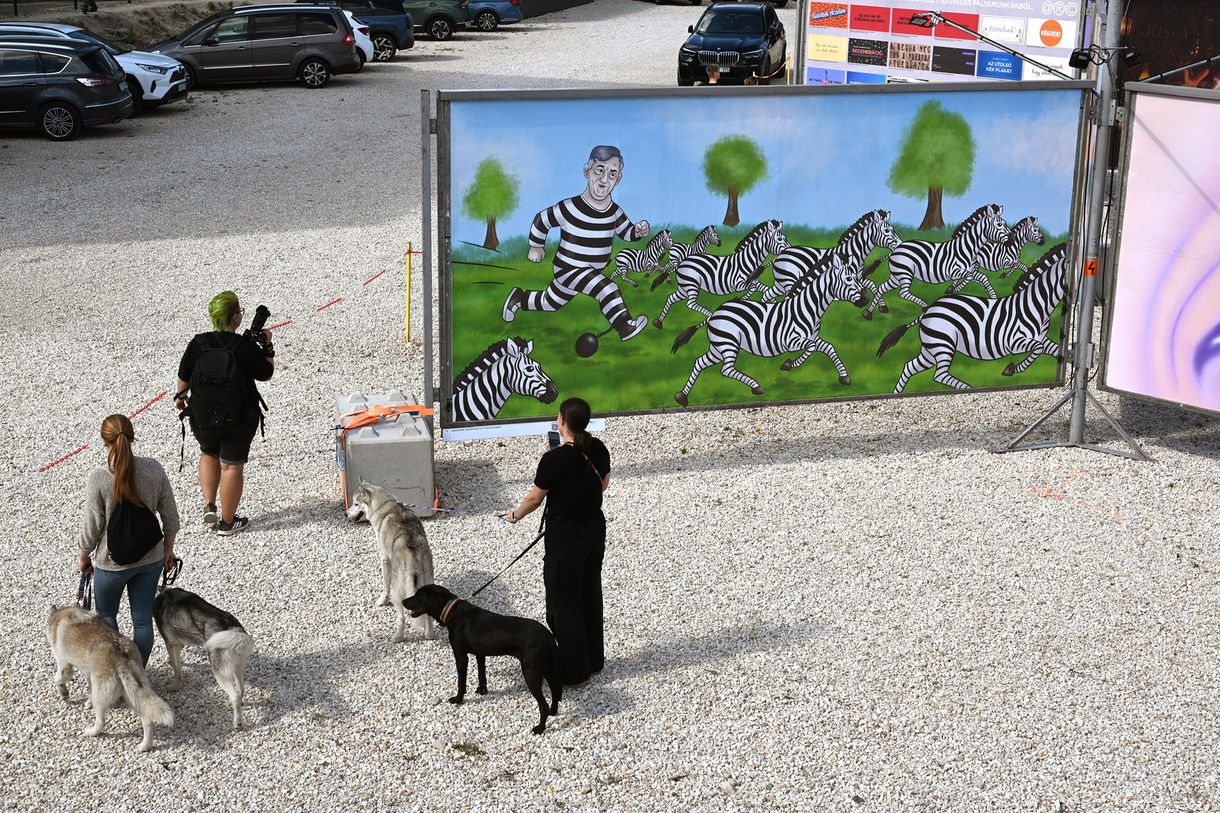
The response was enormous. 920 works were submitted to the anonymous competition, and a 23-member professional jury, including two curators, decided which works would appear at the exhibition.
The main prize went to illustrator Johanna Kügerl for Fejben dől el – roughly, It’s All in the Mind. Tamás Északi came second with Ébredések (Awakenings), while Móric Madarász received third prize for Elbaszott lények.
As usual, the selected pictures cover much more than one subject. Some respond to public affairs, while others focus on social problems, personal experiences, emotions or the small absurdities of everyday life. Humour remains one of ARC’s most recognisable tools. A poster may look funny at first and become considerably less funny once its message becomes clear.
That combination of humour and discomfort has been part of ARC almost from the beginning.
A gallery without walls
Perhaps the most unusual thing about ARC is still its location: outside.
You do not need to decide that you are going to visit an art museum. You do not need a ticket. You do not even need to know much about contemporary art.
You can simply walk past a billboard.
And then something on it may catch your attention.
This changes the relationship between the artwork and the audience. A poster has only a few seconds to communicate its idea. There is rarely room for a long explanation. One picture and a few words have to do most of the work. That is partly why humour, wordplay and visual references work so well at ARC.
The format also borrows directly from advertising. Commercial billboards constantly compete for our attention, usually because somebody wants us to buy something. ARC uses exactly the same size and visual language but removes the product.
What remains is the message.
Not everyone will agree with every poster, of course. Some may seem clever to one visitor and irritating to another. Others may require knowledge of Hungarian culture or current events to fully understand the joke. But disagreement is not necessarily a problem for this kind of exhibition. The posters do not have to provide final answers. Their job can simply be to start a thought or a conversation.
After twenty-six editions, this may be one of the reasons ARC is still here.
Hungary has changed enormously since the first exhibition in 2000. The internet and social media have transformed the way people communicate. Advertising has moved from streets and television screens onto phones. Political and social debates have changed, new problems have appeared, and an entire generation has grown up during the lifetime of the exhibition.
Yet every year ARC returns to the same basic idea.

