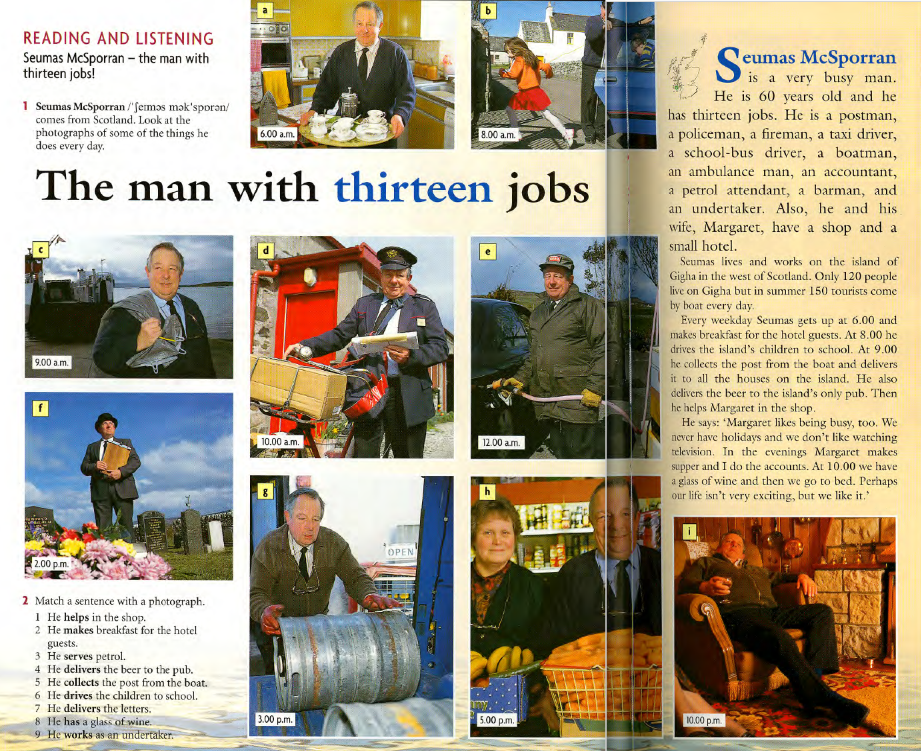
For generations of English learners, the name Seumas McSporran may sound strangely familiar. He appeared in New Headway Elementary, where students read about a Scottish man who seemed to have an almost impossible number of jobs. He was a postman, policeman, fireman, taxi driver, school-bus driver, boatman, ambulance driver, accountant and undertaker, among other things.
It sounded like the perfect textbook story: simple vocabulary, an unusual character and plenty of jobs to learn.
But there was one important detail.
Seumas McSporran was real.
And his real life was even more remarkable than the version many students met in their English lessons.
Born James Alexander Graham McSporran on 9 January 1938, Seumas grew up on the small Scottish island of Gigha, off the west coast of Scotland. His family were Gaelic speakers, and island life was part of his identity from the very beginning.
Gigha is one of the southernmost islands of the Inner Hebrides. It lies just a few miles west of the Kintyre peninsula and is small enough that life there has always depended heavily on cooperation between neighbours.
During much of McSporran’s working life, the island had a population of only about one hundred people. It was beautiful and peaceful, but living in such an isolated place also created practical problems. A small community still needed a shop, post office, emergency services, transport, fuel, a harbour and people to deal with official paperwork. There were simply not enough residents for every job to have its own full-time employee.
That was where Seumas came in.
From Gigha to the RAF – and back again
McSporran left Gigha when he was eighteen to complete his National Service in 1956. He served as a storeman in the Royal Air Force before eventually returning to the island.
By the early 1960s he had married Margaret, and in 1964 the couple took over Gigha’s post office and shop.
At first, this did not look like the beginning of one of Britain’s most unusual working careers. They were simply running an important local business.
Then one small detail changed everything.
The post office had the only telephone on the island.
This was a time long before mobile phones and the internet, and being reachable by telephone was an enormous advantage. Organisations and companies based on the Scottish mainland often needed someone on Gigha to carry out small but essential jobs for them.
And if they wanted to contact somebody on the island, there was one obvious person to call.
McSporran later remembered that many of his jobs came about for exactly this reason: employers were looking for someone who had access to a telephone.
One job became two.
Two became five.
And eventually the list became extraordinary.
Fourteen jobs – and sometimes even more
By the time his story attracted national attention, McSporran was performing an astonishing variety of roles.
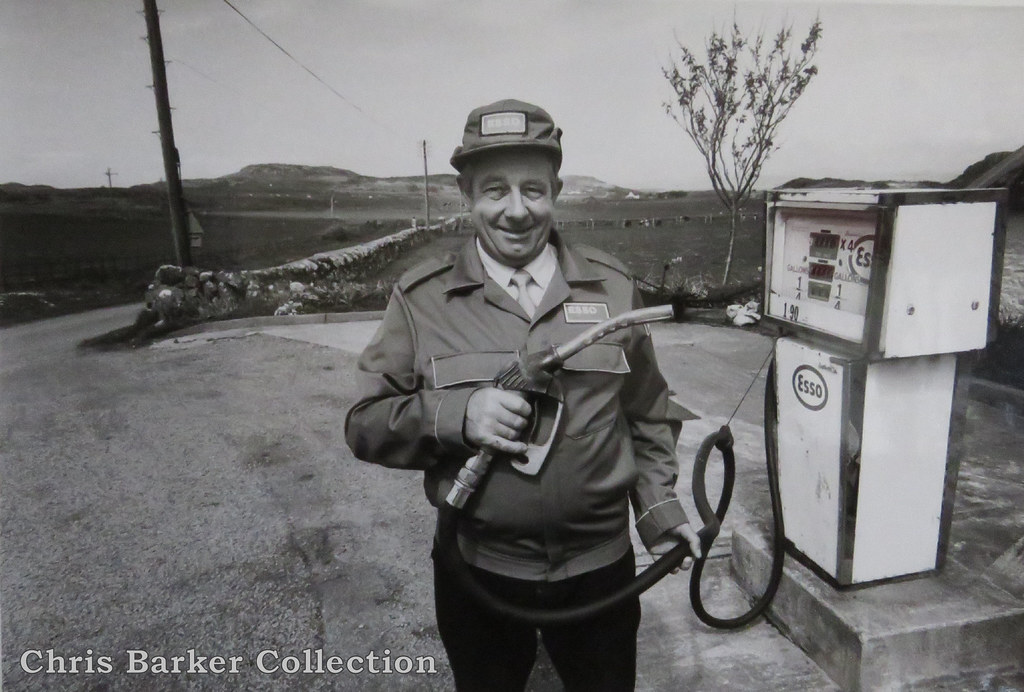
A Reuters report published when he announced his retirement in 2000 listed 14 jobs. He was a shopkeeper, rent collector, postman, special police constable, insurance agent, pier master, registrar, fire chief, ambulance driver, school-bus driver, guesthouse owner, petrol pump attendant, taxi driver and undertaker.
Other accounts mention still more activities that he performed at different periods of his life. He rented bicycles to tourists, delivered supplies, transported beer to the island pub and worked in connection with the coastguard and shipping services.
Some of the jobs even shared the same equipment.
His vehicle could serve as a taxi, school bus and ambulance, depending on what the island needed at that particular moment.
In a large city, each of these jobs would normally belong to a different person, organisation or department. On Gigha, however, flexibility mattered far more than job titles.
McSporran simply became the person who could be called when something needed doing.
His unusual working life eventually became famous enough for him to be associated with the Guinness Book of Records for holding an exceptional number of jobs.
There is some confusion about exactly how many jobs he had. The famous New Headway reading presents him as “the man with thirteen jobs”, while contemporary newspaper reports generally described him as having 14 at the time of his retirement.
The explanation is probably quite simple. McSporran’s responsibilities changed over the decades. He gained some jobs and stopped doing others, and certain roles could be counted separately or together.
The exact total is perhaps less important than the bigger picture.
For more than thirty years, one man was doing the work of a small team.
A working day from six in the morning
The textbook version of McSporran’s life describes a routine beginning at around six o’clock in the morning.
That was not an invention.
McSporran and Margaret really did work extremely long days. Their routine could begin around 6 a.m. and continue until 10 p.m., and McSporran later said that they had been fortunate to remain healthy enough to continue working like that for decades.
A typical morning could begin with helping prepare breakfast for guests staying at their accommodation. Then Seumas might drive the island’s children to school.
Later he would collect the post when it arrived on Gigha and deliver it around the island.
After that, there was the shop.
But the day could change immediately if someone became ill, if the fire service was needed, if a visitor required a taxi or if another emergency appeared.
There was no normal nine-to-five working day.
And behind much of this extraordinary schedule stood Margaret.
While Seumas became famous as Gigha’s “man with many jobs”, his working life depended heavily on the partnership between husband and wife. Margaret helped run the shop and guest accommodation and supported the complicated daily routine.
McSporran himself repeatedly acknowledged how important she was.
The couple were so busy that traditional holidays were almost unknown.
The famous textbook text tells students that they did not go on holiday and that, after finishing their work in the evening, they would finally sit down, have a glass of wine and go to bed.
The real life behind those simple sentences involved an extraordinary amount of work.
When an island needs someone to do everything
McSporran’s story becomes more interesting when we stop thinking about the number of jobs and think instead about why those jobs existed.
Gigha was a remote community.
If someone needed an ambulance, there was no ambulance station around the corner.
If a fire started, firefighters could not simply arrive from a nearby city within minutes.
If somebody died, practical arrangements still had to be made.
If children needed to travel to school, someone had to drive them.
If supplies arrived by boat, somebody needed to deal with them.
McSporran became part of the solution to all of these everyday problems.
One particularly memorable story concerned funerals.
The island’s Church of Scotland minister recalled that if professional gravediggers from the mainland had to leave Gigha early enough to catch the last ferry before completing their work, McSporran would simply step in and finish the grave himself.
That small story probably tells us more about him than a list of fourteen job titles ever could.
If something needed to be done, he did it.
The policeman on an island with almost no crime
One of McSporran’s many positions was special constable.
His main responsibility was to act as a connection between Gigha and police officers on the mainland.
Fortunately, policing the island was not usually dangerous work.
McSporran joked that crime was rare because the islanders were either friends or relatives. There was also the practical question of what to do with a criminal on an island that had no police station or prison.
As he humorously pointed out, apart from giving someone “a dip in the sea”, there was nowhere to put them.
It is a funny detail, but it also says something about the type of community Gigha was.
People knew one another.
Neighbours depended on one another.
And McSporran was involved in almost every part of that shared life.
More than just an employee
Over time, McSporran became much more than the man who delivered the mail or drove the school bus.
He also became a public voice for Gigha.
In 1992, when the island’s then owner faced financial problems and Gigha was repossessed by a Swiss bank, McSporran acted as a spokesman for island residents. The uncertainty affected businesses and even led to the temporary closure of Gigha’s hotel.
The episode showed another side of McSporran’s relationship with the island.
Gigha was not simply where he worked.
It was his home.
And protecting the community mattered to him.
His years of service were officially recognised as well. In the 1989 New Year Honours, James Alexander Graham McSporran received the British Empire Medal for services to the community in Gigha, Argyll. His award appears in the official London Gazette.
He also received long-service and good-conduct recognition connected with his work for services including the police, fire brigade and coastguard.
From a Scottish island to English classrooms
Then something rather unexpected happened.
Seumas McSporran became famous far beyond Gigha.
Newspapers and television discovered that his life made a wonderful human-interest story. The idea was irresistible: arrive on a tiny Scottish island, meet the postman – and then discover that the same man might later appear as your taxi driver, petrol attendant or undertaker.
His story eventually travelled far beyond Scotland.
And somehow, Seumas McSporran became part of the English-learning experience of people around the world.
A simplified version of his life appeared in Oxford University Press’s New Headway Elementary.
Suddenly, this man from a tiny Scottish island was sitting on classroom desks in Britain, Hungary, Spain, Italy, Japan and countless other countries.
Students met Seumas while learning the present simple, daily routines, telling the time and the vocabulary of occupations.
“My name is Seumas McSporran and I’m a very busy man…”
For many English learners, those words became surprisingly memorable.
Students read about him getting up at six, driving children to school, collecting the post, helping Margaret in the shop and doing the accounts in the evening.
Because the language was elementary, the story felt almost like something invented specifically for a textbook.
But the clever thing about the text was that the extraordinary central idea required very little invention.
There really was a man called Seumas McSporran.
He really did live on Gigha.
And he really did have an almost unbelievable number of jobs.
Finally, retirement
By 2000, McSporran was 62 years old and had spent around 35 years working at the centre of island life.
Eventually, he decided the time had come to stop.
When he announced his retirement, he joked that it was time to make way for “a younger man – or men”.
The plural was important.
Replacing Seumas McSporran was not a one-person job.
He and Margaret moved away from Gigha to Ardrishaig, on the Scottish mainland near Lochgilphead.
For the first time in decades, the island would have to function without one man performing an extraordinary collection of essential roles.
Margaret died the following year, in 2001.
McSporran later married again. In 2005 he married his second wife, Sonya.
Meanwhile, major changes were taking place back on Gigha.
After decades of private ownership, islanders eventually took control of their own home through a community buyout. McSporran’s older brother, Willie McSporran, played an important part in that process.
The community purchase marked the beginning of a new chapter for Gigha – one very different from the island where Seumas had once been required to perform so many jobs simply because there was nobody else available.
The end of an extraordinary life
Seumas McSporran died at his home in Ardrishaig on 15 February 2026, aged 88.
Tributes remembered a man who had been deeply connected not only with Gigha but also with the community he later joined in Ardrishaig.
By then, the world in which he had built his unusual career had changed enormously.
Telephones were no longer rare.
Emergency services had changed.
Communication with the mainland had become easier.
And the kind of life in which one person could simultaneously act as postman, ambulance driver, policeman, taxi driver and undertaker seemed to belong to another age.
Perhaps that is part of what makes his story so appealing today.
Modern working life usually encourages us to specialise. We have increasingly precise job descriptions and professional roles.
McSporran’s working life was almost the opposite.
If the post needed delivering, he delivered it.
If children needed taking to school, he drove them.
If somebody needed an ambulance, he drove that too.
If a tourist needed accommodation, he and Margaret helped provide it.
If someone needed petrol, Seumas might be waiting at the pump.
And if somebody died, he could even become the undertaker.
For decades, Gigha did not simply have fourteen different services.
In many cases, it had Seumas.
Perhaps that is why his story worked so well in an English textbook.
At first, it seems almost too neat to be true – exactly the kind of colourful character somebody might invent to teach the vocabulary of jobs.
But behind those simple textbook sentences was a real man, a real marriage, a tiny Scottish island and more than thirty years of service to a community that depended on people being willing to do whatever needed to be done.
Millions of students may remember him simply as Seumas McSporran, the man with thirteen jobs.
The real Seumas had an even better story.

