The name Alexandra Nechita may bring back a surprisingly clear memory for those people who studied English with New Headway Elementary.
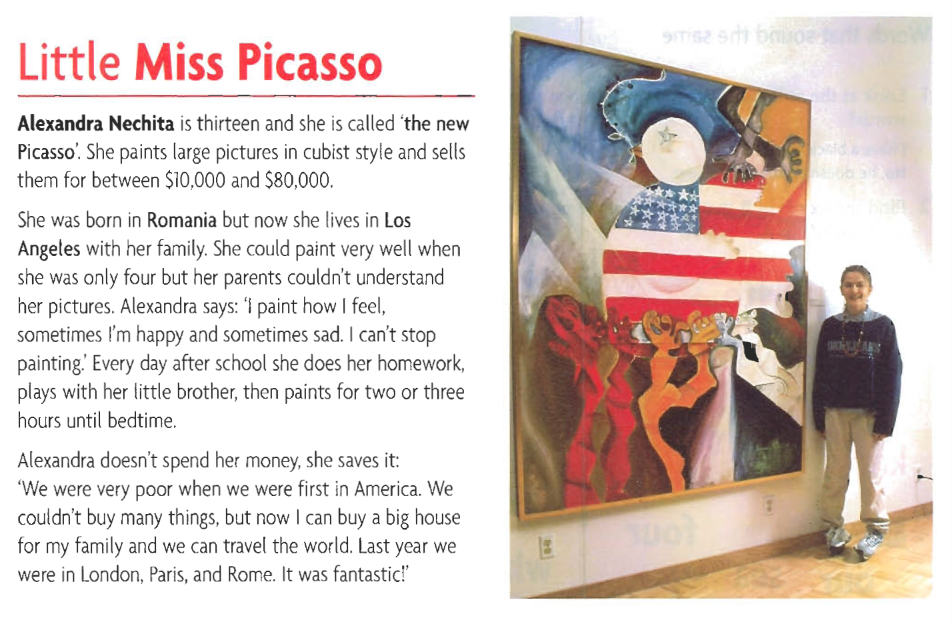
In Unit 6 of an older edition of the coursebook, there was a short reading called “Little Miss Picasso.” It introduced a thirteen-year-old girl who hwas born in Romania but lived in Los Angeles. She painted enormous colourful pictures in a Cubist style, and some of them were selling for tens of thousands of dollars.
The text was perfect for an elementary English lesson. Students could practise can and could while reading about a girl who could paint when she was very young.
But Alexandra Nechita was not a fictional textbook character. She was already an internationally known artist. And unlike many stories about child prodigies, hers did not end when childhood did.
From Communist Romania to California
Alexandra Nechita was born on 27 August 1985 in Vaslui, Romania, during the final years of Nicolae Ceaușescu’s Communist regime.
Her father, Niki, had left Romania shortly before Alexandra was born. Her mother, Viorica, and the baby Alexandra were eventually allowed to join him in the United States when Alexandra was about a year and a half old.
The family settled in California.
They did not arrive as wealthy immigrants. Her parents worked hard to establish a new life, and Alexandra would later remember that money was limited during those early years.
But one thing quickly became obvious.
Their daughter wanted to draw.
Constantly.
According to accounts of her childhood, Alexandra was already spending large amounts of time with pens and colouring books when she was two. When her parents worried that she was becoming too absorbed in them and took the colouring books away, she simply began creating her own pictures on pieces of paper.
By five, she was using watercolours and pastels.
By seven, she was painting with oils and acrylics on canvas.
This was more than the normal enthusiasm of a child who enjoyed drawing.
Alexandra could spend hours working on a picture. Her figures were unusual too: faces, hands and bodies did not necessarily appear where people expected them to. She seemed much less interested in creating realistic pictures than in showing people and emotions in her own visual language.
At first, even her parents were not sure what to make of it.
The first exhibition
Art materials were expensive, particularly for an immigrant family that was still establishing itself in America.
When Alexandra began using canvas, acrylics and oils, the cost increased even more. Her parents sometimes travelled considerable distances to find cheaper art supplies.
Eventually, some of Alexandra’s paintings were displayed at a local public library.
She was only eight years old.
At that exhibition, she sold one of her first paintings for $50. Alexandra later remembered how exciting this was: somebody outside her family had taken her work seriously enough to pay for it.
Her parents also took her to art classes at the Barnsdall Junior Arts Center in Los Angeles. There, art teacher Elmira Adamian recognised that something unusual was happening.
Rather than teaching Alexandra to copy a particular technique, Adamian reportedly advised her parents to let the girl develop naturally without too much formal influence.
That decision became important.
Alexandra’s paintings already had a distinctive appearance: bright colours, fragmented faces, distorted bodies and unusual perspectives.
Before long, people began making one inevitable comparison.
Picasso.
The “Petite Picasso”
The media began calling Alexandra “Petite Picasso”, or sometimes “Little Miss Picasso.”
The nickname was easy to understand.
Like Pablo Picasso and other Cubist artists, Alexandra often broke the human figure into separate shapes and showed different perspectives at the same time. Eyes might appear in unexpected places. Faces could seem to be seen from several directions. Arms and hands became symbols rather than realistic anatomy.
But the comparison was also a simplification.
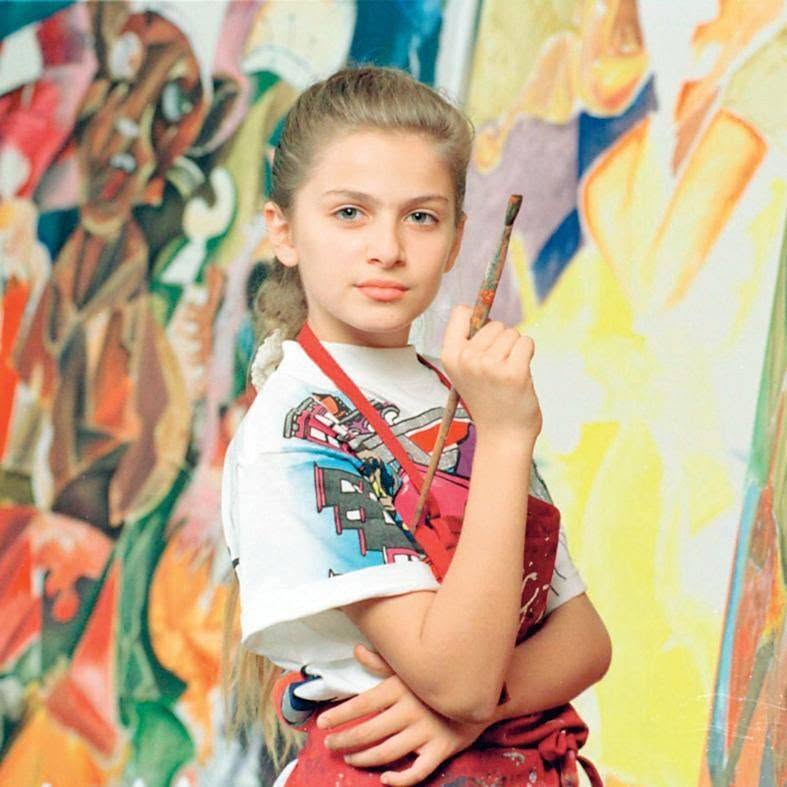
Alexandra was not simply producing small versions of Picasso paintings. Her pictures used elements associated with Cubism, but also highly personal colours, figures and emotional themes.
Even during childhood, subjects such as family, love, peace, friendship, loneliness and human relationships appeared repeatedly in her work.
By 1998, when The Christian Science Monitor profiled the twelve-year-old artist, her work had already received enormous media attention from organisations including CNN, NBC, CBS and the BBC. Some gallery prices had reached tens of thousands of dollars, and well-known collectors included Oprah Winfrey and Whoopi Goldberg.
The child who had once drawn on spare pieces of paper was suddenly travelling around the world for exhibitions.
A childhood unlike most others
There is an obvious danger in the story of any child prodigy.
Adults can easily turn a talented child into a business.
Alexandra’s parents were aware of that problem and repeatedly said that they tried to give their daughter as normal a childhood as possible.
Her life, however, could never be completely normal.
She still had homework and school friends, but she also had exhibitions, interviews, gallery appearances and international travel.
She might spend one day in class and another speaking to journalists.
In interviews as an adult, Alexandra has explained that her parents regularly asked whether she still wanted to continue. They tried to make sure that painting remained something she chose rather than an obligation forced on her by adults.
Sundays, for example, were traditionally reserved for the family.
Alexandra herself has said that she did not originally think of herself as fundamentally different from other children. She simply understood that she painted differently from her classmates.
Sometimes that difference was difficult. Other children could make fun of her unusual drawings.
But she continued painting.
A twelve-year-old at the Grammys
One of the most remarkable moments came in 1997.
Alexandra was commissioned to create the official artwork for the 39th Grammy Awards.
She was only eleven when selected and twelve by the time of the ceremony.
Her painting, connected with the idea of loving what you do, placed a school-age artist in the middle of one of the world’s biggest entertainment events.
More than two decades later, the Recording Academy interviewed Nechita about the experience, confirming just how extraordinary the commission had been for somebody of her age.
And the Grammys were far from the end of her international work.
In 1999, the World Federation of United Nations Associations selected her to participate in a global arts initiative involving more than 100 countries. Her work increasingly became connected with themes of peace and international understanding.
Then came New Headway
Around the same period, something else happened that Alexandra herself probably could not have predicted.
She became part of an English lesson.
An older edition of New Headway Elementary included her story under the title “Little Miss Picasso.”
The textbook presented Alexandra at thirteen. It explained that she had been born in Romania, now lived in Los Angeles and painted large Cubist pictures. Students also read about her daily routine: after school she did her homework, spent time with her younger brother and then painted for several hours.
The article even mentioned her family’s difficult financial beginnings in America and the fact that her successful career had changed their circumstances.
For English teachers, the story had an obvious grammatical purpose.
It appeared in Unit 6, “Can you speak English?”, where learners were practising can and could.
Alexandra fitted the lesson perfectly:
Most children could draw.
Alexandra could paint remarkably well when she was still very young.
But there is something charming about returning to that little textbook article today.
For millions of language learners, Alexandra remains frozen at thirteen years old.
The real Alexandra kept going.
Growing beyond the child prodigy
This is perhaps the most important part of her story.
Being famous as a talented child is one thing.
Building an adult career as an artist is something very different.
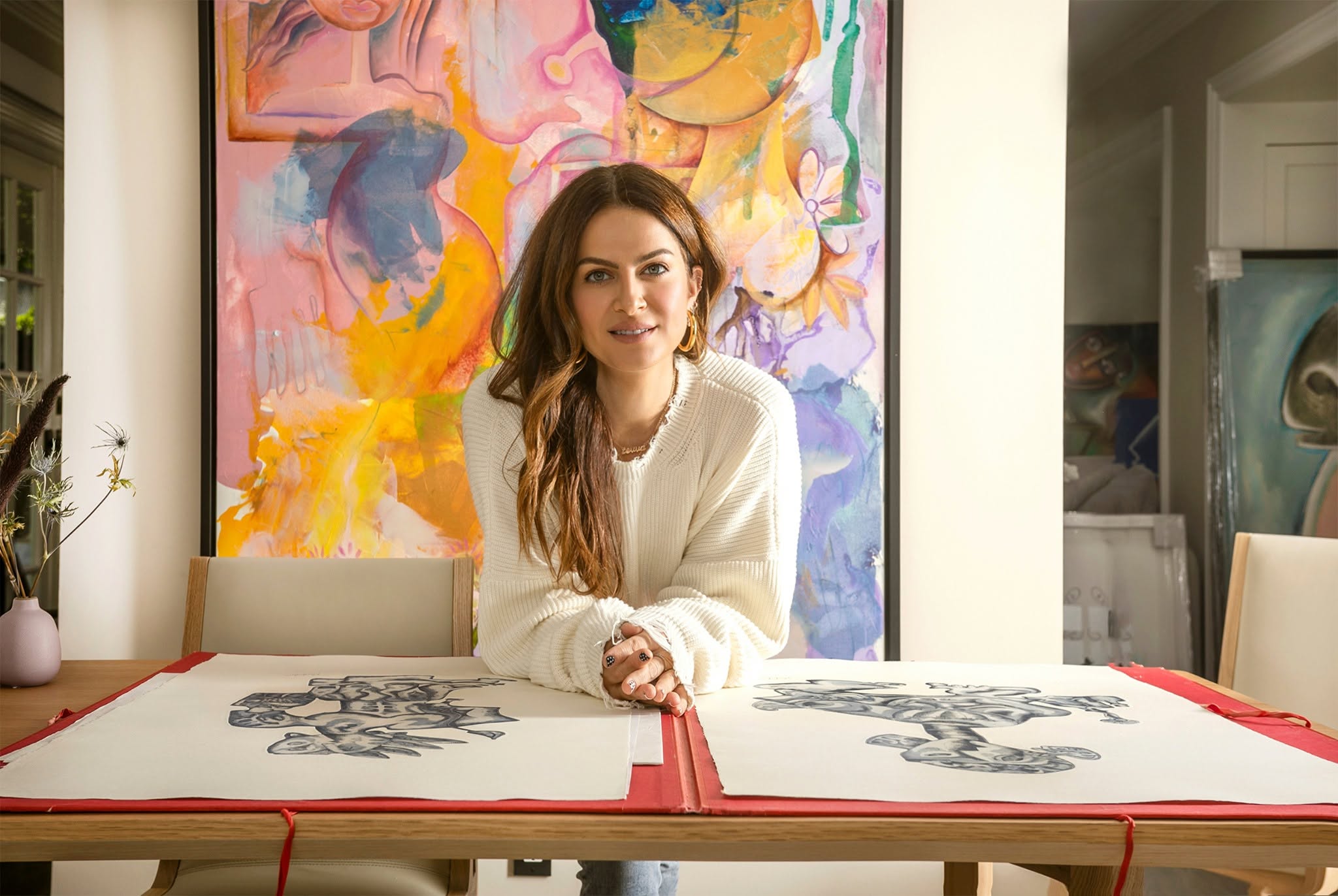
Alexandra continued her education rather than relying entirely on her childhood fame. She studied fine art at the University of California, Los Angeles, graduating in 2008.
Meanwhile, her artistic work expanded beyond painting.
She experimented with printmaking, sculpture, glass, metal, collage and works on paper. Human figures remained central to her visual world, but the subjects became more connected to her experiences as an adult woman.
The bright colours and fragmented forms of her childhood paintings never disappeared completely, but her relationship with them developed.
And so did her relationship with the famous nickname.
As an adult, Nechita has made clear that “Petite Picasso” was essentially a label created by the media. She has said that she does not see much purpose in continuing the comparison now.
That makes sense.
A nickname that helped newspapers explain an eight- or twelve-year-old artist becomes more restrictive when that artist is approaching forty years of professional work.
She was no longer interesting because she was a child who painted like an adult.
She had become an adult artist with her own history.
Art about peace
Peace has been one of the strongest themes running through Nechita’s career.
After the September 11 attacks, she created work connected with humanitarian and peace initiatives. Her Let There Be Peace project eventually developed into monumental sculpture.
In 2005, a large bronze sculpture carrying that title was unveiled in Singapore. The work shows a female figure associated with doves – one of the most recognisable symbols of peace.
This was a major change of scale.
The girl once known for standing beside colourful canvases was now producing monumental public sculpture.
Her official biography also records numerous charitable and humanitarian projects and commissions connected with organisations including the Special Olympics and other international initiatives.
For Nechita, art increasingly became more than decoration.
It became a way of talking about how people treat one another.
Women, identity and motherhood
Her work changed again when she became a mother.
Nechita has spoken openly about how motherhood affected both her daily life and the emotional tone of her art.
Before having children, she could work whenever inspiration appeared – sometimes for extremely long periods. Parenting forced her to organise studio time differently.
But the deeper change was psychological.
Themes of womanhood, femininity, identity, equality, vulnerability and belonging became increasingly important.
In a 2022 interview connected with her exhibition Setting the Stage, Nechita described art as the most authentic side of herself. The exhibition reflected several years of personal change and included ideas connected with motherhood and belonging.
She has also explained that becoming a mother made parts of her creative process softer and more reflective.
Earlier in her life, being a young girl working in an adult, often male-dominated art world had encouraged her to present herself with unusual confidence and seriousness.
Later, she began exploring femininity not as something that weakened that strength, but as part of it.
It is an interesting development when compared with the girl in New Headway.
The textbook Alexandra painted because she could not stop painting.
The adult Alexandra still paints, but now has decades of experience to understand why she paints.
From canvas to the city
Nechita has also continued creating art for public spaces.
One of her most visible recent works is Love Anatomy, a nine-foot bronze sculpture installed in Beverly Hills.
The work shows how far Nechita has moved beyond the image of the child standing beside an easel.
Her artistic vocabulary now exists in three dimensions and at architectural scale.
Yet some familiar elements remain: the simplified human body, curved and fragmented forms, and the attempt to express emotional relationships visually.
Her official biography states that her works are represented in permanent collections including the Vatican Collection and the Rock and Roll Hall of Fame, alongside numerous private collections.
What happened to Little Miss Picasso?
Today, Alexandra Nechita lives in Los Angeles and continues to work as a painter and sculptor.
She is also a wife and mother of two children. And in 2026, she turned 41. That simple fact makes looking back at the old New Headway page rather fascinating.
There she is forever thirteen: a Romanian girl living in Los Angeles, doing her homework after school, playing with her little brother, then disappearing into her studio for two or three hours before bedtime.
The textbook called her “the new Picasso.”
More than twenty-five years later, perhaps the most interesting thing about Alexandra Nechita is that she never needed to become the new Picasso.
She needed to become Alexandra Nechita.
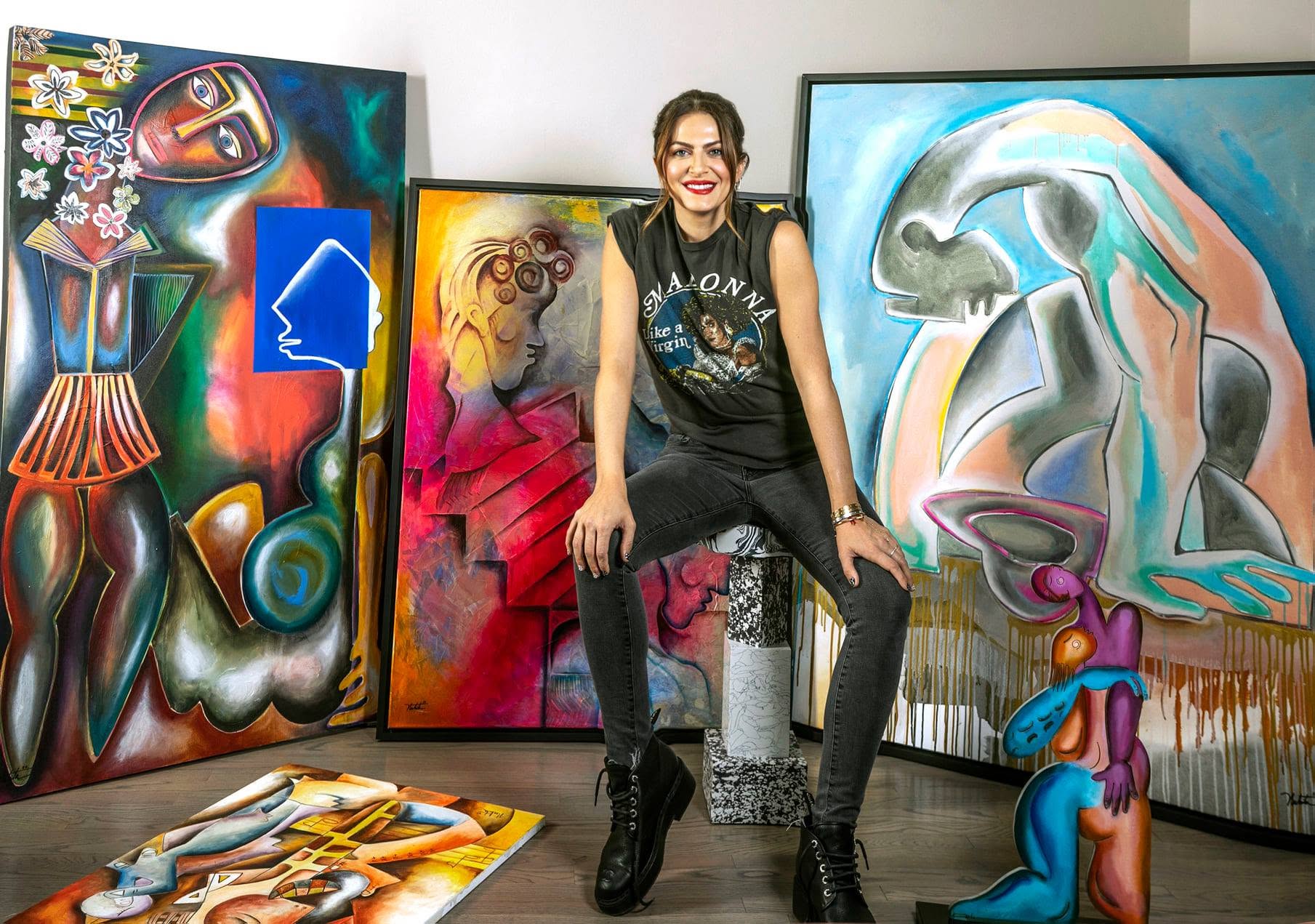
The colourful Cubist-inspired paintings of her childhood were only the beginning. Since then, her work has moved through painting, printmaking and monumental sculpture, while its subjects have grown with her – from the emotions of a child to questions about peace, womanhood, motherhood, identity and human relationships.
There is also something rather satisfying about discovering what happened after the final line of an old English textbook.
Many students probably closed the book after Unit 6 and remembered Alexandra simply as the extraordinary Romanian-American girl who could paint.
Her story continued long after the grammar exercise was finished.
Little Miss Picasso grew up.
And she never stopped making art.

