Every year on 6 October, Hungary remembers one of the darkest days in its history. It is a day of silence, respect and remembrance. On this day in 1849, thirteen Hungarian military leaders were executed in the city of Arad after the defeat of the Hungarian Revolution and War of Independence of 1848–1849. Today, they are known as the Martyrs of Arad.
The revolution had started in March 1848, when Hungarians demanded political reforms, freedom of the press and greater independence within the Habsburg Empire. What began as a peaceful movement later became a war for Hungarian independence. For more than a year, Hungarian soldiers fought against the forces of the Habsburg Empire.
By the summer of 1849, however, the situation had become almost impossible. The Austrian emperor asked Russia for military help, and the Russian army entered Hungary with a huge force. The Hungarian army was eventually defeated, and on 13 August 1849, General Artúr Görgei surrendered to the Russians at Világos.
The end of the war did not bring peace immediately. The Habsburg authorities wanted to punish those who had taken part in the fight for Hungarian independence. Several military and political leaders were arrested, and many of them were sentenced to death.
On the morning of 6 October 1849, thirteen officers of the Hungarian army were executed in Arad. Their names were:
Lajos Aulich, János Damjanich, Arisztid Dessewffy, Ernő Kiss, Károly Knezich, György Lahner, Vilmos Lázár, József Nagysándor, Ernő Poeltenberg, József Schweidel, Ignác Török, Károly Vécsey and Károly Leiningen-Westerburg.
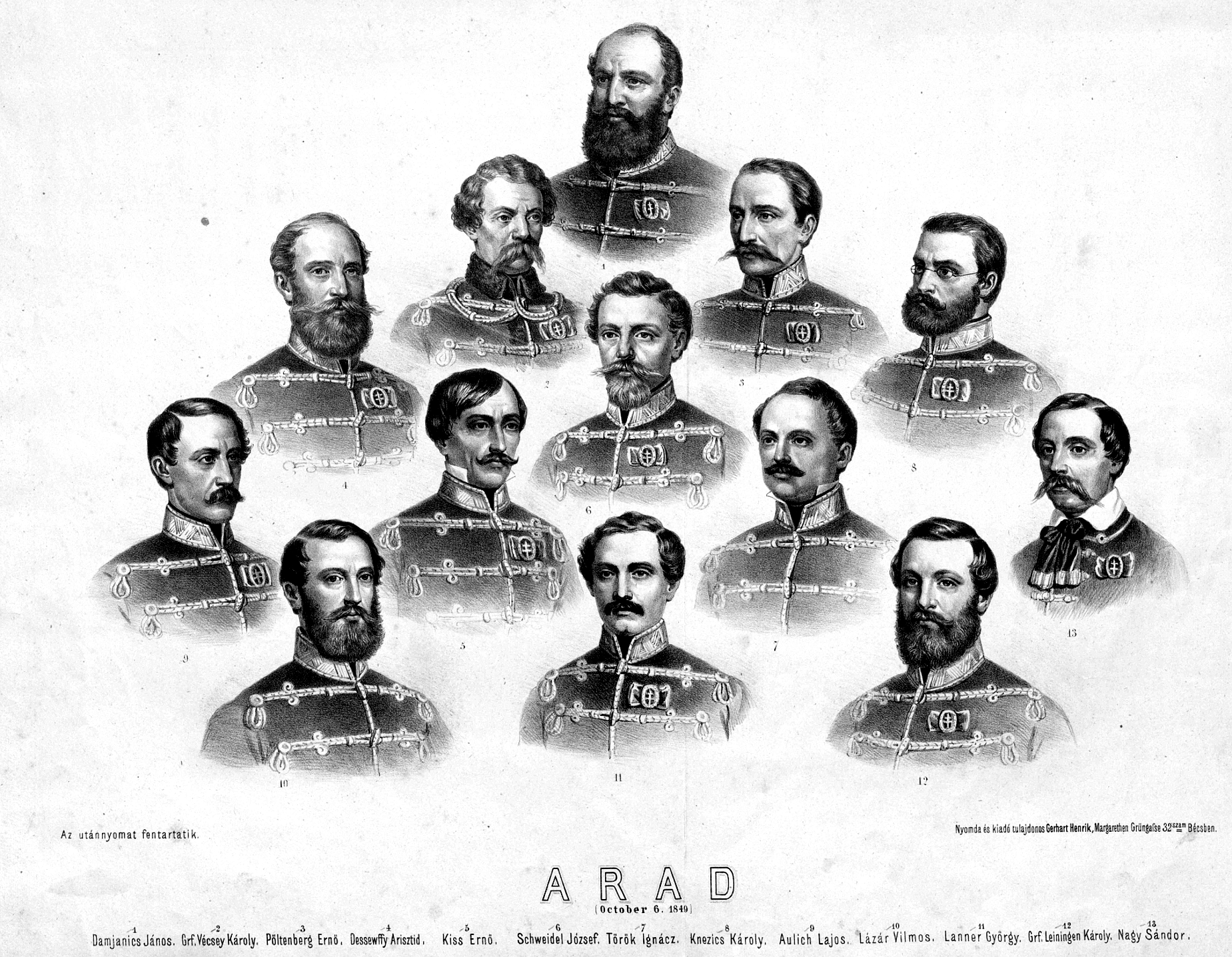
They were different people with different backgrounds. Not all of them were born Hungarian, and not all of them had Hungarian as their first language. Among them were men of German, Serbian, Croatian and other origins. What connected them was their decision to serve the Hungarian cause and to fight for the same ideals.
Four of the officers were executed by firing squad, while the others were hanged. Their deaths were meant to be a warning to the country, but instead they became symbols of courage, loyalty and sacrifice.
On the same day, Count Lajos Batthyány, the first Prime Minister of Hungary, was executed in Pest. His death made 6 October an even more painful date in Hungarian history. The government of the revolution had tried to create a modern, constitutional Hungary, and Batthyány had played a central role in this process.
In the years that followed, the memory of the executed leaders remained alive, even when people were not always free to speak openly about them. Their names were remembered in families, communities and later in schools and public ceremonies. With time, 6 October became a national day of mourning.
But remembering the Martyrs of Arad is not only about remembering the way they died.
It is also about remembering what they believed in.
They lived at a time when people across Europe were demanding political rights, national freedom and social change. The Hungarian Revolution of 1848 was part of this much larger European movement. The thirteen officers chose to take responsibility for a cause they believed was worth defending, even when they knew what the consequences could be.
More than 175 years have passed since that morning in Arad. The world around us has changed completely. Yet the questions connected to their story are still important. What does freedom mean? How much are we willing to sacrifice for our beliefs? What happens when political conflicts turn into violence? And why is it important to remember those who came before us?
There are no simple answers.
Perhaps this is why 6 October should not be a loud day. It is not a day for celebration. It is a day to stop for a moment and think about thirteen men who faced death after fighting for a cause they believed in, and about all those whose lives were destroyed by the events of the revolution and the repression that followed.
The Martyrs of Arad did not live to see a free and independent Hungary. But their memory survived the empire that sentenced them to death.
Every year, when candles are lit and wreaths are placed at memorials across the country, their names are spoken again.
And as long as they are remembered, their story remains part of Hungary’s story.

