Lukáš Vondráček belongs to the second group.
Long before he became an internationally respected concert pianist, he was already being introduced to the public as a musical phenomenon. He started playing the piano at an age when most children were still learning to speak in full sentences, appeared on stage at four, and by the time he was ten, music had already taken him far beyond his native Czech Republic.
That was also the age at which many English learners first met him.
In an older edition of New Headway Elementary, Vondráček appeared in a short reading under the title “The New Mozart.” The text described a shy ten-year-old boy who practised for hours, travelled abroad to perform, could read music before he could read books, and still found time for football and ice hockey.
For students, it was a memorable way to practise can and could. For Lukáš, it was simply everyday life.
The comparison with Mozart was striking, but it also risked reducing him to a label. What makes his story more interesting is what happened afterwards. The boy in the English textbook grew up.
He studied in several countries, performed with leading orchestras, played at Carnegie Hall, worked with Vladimir Ashkenazy and, in 2016, won one of the most prestigious competitions in classical music: the Queen Elisabeth Competition in Brussels.
So the real story is not only about a child who could play the piano extraordinarily well. It is about how a child prodigy became a mature artist.
A piano almost from the beginning
Lukáš Vondráček was born in Opava, Czechoslovakia, in 1986.
Music was part of his life almost from the beginning.
Both of his parents were pianists and became his first teachers. His mother worked for many years as a répétiteur at the Silesian Theatre in Opava, while his father later taught piano at the University of Hradec Králové.
He began learning the piano at around two years old.
That sounds almost impossibly early, but for Vondráček the instrument was simply part of family life. Both parents played at home, and according to family stories, the toddler Lukáš would lose interest in his toys and move towards the piano instead.
His first public performance came when he was only four.
At one early appearance, he was so small that he needed a box beneath his feet at the piano. His first programmes included children’s pieces by Schumann and Tchaikovsky.
For most children, playing a few pieces at four years old would already be extraordinary.
For Lukáš, it was only the beginning.
The boy in New Headway
By the age of ten, Vondráček was already travelling internationally.
That was the Lukáš who appeared in New Headway Elementary.
The textbook describes a very unusual childhood. It says that he was living with his parents in Vienna, attended ordinary school only two days a week, practised the piano for around six hours a day, and regularly travelled to give concerts.
It also says he could play at two and could read music before he could read books.
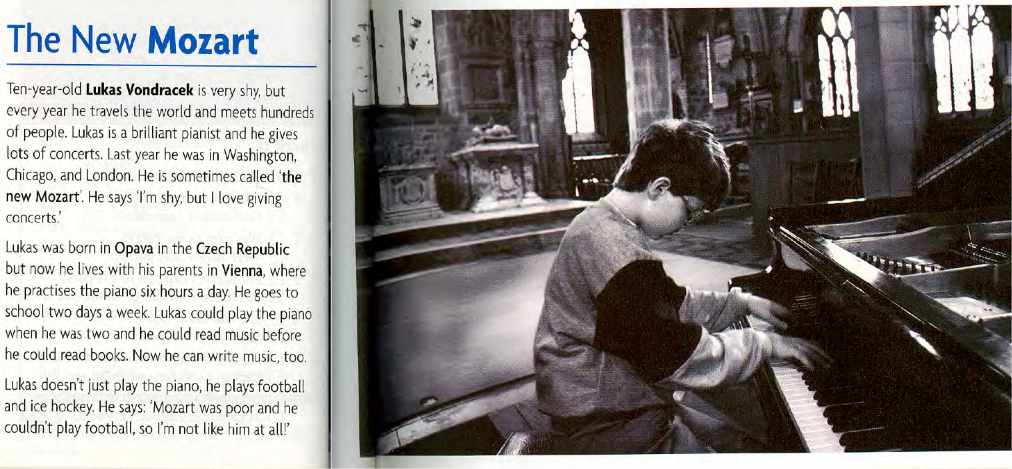
Yet the textbook deliberately showed another side of him as well.
He played football.
He played ice hockey.
And when compared with Mozart, the young Lukáš apparently had a wonderfully practical answer: Mozart had been poor and could not play football, so Lukáš decided he was not really like Mozart at all.
The coursebook presented him as a shy boy who nevertheless loved performing in public.
That contrast – quiet away from the piano but completely at home on stage – seems to have remained part of his personality.
The shy ten-year-old had not disappeared completely.
He had simply grown into the instrument.
A childhood built around music
Being a child prodigy sounds glamorous from the outside. The reality can be much more complicated.
While other children spent their afternoons playing or watching television, Vondráček’s schedule included hours of practice, lessons, travelling and concerts. His talent was unusual, but so was the amount of work required to develop it.
In later interviews, Vondráček stressed that talent alone was never enough. Natural ability had to be accompanied by hard work. He also had an unusually strong musical memory. As a child, he could sometimes memorise music only a day after learning it.
As an adult, however, he reflected that this ability could also become a disadvantage. If a musician memorises a piece too quickly, it is easy to stop studying the score carefully.
Over time, he learned to return to the written music again and again in search of what the composer actually intended. That idea says a great deal about the difference between being a talented child and becoming a mature musician. As a child, people were amazed that he could play the notes. As an adult, Vondráček became increasingly interested in what lies behind the notes.
An extraordinary education
His musical education was equally unusual. At around eleven, he was admitted to university-level study in Ostrava through a special exception because of his age. He later studied at the Vienna Conservatory and at the Academy of Music in Katowice. Eventually, his studies took him across the Atlantic.
At Boston’s prestigious New England Conservatory, he studied with pianist Hung-Kuan Chen and completed an Artist Diploma with honours in 2012. This long period of study is important because it reveals something that the “child prodigy” label can easily hide. Vondráček did not simply rely on the extraordinary abilities people had noticed when he was four or ten. He continued studying for years. The boy who could already perform complicated music still needed teachers, new ideas and time to develop.
Vladimir Ashkenazy
One particularly important figure in Vondráček’s early career was the legendary pianist and conductor Vladimir Ashkenazy.
Vondráček worked with Ashkenazy during his teenage years, and in 2002, at the age of fifteen, he made his debut with the Czech Philharmonic under Ashkenazy’s direction. A major American tour followed in 2003. Ashkenazy’s opinion of the young Czech pianist was famously enthusiastic. He was quoted as saying that a pianist like Vondráček appeared only once in several decades. At sixteen, Vondráček also made his debut at Carnegie Hall in New York.
The international career that New Headway had introduced when he was still a little boy was becoming something much more serious.
From child prodigy to professional pianist
For musicians who become famous very young, there is often a difficult question waiting in adulthood: What happens when being young is no longer special? A ten-year-old who performs difficult piano music immediately attracts attention. A thirty-year-old pianist must compete with the world’s finest professional musicians.
Vondráček has spoken openly about this transition. As he grew older, the expectations surrounding him naturally changed. He could no longer rely on the fact that audiences were impressed by his age. He needed to continue learning. Later, he described his early life explicitly as a “child prodigy phase.” The phrase is revealing. Being a prodigy was part of his life. It did not have to become his entire identity. This is one of the most interesting similarities between Vondráček and Alexandra Nechita. She had to grow beyond the label “Little Miss Picasso.” He had to grow beyond “The New Mozart.” Neither could remain a remarkable child forever. They had to become adult artists.
Competition after competition
As his career developed, Vondráček also entered some of the world’s major piano competitions.
He won first prizes at the Hilton Head International Piano Competition, the San Marino International Piano Competition and the UNISA International Piano Competition in South Africa.
At the 2009 Van Cliburn International Piano Competition, he received a special jury prize. Interestingly, Vondráček has expressed mixed feelings about competitions themselves. In later interviews, he explained that he considered normal concert performance much more natural than competitive music-making. That makes sense. Music is not athletics: there is no stopwatch that can objectively determine who has played Beethoven or Rachmaninov “best.” Still, one particular competition was about to transform his career.
Brussels, 2016
In May 2016, Vondráček entered the Queen Elisabeth Competition in Brussels, one of the major international competitions in classical music. He was no longer the ten-year-old “New Mozart.” He was 29 and already had years of international concert experience behind him. During the competition, he performed music by Bach, Mozart, Chopin, Liszt, Brahms and other composers.
Then came the final. Vondráček chose one of the most demanding works in the piano repertoire: Sergei Rachmaninov’s Piano Concerto No. 3 in D minor. He performed it with the National Orchestra of Belgium under conductor Marin Alsop. On 26 May 2016, the audience responded with a standing ovation. Shortly afterwards, Lukáš Vondráček was announced as the First Prize winner of the 2016 Queen Elisabeth Competition.
The victory changed his career dramatically.
Although he had already enjoyed major experiences – including concerts with Ashkenazy – winning the Queen Elisabeth Competition brought a new level of international attention. His schedule became considerably busier, and the number of important invitations increased. It was arguably the moment when any remaining idea of him simply being a former child prodigy finally disappeared.
He was now recognised internationally on his own terms.
Rachmaninov – music built for Vondráček?
Rachmaninov has remained closely connected with Vondráček’s career. That is hardly surprising. The Russian composer’s piano music demands enormous technical control, physical power, lyrical sensitivity and an ability to shape long emotional lines.
Those qualities suit Vondráček’s playing particularly well. The Queen Elisabeth final featured Rachmaninov’s Third Concerto, and in later years he continued performing the composer’s major works around the world. But his repertoire is much wider. Brahms has become another particularly important composer for him, and his programmes have included works by Mozart, Beethoven, Schumann, Liszt, Prokofiev and many others.
For Vondráček, technical difficulty is not the final goal. In interviews, he repeatedly returns to the idea that the pianist’s job is not simply to demonstrate skill but to understand and communicate the composer’s intentions.
More than a thousand concerts
Even before his Queen Elisabeth victory, Vondráček had already built an extraordinary international career.
The competition’s official biography reported that he had performed more than a thousand concerts on five continents.
His appearances have taken him to venues including the Kennedy Center in Washington, Suntory Hall in Tokyo and the Sydney Opera House, while his later recital career has included the Concertgebouw in Amsterdam, Vienna’s Konzerthaus, Leipzig’s Gewandhaus and Hamburg’s Elbphilharmonie.
He has also performed with orchestras including the Chicago Symphony Orchestra, London Symphony Orchestra, Boston Symphony Orchestra, Czech Philharmonic, Sydney Symphony Orchestra, Philadelphia Orchestra and Oslo Philharmonic, among many others.
The list is impressive.
But Vondráček himself has offered a much simpler definition of success.
In an interview, he suggested that success can be measured by each satisfied listener and that musicians should not dream primarily about careers, but about music itself.
That idea feels very far from the world of the ten-year-old prodigy.
And perhaps that is exactly the point.
The New Mozart was never really Mozart
There is something slightly unfair about giving exceptionally talented children names like “the new Mozart.” It makes an easy newspaper headline. It also gives people an easy way to understand something unusual. But it creates an impossible comparison.
Mozart lived in another century, in another society and in a completely different musical world. Lukáš Vondráček did not need to become another Mozart. Just as Alexandra Nechita did not need to become another Picasso. The remarkable thing is not simply that Vondráček could play the piano when he was two. It is not that he could read music before books. It is not even that he gave international concerts as a child.
The more remarkable achievement came afterwards. He kept learning. He survived the expectations that come with being called a prodigy. He developed from a talented child into an adult musician whose career has now lasted for decades. For many English learners, Lukáš Vondráček may always be the shy ten-year-old boy on an old New Headway page.

