Budapest is famous for its magnificent buildings, historic bridges and lively streets. However, not far from the busy city centre lies a place where time seems to move a little more slowly. With its peaceful avenues, centuries-old trees and impressive monuments, Fiumei Road Cemetery is much more than a final resting place. It is an open-air museum, a beautiful green space and, above all, a remarkable journey through Hungarian history.
From an Ordinary Cemetery to a National Memorial
The story of Fiumei Road Cemetery, originally known as Kerepesi Cemetery, began in the middle of the 19th century. In 1847, the authorities of Pest decided to establish a new public cemetery on the outskirts of the city. At the time, the existing burial grounds were becoming overcrowded, and the growing population needed more space.
The cemetery officially opened on 1 April 1849, during a cholera epidemic. Interestingly, it was not originally intended to become a prestigious national burial ground. Its transformation happened gradually, as some of Hungary’s most important historical and cultural figures were laid to rest there.
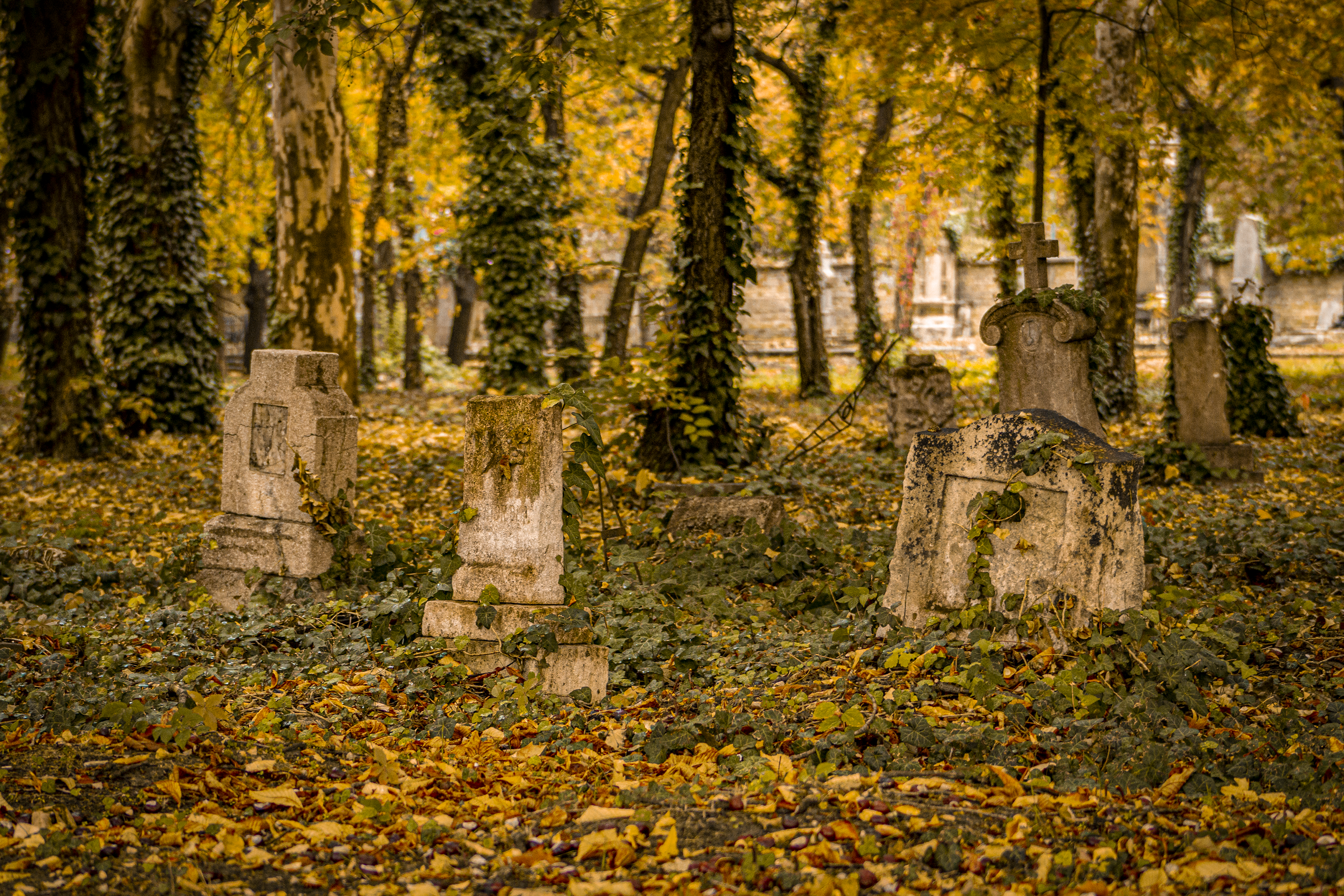
One of the earliest famous people buried in the cemetery was Béni Egressy, the composer who wrote the music for Szózat, one of Hungary’s most important patriotic songs. A few years later, in 1855, the funeral of poet Mihály Vörösmarty attracted an enormous crowd. Under Austrian rule, the ceremony became something more than a farewell: it was also a silent demonstration of Hungarian national feeling.
By the late 19th century, Kerepesi Cemetery had become one of the country’s most respected burial grounds. In 1885, Budapest officially recognised its special status as a ceremonial cemetery.
Today, the 56-hectare site is considered Hungary’s national pantheon, a place where the country’s history can be explored through the lives of the people buried there.
The Three Great Mausoleums: Monuments to Hungary’s Past
Perhaps the most impressive features of Fiumei Road Cemetery are its three great mausoleums, built to honour Lajos Batthyány, Ferenc Deák and Lajos Kossuth.
These magnificent monuments are not simply beautiful pieces of architecture. Each represents a different chapter of 19th-century Hungarian history, a period filled with revolution, political struggles, difficult decisions and hopes for a more independent future.
Although the three statesmen followed different political paths, all played important roles in shaping modern Hungary. Their mausoleums also helped transform an ordinary cemetery into a place of national remembrance.
The Batthyány Mausoleum – A Monument to Hungary’s First Prime Minister
Lajos Batthyány was Hungary’s first prime minister, appointed in 1848 during the revolutionary events that transformed the country. His government attempted to introduce political reforms and establish greater independence within the Habsburg Empire.
However, the revolution eventually turned into a war of independence, and Batthyány’s political career ended tragically.
On 6 October 1849, he was executed in Pest, on the same day that thirteen Hungarian military leaders were executed in Arad. His death made him one of the most important martyrs of the Hungarian struggle for independence.
What happened to his body afterwards is a particularly fascinating chapter of Hungarian history.
The Austrian authorities intended to bury him without public ceremony. However, his remains were secretly taken to the Franciscan Church in central Pest, where they were hidden in the crypt. For more than twenty years, his resting place remained largely unknown to the public.
Following the Austro-Hungarian Compromise of 1867, the political situation finally made a public funeral possible.
On 9 June 1870, an enormous crowd gathered to accompany Batthyány’s remains to Kerepesi Cemetery. His reburial became an important national event, allowing Hungarians to honour a man whose memory had previously been politically sensitive.
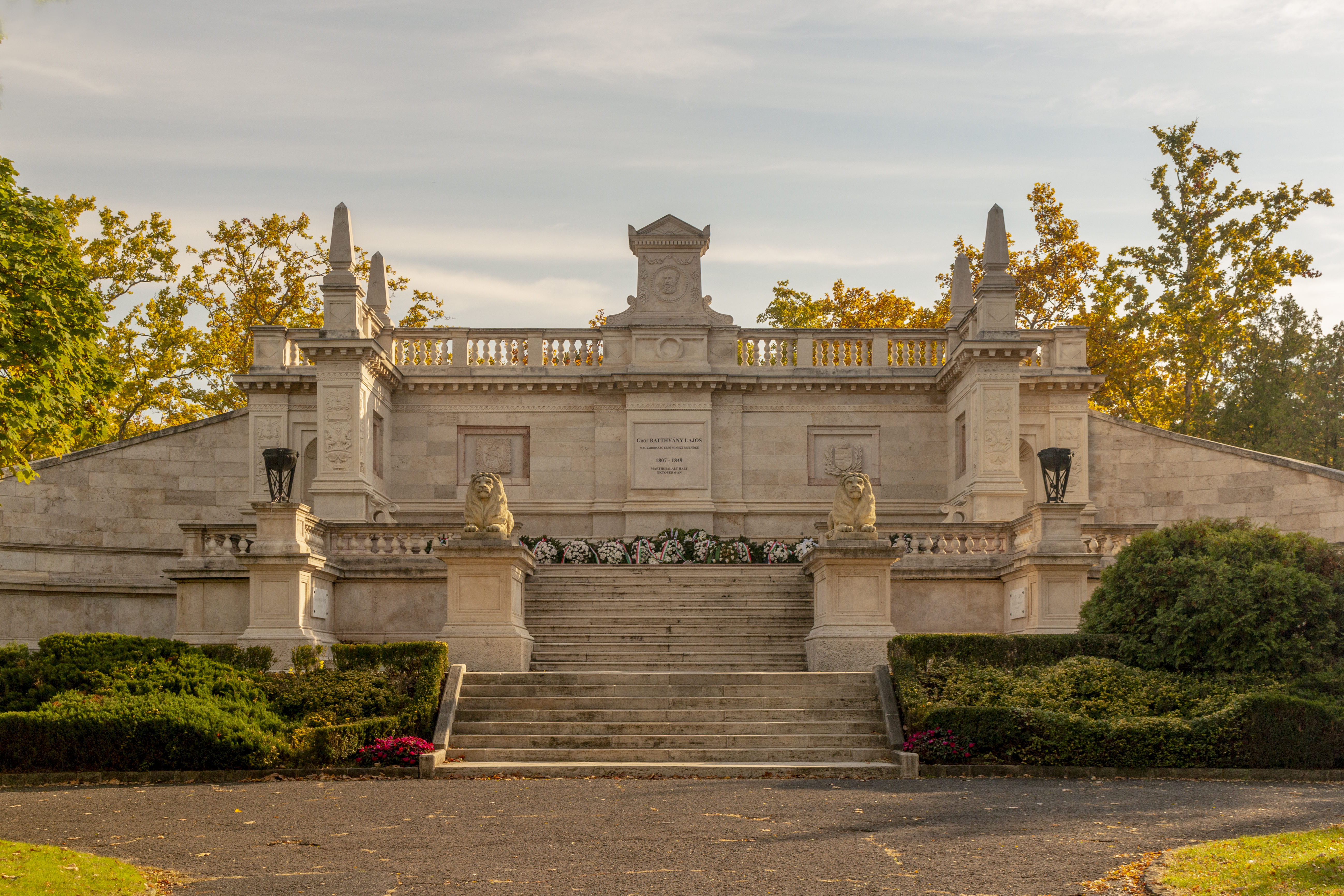
The impressive mausoleum standing above his grave today was constructed between 1872 and 1874, using money collected through public donations.
Designed by architect Albert Schickedanz, the monument combines classical and Neo-Renaissance architectural elements. Its broad terraces, monumental staircases and carefully arranged stone decorations give it an appearance that is both elegant and powerful.
The crypt is located beneath the raised structure, while the upper level creates the impression of a grand ceremonial platform.
Interestingly, the original plans were never fully completed because of financial difficulties. The building was later restored, receiving its present appearance during renovations in 2000.
Today, the Batthyány Mausoleum is not only an impressive architectural landmark but also a reminder of the sacrifices made during Hungary’s fight for independence.
The Deák Mausoleum – Remembering the Wise Man of the Nation
Only a short distance away stands another magnificent building, dedicated to Ferenc Deák, one of Hungary’s most respected 19th-century politicians.
Deák is often remembered as the “Wise Man of the Nation”, a title reflecting his reputation for patience, political judgement and his ability to find compromises.
Unlike Lajos Kossuth, who became an internationally recognised symbol of Hungarian independence, Deák believed that Hungary’s future could be secured through political negotiation.
He played a central role in the Austro-Hungarian Compromise of 1867, which established the Dual Monarchy and gave Hungary considerable political autonomy within the Habsburg Empire.
When Deák died on 28 January 1876, his passing became a major national event.
His body was placed in the ceremonial hall of the Hungarian Academy of Sciences, where thousands of mourners came to pay their respects. Even Queen Elisabeth, who was particularly popular among Hungarians, visited to honour the deceased statesman.
One especially interesting detail concerns Lajos Kossuth. Although Kossuth strongly disagreed with Deák’s political approach, he sent a symbolic myrtle branch for the funeral, demonstrating his respect for his former political opponent.
The funeral procession on 3 February 1876 attracted enormous crowds.
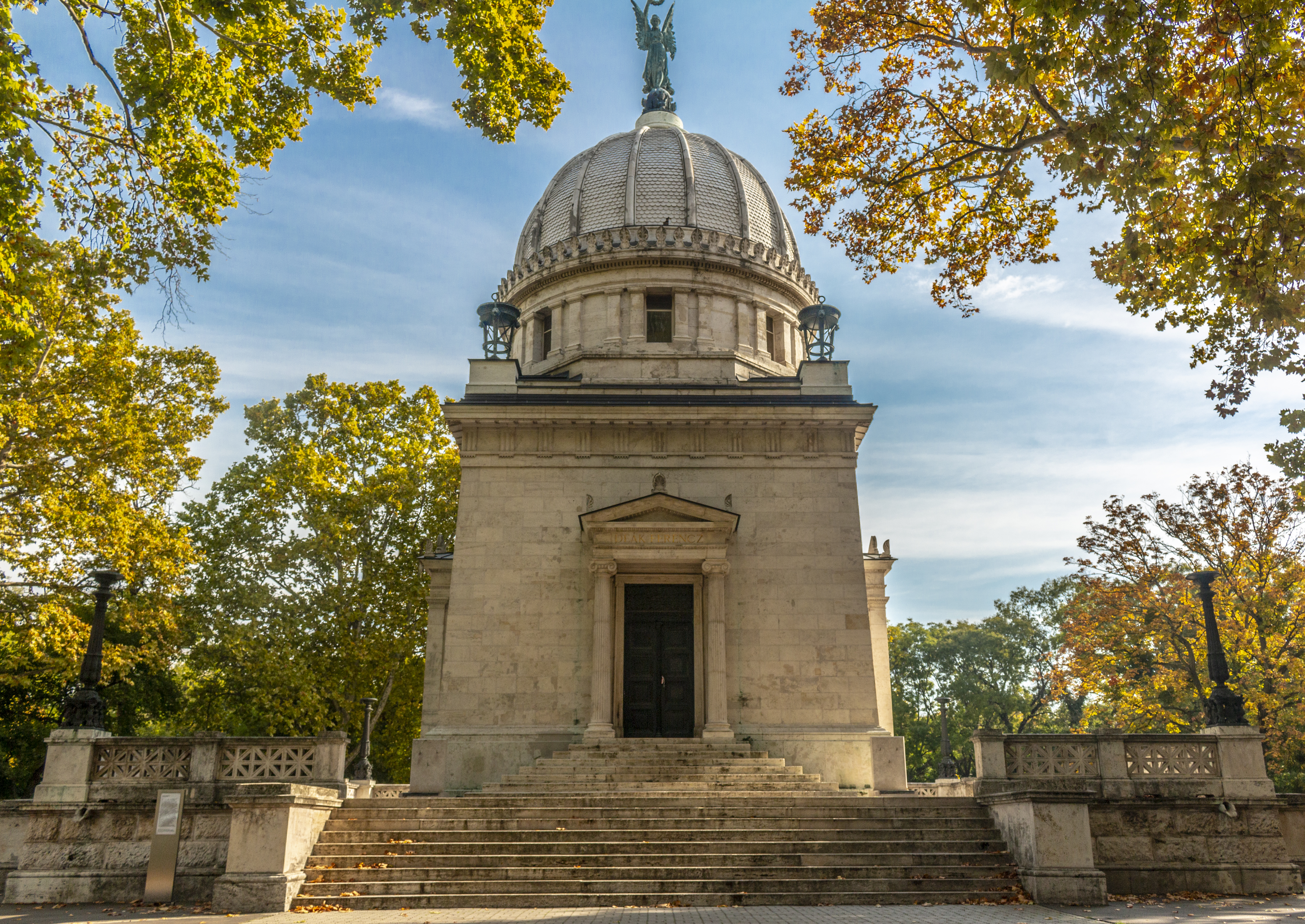
Deák’s permanent mausoleum was inaugurated on 21 May 1887, more than eleven years after his death.
The building was designed by architect Kálmán Gerster. Its exterior was inspired by Italian Renaissance architecture, while the interior combines several artistic styles.
The magnificent decorative sarcophagus, inspired by Renaissance papal tombs, was created by sculptor Alajos Stróbl. The impressive six-metre-high figure standing above the dome was designed by György Kiss, while Bertalan Székely contributed to the interior decoration.
The result is one of the most beautiful funerary buildings in Hungary.
Unlike the dramatic story of Batthyány’s execution or Kossuth’s long exile, Deák’s mausoleum represents a different kind of historical achievement: the belief that political change could also be achieved through negotiation rather than revolution.
The Kossuth Mausoleum – The Largest Funerary Monument in Hungary
If one monument dominates the cemetery, it is undoubtedly the mausoleum of Lajos Kossuth.
Kossuth was one of the leading figures of the Hungarian Revolution and War of Independence of 1848–49. Following the defeat of the revolution, he was forced into exile and spent much of the rest of his life abroad.
Over the following decades, he became an internationally recognised symbol of Hungarian independence.
He died in Turin, Italy, on 20 March 1894, at the age of 91.
His body was brought back to Hungary, where his funeral attracted enormous crowds. However, there was a significant political complication.
Emperor Franz Joseph refused to allow an official state funeral, as Kossuth had remained a symbol of opposition to Habsburg rule. Instead, the city of Budapest organised the ceremony.
Despite this restriction, the funeral became one of the largest public mourning events in Hungarian history.
Plans were soon developed for a monumental mausoleum worthy of Kossuth’s historical importance.
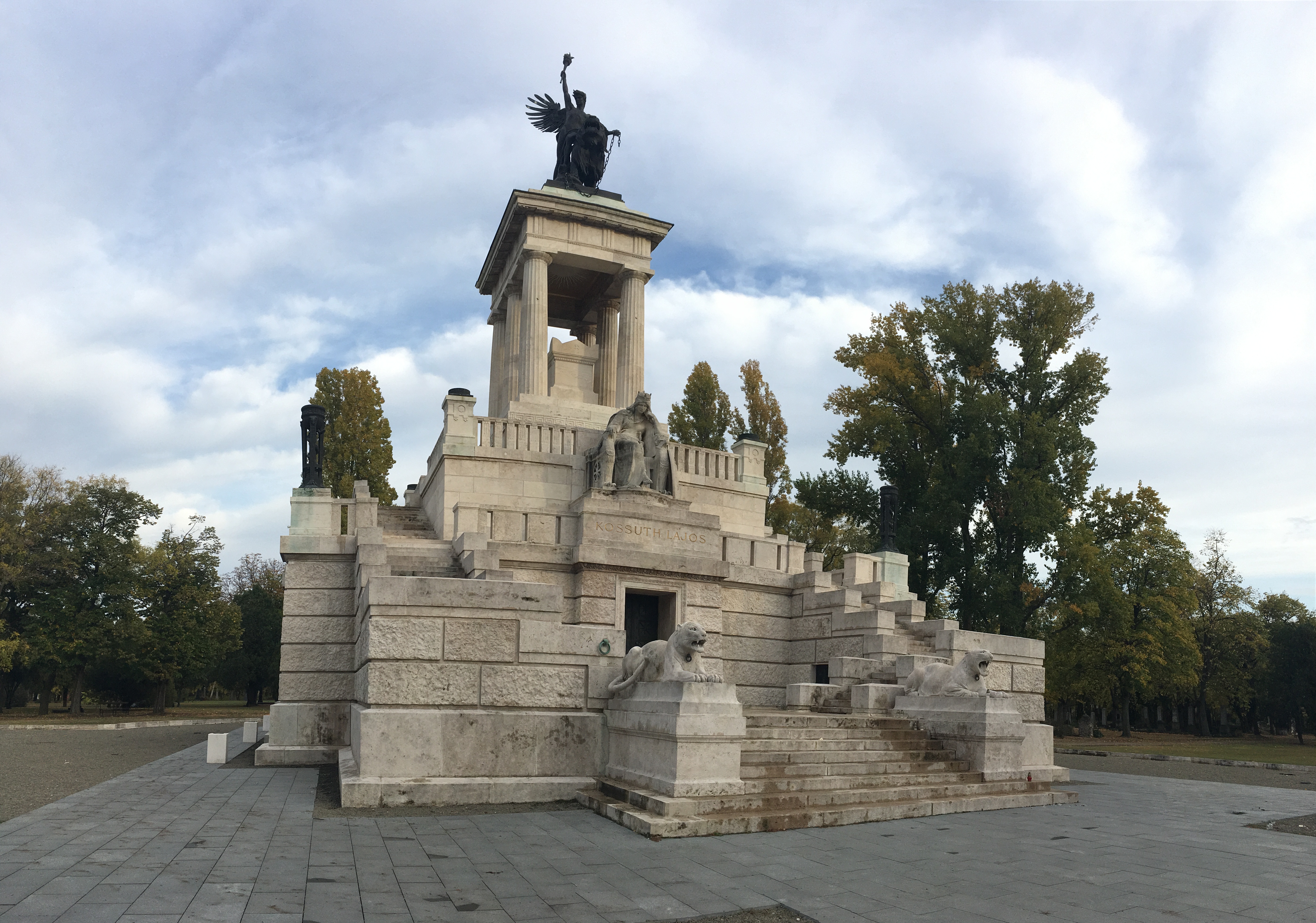
The building, designed by architect Kálmán Gerster and sculptor Alajos Stróbl, was finally completed in 1909.
It remains the largest funerary monument in Hungary.
Its imposing architectural composition, enormous stone structures and magnificent sculptures create an atmosphere of national importance. In fact, the exterior resembles a public monument as much as a traditional tomb.
However, the interior is equally remarkable.
At its centre stands a decorative sarcophagus made of green onyx. Above it, the ceiling is decorated with magnificent mosaics created in the workshop of Miksa Róth, based on designs by Dezső Kölber.
The mosaics incorporate Murano glass and gilded details, giving the interior a rich and colourful appearance.
The mausoleum suffered damage during the Second World War and again during the fighting of 1956. Following restoration work completed in 2015, much of its original beauty can once again be appreciated.
Standing in front of Kossuth’s final resting place, visitors are reminded of the extraordinary public respect that surrounded him, even decades after the failure of the revolution he had helped lead.
Together, the mausoleums of Batthyány, Deák and Kossuth tell three different stories of Hungary’s struggle to find its place in modern Europe.
A Meeting Place of Hungary’s Greatest Minds
Although the grand mausoleums immediately attract attention, some of the cemetery’s most fascinating stories can be found among its smaller graves.
Walking along its peaceful paths, visitors encounter names that have shaped Hungarian literature, music, painting, theatre and cinema.
The great poets János Arany, Endre Ady and Attila József are buried here, alongside writers such as Mór Jókai and Zsigmond Móricz. Their works remain an important part of Hungarian cultural identity.
Music lovers may recognise the name Ferenc Erkel, the composer of the Hungarian national anthem, while admirers of fine art can discover the resting places of painters Mihály Munkácsy and Tivadar Csontváry Kosztka.
The cemetery also preserves the memory of celebrated performers, including actresses Lujza Blaha and Mari Jászai, whose names are still familiar to generations of Hungarians.
More recent cultural figures have also found their final resting places here. Among them are Nobel Prize-winning author Imre Kertész, poet György Faludy and film director Miklós Jancsó.
One particularly interesting section is the so-called Artists’ Plot, developed between the two world wars. Here, numerous important figures of Hungarian cultural life rest close to one another, creating a unique meeting place of literature, art and history.
For visitors interested in Hungarian culture, a walk through this part of the cemetery can feel surprisingly similar to turning the pages of a history book.
The Soviet Military Plot – A Reminder of War and Occupation
Not every part of Fiumei Road Cemetery celebrates famous politicians, writers or artists. Some sections tell much darker stories about the events of the 20th century.
One of these is the Soviet Military Plot, a burial area connected to the final months of the Second World War and the Soviet presence in Hungary.
During the winter of 1944–45, Budapest became the scene of one of the most destructive battles in its history. Soviet forces surrounded the city, where German and Hungarian troops continued to resist.
The Siege of Budapest lasted for weeks and resulted in enormous military and civilian losses.
The cemetery itself suffered serious damage during the fighting. Numerous graves and monuments were destroyed or damaged, while some burial sites were disturbed.
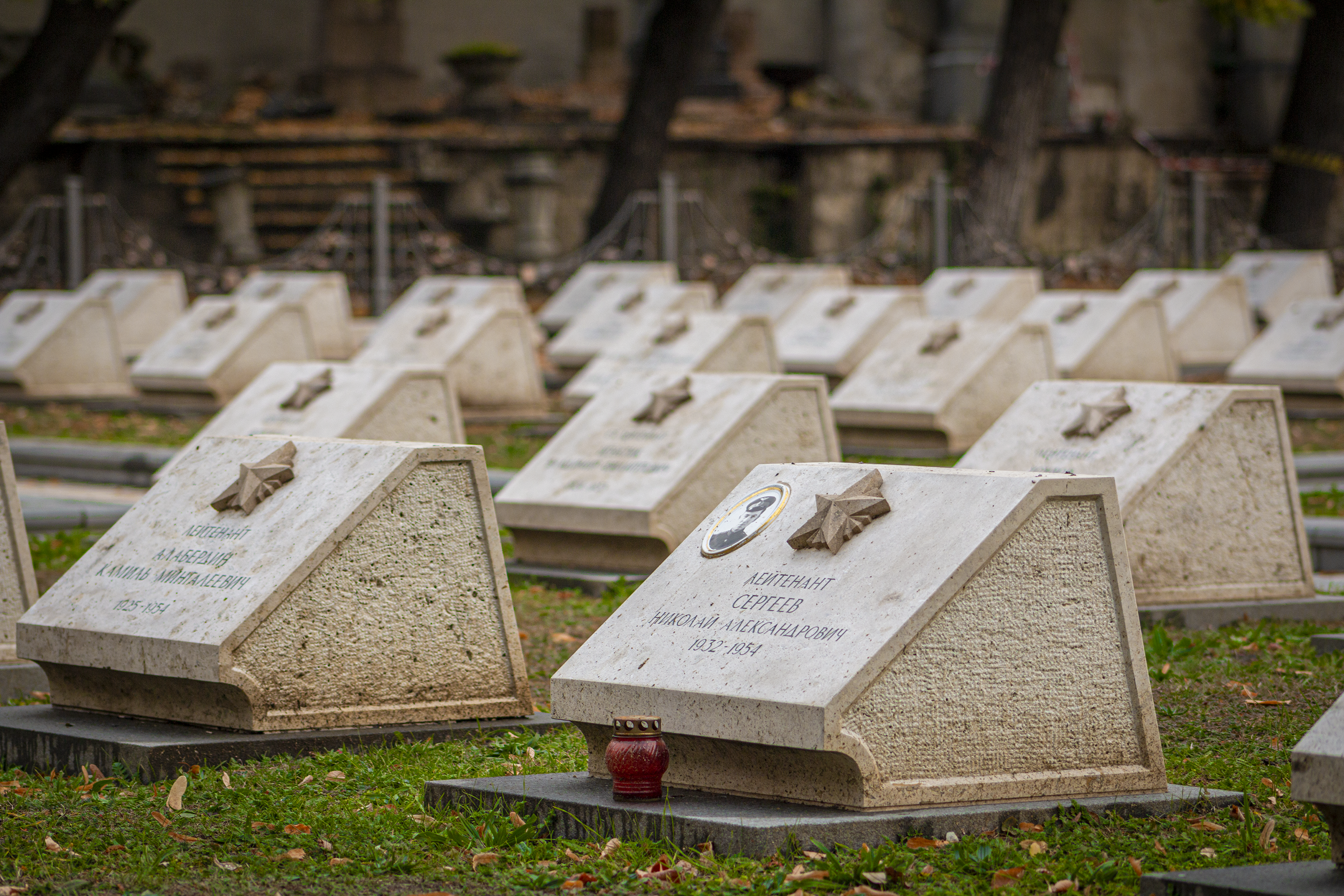
After the battle, Soviet soldiers who had died during the fighting were buried in the cemetery. Their graves were later reorganised into a separate military section.
The plot is noticeably different from the artistic and decorative graves found elsewhere in the cemetery.
Its military arrangement, gravestones and commemorative monuments reflect the traditions of Soviet remembrance.
The burial ground also has a connection to the Hungarian Revolution of 1956, as Soviet soldiers killed during the military intervention were buried in the cemetery.
This makes the Soviet section a particularly complicated historical place.
For the communist authorities, Soviet military graves represented the defeat of Nazi Germany and the official idea of liberation. However, for many Hungarians, the arrival of Soviet troops in 1945 also marked the beginning of another period of foreign domination.
The Soviet suppression of the Hungarian Revolution in 1956 made that historical contradiction even more painful.
Today, the Soviet Military Plot offers an opportunity to reflect on these different experiences of the past.
It is a place where military sacrifice, political memory and the difficult relationship between Hungary and the Soviet Union come together.
The graves are also a reminder that behind every major historical event were individual human lives, often lost far from home.
The Workers’ Movement Pantheon – A Monument from the Communist Era
Perhaps the most unusual monumental complex in Fiumei Road Cemetery is the Workers’ Movement Pantheon, known in Hungarian as the Munkásmozgalmi Panteon.
Unlike the mausoleums of Batthyány, Deák and Kossuth, this memorial was not created during the 19th-century development of the cemetery. Instead, it reflects the political system that ruled Hungary after the Second World War.
Following the communist takeover, the authorities wanted to transform the cemetery into a place that would celebrate the history of the socialist and communist movements.
At one point, there were even plans to redesign much of the burial ground according to this political vision.
Although the most ambitious plans were never realised, the government eventually decided to construct a monumental memorial complex.
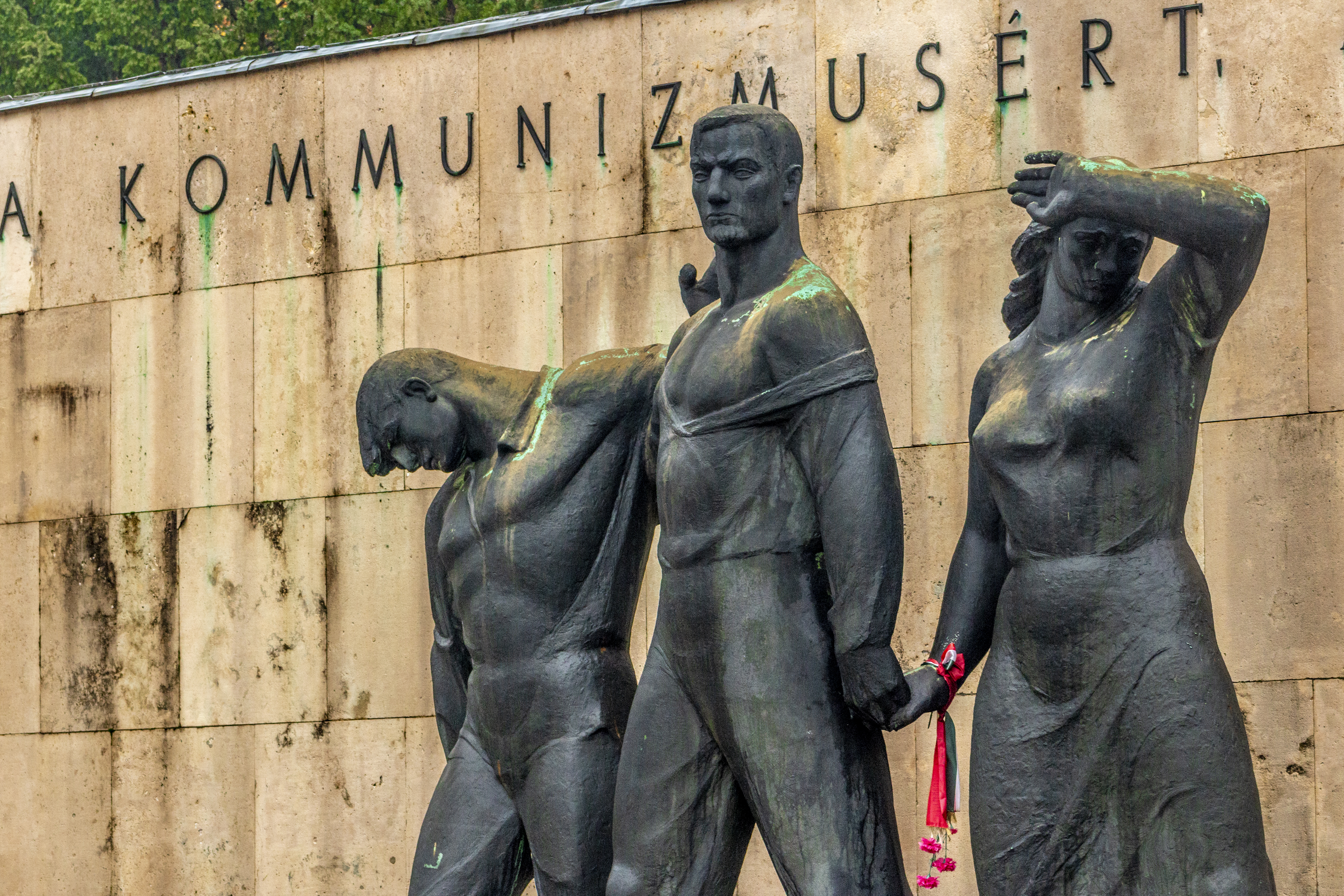
The Workers’ Movement Pantheon was designed by architect József Körner, while its statues and reliefs were created by sculptor Zoltán Olcsai-Kiss.
It was inaugurated in 1959, on the 40th anniversary of the establishment of the Hungarian Soviet Republic of 1919. Construction and decorative work continued into the following decade.
The choice of date was highly symbolic.
In 1919, Hungary had experienced a short-lived communist government led by Béla Kun. The communist authorities of the 1950s regarded this earlier political experiment as an important part of their historical tradition.
By connecting the events of 1919 with the political system established after 1945, they hoped to present Hungarian communism as part of a long and continuous historical movement.
The Pantheon was designed to express this idea on a monumental scale.
Its large architectural forms, impressive ceremonial spaces and sculptures reflect the artistic traditions of the socialist period.
The complex was intended to honour figures associated with the Hungarian workers’ movement and communist political history.
However, its construction also had a deeper political purpose.
After the Hungarian Revolution of 1956, the communist government led by János Kádár faced a serious problem of political legitimacy. The creation of the Pantheon helped the authorities rebuild their public image and establish a new official interpretation of the country’s recent history.
The cemetery became an important location for political ceremonies, public commemorations and the remembrance of people selected by the communist leadership.
Yet the relationship between politics and burial traditions was not always straightforward.
Interestingly, János Kádár himself was not buried in the Workers’ Movement Pantheon when he died in 1989.
Instead, he received a separate, prominent grave elsewhere in the cemetery. His funeral attracted enormous crowds, despite the fact that Hungary was already moving away from the one-party political system he had led for more than three decades.
Today, the Workers’ Movement Pantheon remains an important historical monument.
Its significance goes far beyond its architectural appearance. It demonstrates how political systems attempt to influence collective memory, deciding which individuals should be honoured and how their lives should be remembered.
Rather than simply celebrating or rejecting its past, the monument allows visitors to examine one of the most complicated periods of Hungary’s modern history.
The Cemetery and the Revolution of 1956
The events of 1956 left another important mark on Fiumei Road Cemetery.
On 6 October 1956, just a few weeks before the revolution began, László Rajk and three other victims of political show trials were reburied here.
Rajk had been a leading communist politician before becoming a victim of the Stalinist system. He was executed in 1949 following a fabricated political trial.
His rehabilitation and reburial attracted an enormous crowd. What was officially organised as a funeral became a silent demonstration against the dictatorship.
When the Hungarian Revolution broke out on 23 October 1956, the cemetery once again became connected to a major turning point in national history.
During the revolutionary fighting, around fifty people were buried in Plot 21, near the Kossuth Mausoleum.
Among them were revolutionaries, civilians and people who had fought on the side of the communist authorities.
After the revolution was defeated, the authorities changed the arrangement of some graves. Those who had died defending the communist system were moved to other burial areas, including graves connected to the Workers’ Movement Pantheon.
The graves of the revolutionaries and civilian victims remained.
Following the political changes of 1989–90, the plot was restored and became an important place of remembrance.
In 1999, a central memorial designed by László Gömbös was inaugurated.
Today, this part of the cemetery reminds visitors that the events of 1956 were not simply an episode in a history textbook. They affected real people and families whose stories remain closely connected to the cemetery.
More Than a Cemetery: A Museum Beneath the Trees
There is another reason why Fiumei Road Cemetery is such a remarkable place to visit: its natural beauty.
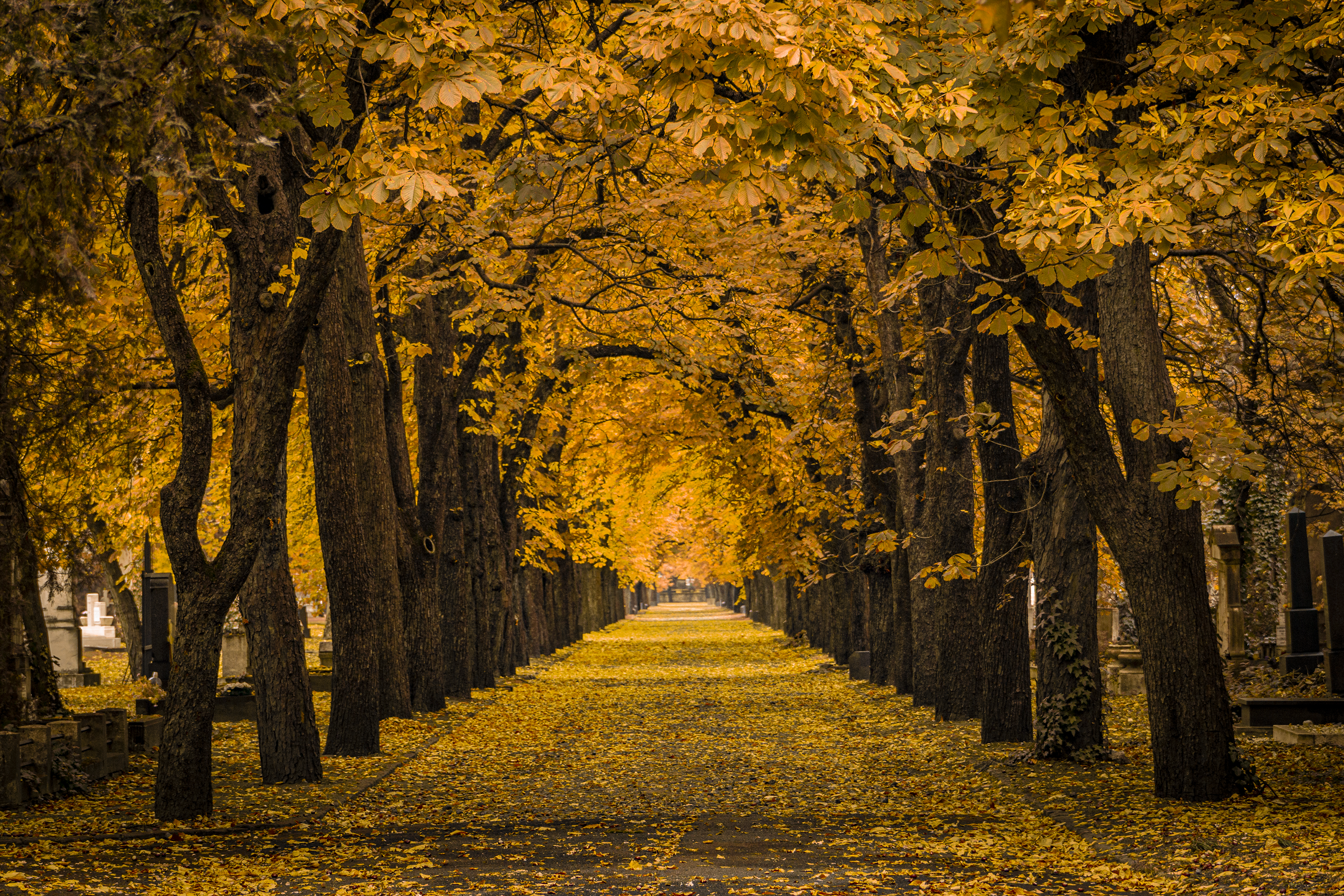
Covering approximately 56 hectares, the cemetery resembles a large landscaped park. Its long avenues, old trees and peaceful green spaces offer a striking contrast to the busy streets of Budapest.
According to the National Heritage Institute, the cemetery is home to approximately 110 bird species, making it an important natural environment as well as a historical site.
The cemetery is also one of Hungary’s most significant collections of outdoor sculpture.
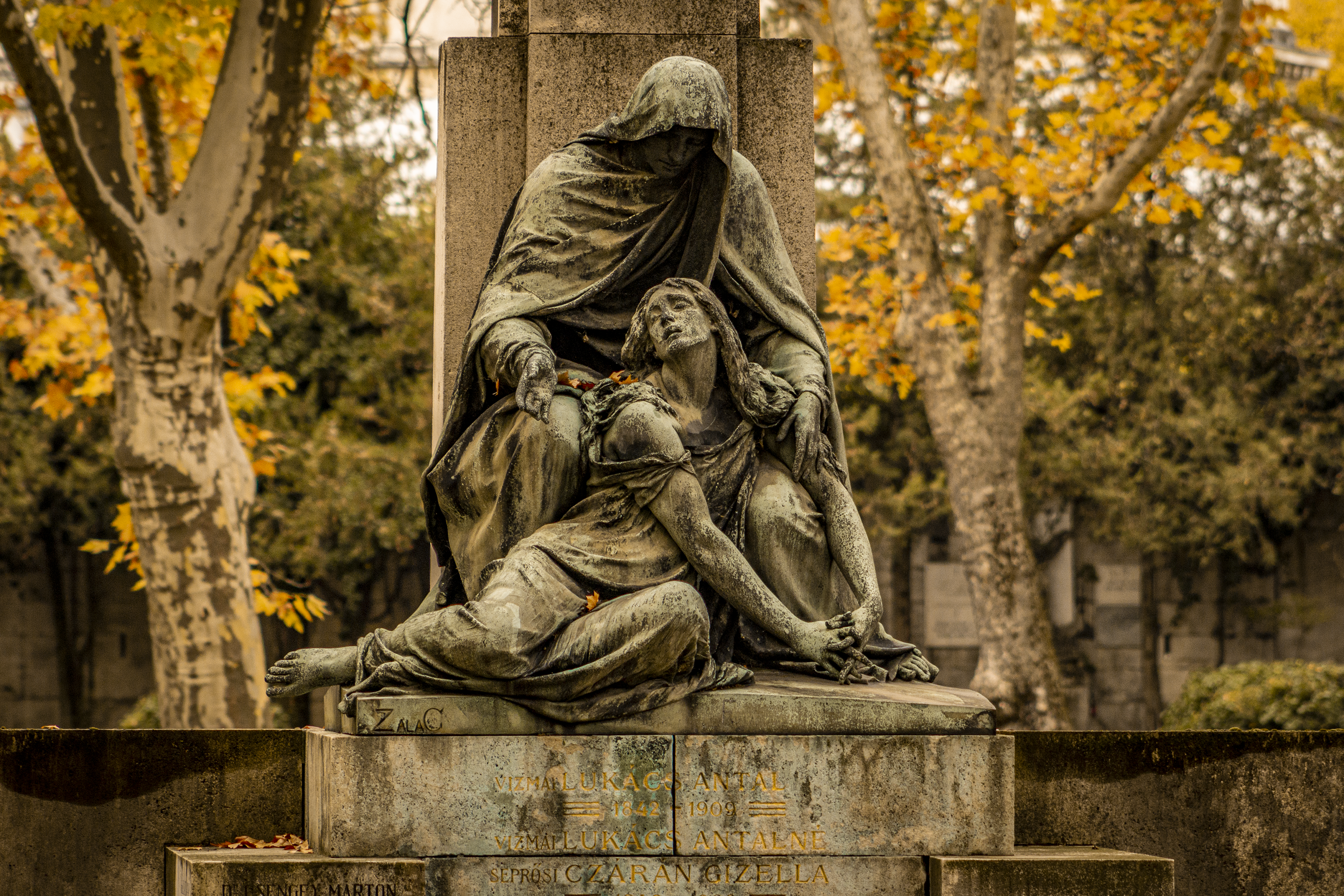
Many graves are decorated with impressive statues, carved stone figures and detailed artistic compositions. Some monuments are simple and modest, while others resemble small temples or elaborate works of architecture.
The beautiful arcades, completed in the early 20th century, are particularly worth exploring. Their family tombs and sculptures demonstrate the artistic traditions and burial customs of an earlier age.
Visitors can also discover the National Museum of Remembrance, where objects connected to funeral traditions are preserved. One of the most unusual is the magnificent Apponyi funeral carriage, a reminder of the grand ceremonies once organised for important public figures.
For those who would like to learn more, the National Heritage Institute organises guided walks focusing on different subjects, including famous writers, historical events, architecture and the cemetery’s magnificent mausoleums.
Although the cemetery is generally open to visitors free of charge, entering the interiors of the great mausoleums requires prior arrangements and the accompaniment of an authorised guide.
A Different Side of Budapest
Fiumei Road Cemetery is not the kind of attraction that appears at the top of every tourist’s list. Yet it offers something that few other places in Budapest can provide.
It brings together history, architecture, literature, art and nature in a single location.
Its great mausoleums tell the story of Hungary’s struggle for independence and political development during the 19th century. The Soviet Military Plot and the Workers’ Movement Pantheon, meanwhile, reveal the conflicts and political changes that shaped the country during the 20th century.
The graves of poets, painters, musicians and actors remind us that a nation’s history is not only written by politicians and soldiers. It is also shaped by the people who create its literature, music and art.
Unlike an ordinary museum, where objects are displayed behind glass, this remarkable place allows visitors to experience history in the open air.
Of course, Fiumei Road Cemetery remains an active burial ground and a place of personal remembrance, so visitors should always approach it with respect.
Perhaps that is what makes this cemetery so special. It reminds us that history is not only found in textbooks, museums or magnificent palaces.
Sometimes, it can be discovered by following a quiet path beneath the trees, stopping beside an old gravestone and reading a name that once helped shape a nation.

