23 October 2026 – The 70th Anniversary of the Hungarian Revolution
There are moments in history when ordinary people do extraordinary things. Moments when fear turns into courage, silence gives way to protest, and a nation decides that enough is enough. For Hungary, 23 October 1956 was one of those moments.
Seventy years ago, the streets of Budapest filled with thousands of people who wanted a better future. Most of them had no intention of starting a war. They were students, workers, teachers and ordinary citizens who wanted freedom, independence and the right to make decisions about their own country. Yet within hours, their peaceful demonstration had turned into a revolution that would attract the attention of the entire world.
The Hungarian Revolution of 1956 lasted only a few weeks, but its impact went far beyond the country’s borders. It became one of the most powerful symbols of resistance against Soviet domination during the Cold War. Although the uprising was eventually crushed, its memory survived through decades of dictatorship and remains an essential part of Hungarian national identity today.
A Country Living in Fear
The story of the revolution did not begin on 23 October. Its roots went back to the years following the Second World War, when Hungary gradually came under Soviet influence.
By the late 1940s, the Hungarian Communist Party had established a dictatorship, and the country became closely controlled by the Soviet Union. Under Mátyás Rákosi, Hungary experienced one of the darkest periods of its modern history.
Political opponents were arrested, independent newspapers disappeared, and the government controlled almost every aspect of public life. The secret police, known as the ÁVH, created an atmosphere of fear. People could be questioned, imprisoned or even tortured because of their political opinions or because someone had accused them of opposing the regime.
Everyday life was difficult, too. The government’s economic policies placed enormous pressure on workers and farmers, while shortages and low living standards caused widespread dissatisfaction.
After Stalin’s death in 1953, there were some attempts to introduce reforms. Imre Nagy, who became prime minister that year, promised a more moderate political direction. However, political struggles within the Communist Party prevented these changes from becoming permanent, and Nagy lost his position in 1955.
By 1956, frustration was growing. Writers, intellectuals and university students were increasingly willing to criticise the government. Events elsewhere in Eastern Europe, particularly the protests and political changes in Poland, also encouraged Hungarians to demand reforms.
The country was approaching a turning point.
Sixteen Demands and a Generation That Wanted Change
On 22 October 1956, students at the Budapest University of Technology gathered to discuss the political situation. During their meeting, they prepared a list of sixteen demands that would soon become the programme of the revolution.
They called for the withdrawal of Soviet troops from Hungary, the formation of a new government led by Imre Nagy, free elections, freedom of speech and greater national independence. They also wanted the removal of Stalinist symbols and a more honest discussion of Hungary’s recent history.
These demands were not simply about replacing one politician with another. They represented a desire to fundamentally change the relationship between the government and the Hungarian people.
The students decided to organise a peaceful demonstration the following day, partly to express their solidarity with the Polish people.
Nobody could have predicted just how important that demonstration would become.
23 October 1956 – The Day Budapest Changed
On the afternoon of Tuesday, 23 October, students began gathering in Budapest. The demonstration started at the statue of the nineteenth-century poet Sándor Petőfi, whose name was closely connected with the Hungarian Revolution of 1848.
From there, the crowds moved through the city towards Bem Square, where another important demonstration took place. As the afternoon continued, more and more people joined the march.
Students were no longer alone. Office workers, factory workers, pensioners and families came onto the streets. The crowd continued to grow, eventually reaching the area around the Hungarian Parliament.
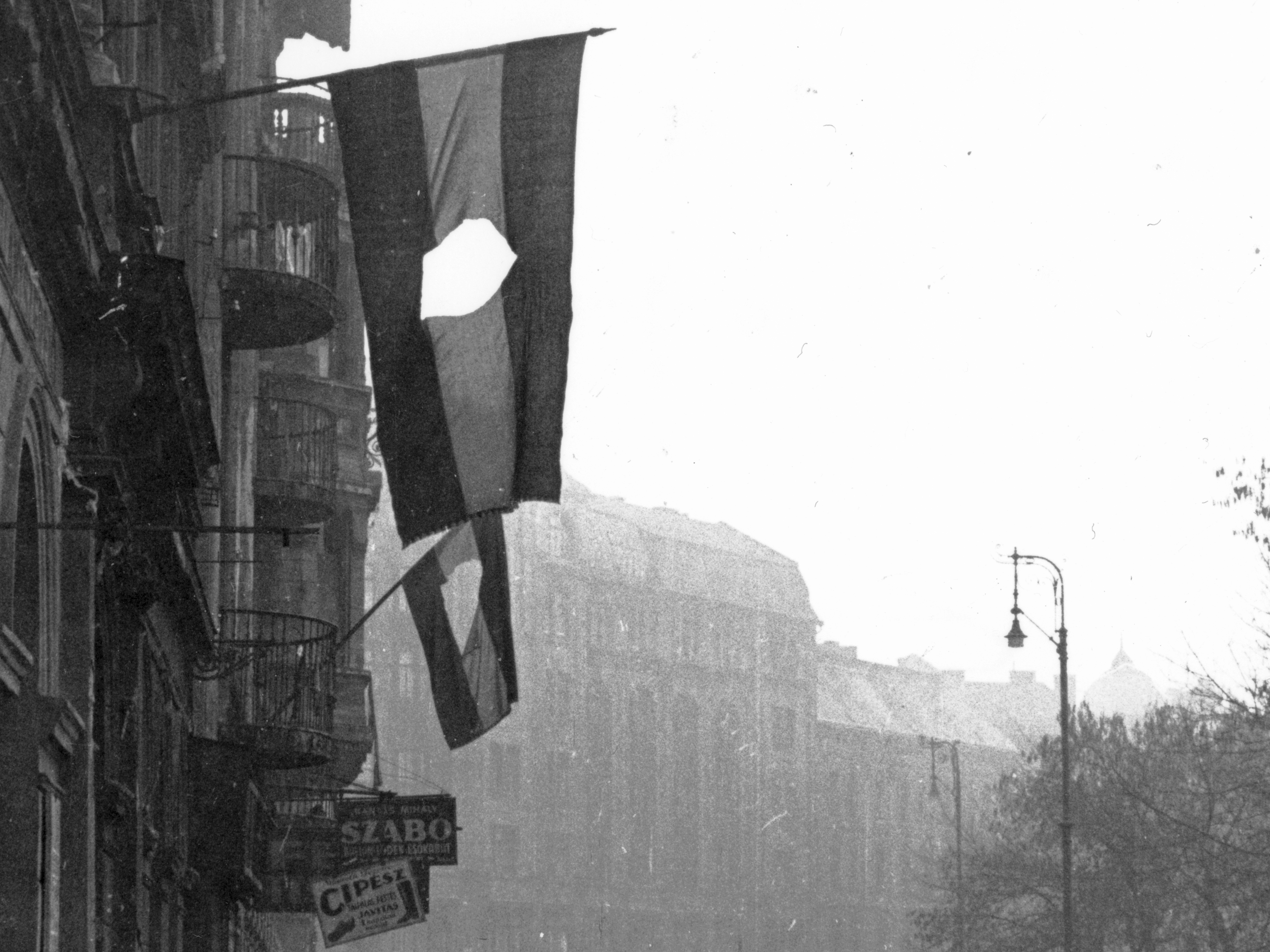
One of the most memorable sights was the Hungarian flag with a hole in its centre. Demonstrators had removed the communist coat of arms, leaving only the traditional red, white and green colours.
It was a simple but powerful message: Hungary wanted to decide its own future.
People sang patriotic songs and shouted demands for freedom and independence. For many participants, it was the first time they had openly expressed their political opinions without hiding their feelings.
However, the peaceful atmosphere did not last.
That evening, Ernő Gerő, the Communist Party leader who had replaced Rákosi in July, gave a radio speech condemning the demonstrations and rejecting the protesters’ demands.
Meanwhile, a large crowd gathered outside the headquarters of Hungarian Radio, demanding that the students’ sixteen points be broadcast. The situation became increasingly tense, and shooting eventually broke out.
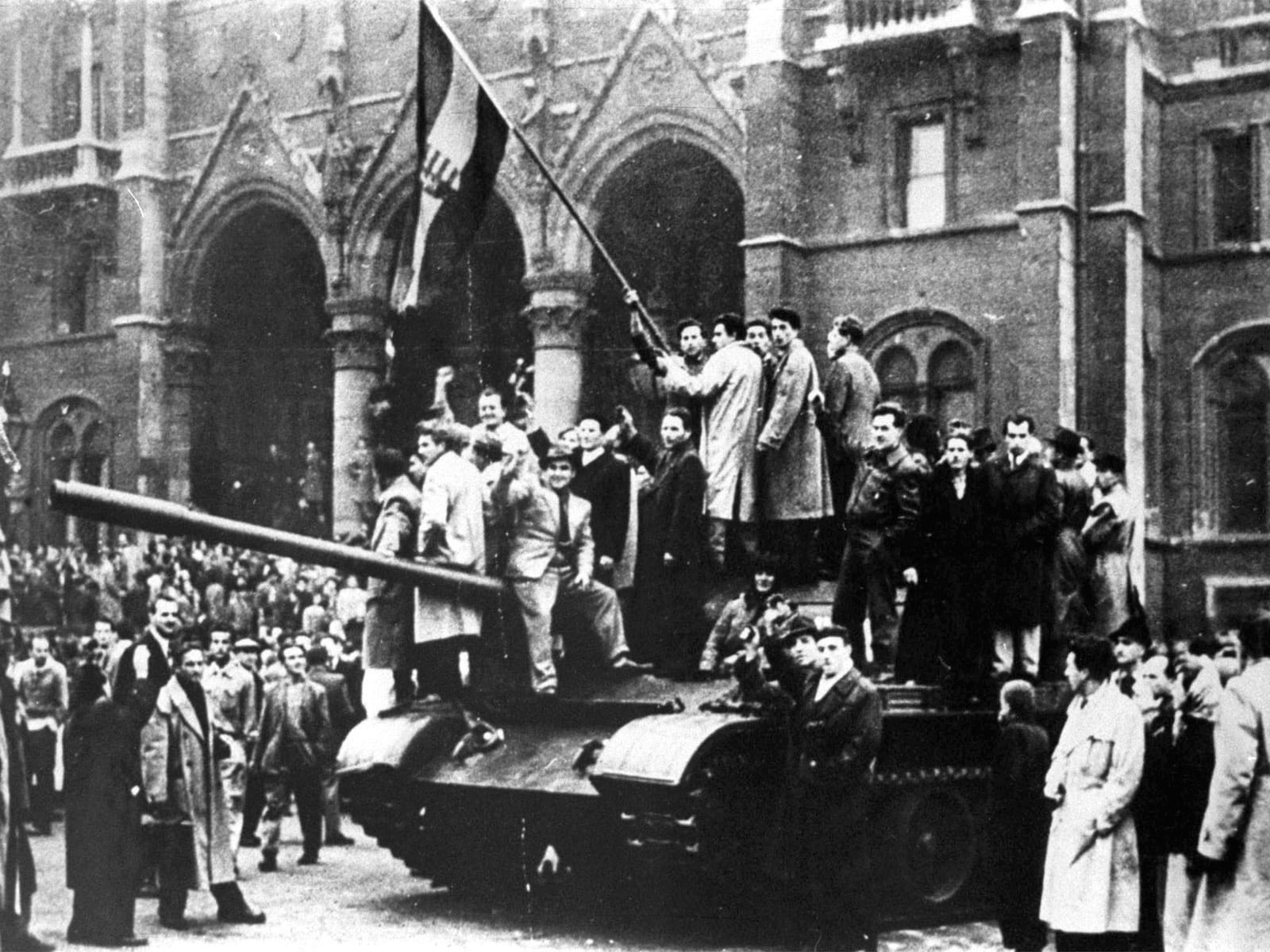
Elsewhere in the city, demonstrators pulled down the enormous statue of Joseph Stalin on Dózsa György Road. The destruction of the monument became another unforgettable symbol of the uprising.
By the early hours of 24 October, Budapest was no longer simply experiencing a political demonstration. An armed revolution had begun.
The Streets Become a Battlefield
As the uprising spread, Soviet military forces entered Budapest to support the communist authorities.
Fighting broke out in several parts of the city. Hungarian revolutionaries built barricades, collected weapons and attempted to stop Soviet tanks.
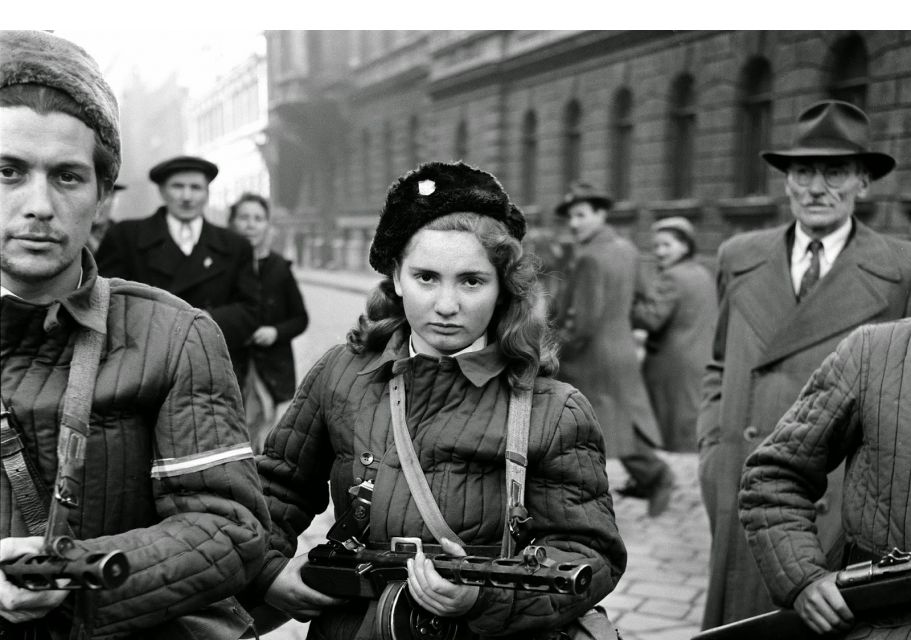
Some of the best-known centres of resistance developed around Corvin Passage and Széna Square. Many of the fighters were very young, and some had little or no military experience.
They became known as the Pesti srácok, or the boys of Budapest, although girls and women also played important roles in the revolution.
The resistance was not limited to those carrying weapons. Doctors and nurses treated the wounded, while ordinary residents helped by providing food, water, medicines and shelter. Volunteers transported supplies, and some families opened their homes to people who had nowhere safe to go.
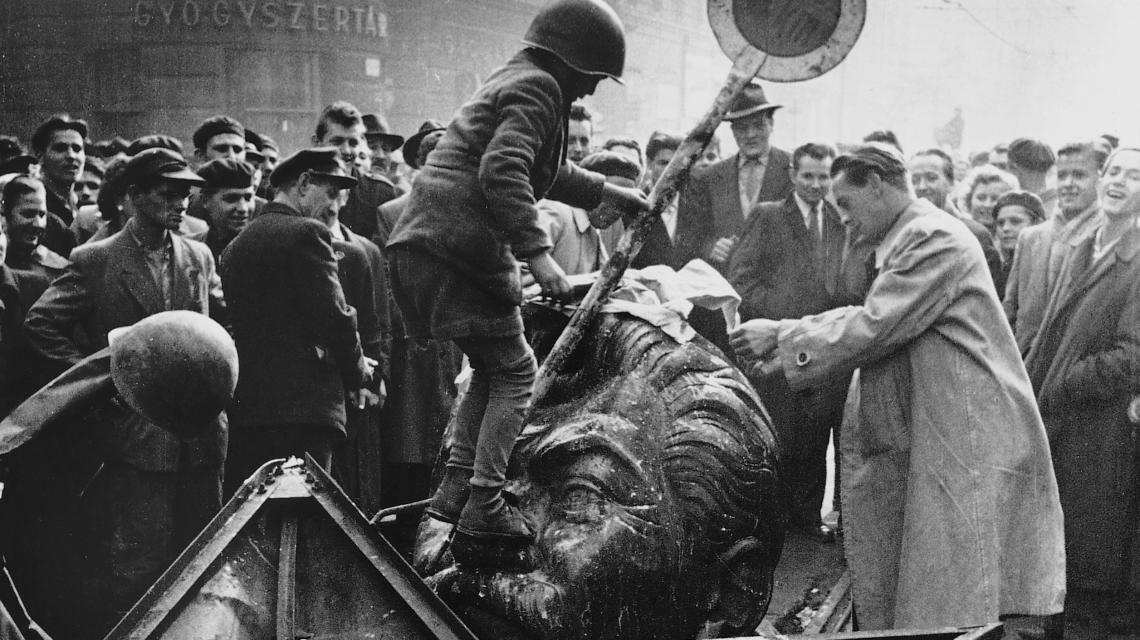
The courage of these people became one of the defining features of the revolution.
However, the fighting also brought terrible suffering. Streets were damaged, buildings caught fire, public transport was disrupted, and civilians were killed or injured.
On 25 October, one of the most tragic events of the uprising took place in Kossuth Square, in front of the Hungarian Parliament. Gunfire struck a large crowd of demonstrators, killing and wounding many people. The exact number of victims remains uncertain, and historians have continued to investigate the circumstances of the massacre.
The events of that day shocked the country and strengthened public opposition to the existing regime.
A Revolution Beyond Budapest
Although photographs of burning tanks and armed young people in Budapest became famous around the world, the revolution was never limited to the capital.
Demonstrations and political movements spread throughout Hungary. In cities such as Győr, Miskolc, Debrecen and many others, people organised protests and demanded political change.
Workers established councils to represent their interests, while local revolutionary committees began replacing communist authorities in some areas.
In several towns, the situation became violent. Security forces opened fire on demonstrators in places including Mosonmagyaróvár and Miskolc, causing further deaths and injuries.
These events demonstrated that the revolution was not simply a student movement or a rebellion involving a small number of armed groups.
It had developed into a nationwide political and social uprising.
At the same time, the situation was extremely complicated. The revolution brought together people with different backgrounds and political beliefs. Some wanted to reform socialism, while others hoped to create a completely different political system. There were also tragic incidents of revenge and violence against representatives of the former regime.
Despite these differences, a shared desire for national independence and an end to dictatorship united much of the movement.
A Brief Moment When Freedom Seemed Possible
On 24 October, Imre Nagy returned to the position of prime minister.
At first, the situation remained confused, and fighting continued. However, as the revolution developed, Nagy gradually accepted more of the protesters’ demands.
A major turning point came on 28 October, when he announced a ceasefire and recognised the uprising as a national democratic movement rather than simply treating it as an attack on the government.
During the following days, important political changes were introduced.
The government moved towards ending the one-party system, political organisations began to reappear, and plans were made to dissolve the hated secret police. Soviet troops also began withdrawing from Budapest.
For a short period, the atmosphere changed dramatically.
After years of censorship and political restrictions, people could suddenly imagine a future in which different political opinions were allowed and Hungary could become a more independent country.
On 1 November, Imre Nagy announced Hungary’s withdrawal from the Warsaw Pact and declared the country’s neutrality. He also appealed to the United Nations and the international community for support.
It was an extraordinary development. A small country in the Soviet sphere of influence was openly challenging the political and military system that had controlled Eastern Europe since the Second World War.
For many Hungarians, freedom seemed closer than ever before.
Unfortunately, that hope would soon disappear.
4 November – The Return of Soviet Tanks
While negotiations were taking place, Soviet leaders had already decided to launch a new military intervention.
On 3 November, Hungarian military representatives, including Defence Minister Pál Maléter, were arrested during negotiations with Soviet officials.
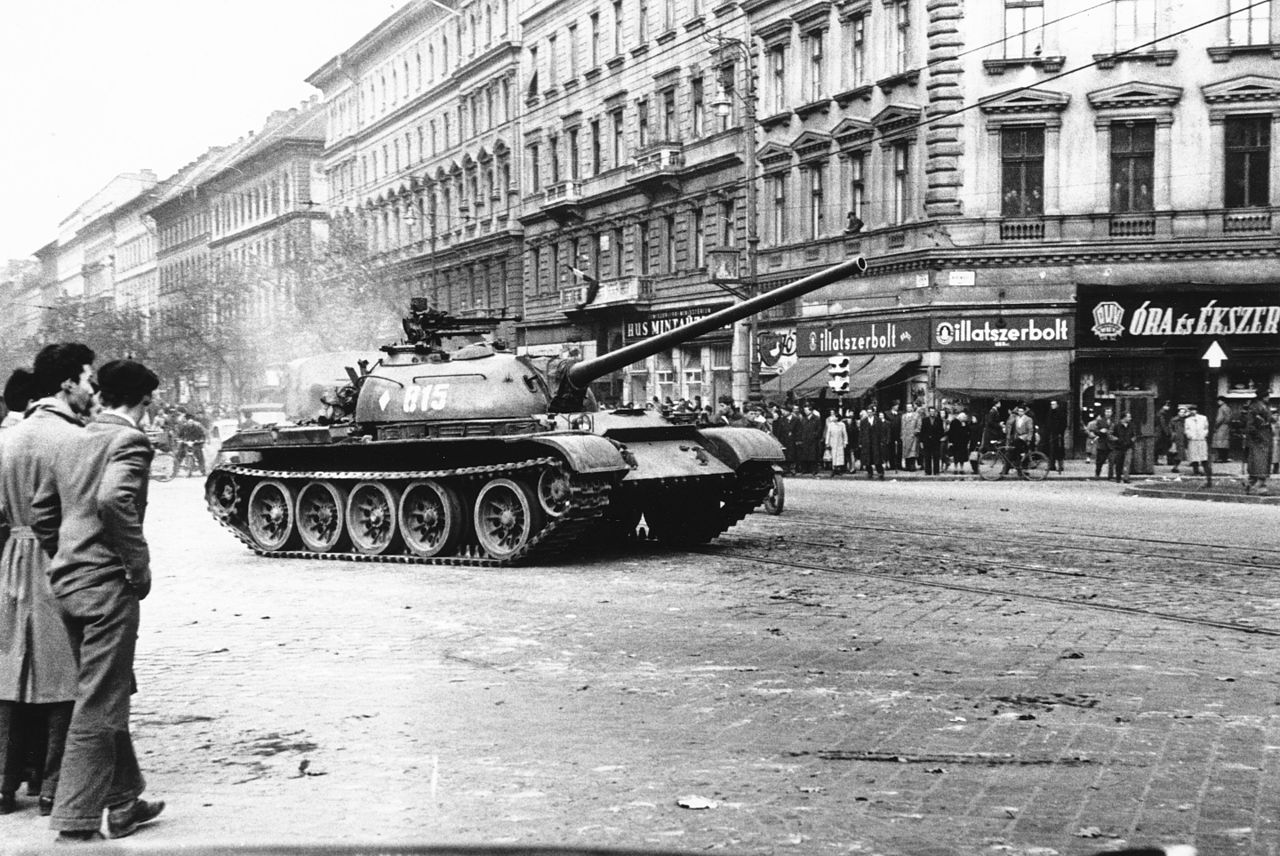
In the early hours of Sunday, 4 November 1956, a major Soviet attack began.
Tanks and troops advanced into Budapest and other parts of Hungary. At approximately 5:20 in the morning, Imre Nagy addressed the nation by radio, announcing that Soviet forces had attacked the capital.
Hungarian resistance fighters once again attempted to defend the city, but the military balance was hopelessly unequal.
Heavy fighting continued in several areas, including Corvin Passage, Széna Square and the industrial district of Csepel. Although the main Soviet operation achieved its objectives within days, some groups continued resisting until around 10–11 November.
The revolution had been defeated by overwhelming military force.
A new government led by János Kádár took power with Soviet support, while Nagy eventually sought refuge in the Yugoslav Embassy.
For Hungarians who had experienced the excitement and optimism of the previous days, the Soviet intervention was a devastating blow.
The World Watches, but Help Does Not Arrive
The Hungarian Revolution attracted enormous international attention.
Newspapers around the world published photographs of destroyed streets, young freedom fighters and Soviet tanks. Reports from Budapest shocked people in Western Europe and North America, and demonstrations of solidarity were organised in several countries.
However, political sympathy did not lead to Western military intervention.
The international situation was particularly complicated. The world was divided by the Cold War, and the United States and its allies were unwilling to risk a direct military confrontation with the Soviet Union.
At the same time, another international crisis was developing around the Suez Canal in Egypt, drawing attention away from Hungary.
Although the Hungarian question was discussed at the United Nations, these international efforts could not stop the Soviet intervention.
Hungary’s revolutionaries had hoped that the outside world might help them achieve independence. Instead, they were forced to face the consequences of defeat largely on their own.
The Human Cost of the Revolution
The fighting and its aftermath left deep wounds in Hungarian society.
According to official Hungarian statistical records, more than 2,600 people died and over 19,000 were injured between the beginning of the revolution and January 1957.
But the suffering did not end when the shooting stopped.
The new communist government began a period of harsh political punishment. Thousands of people were arrested, imprisoned or otherwise punished because of their involvement in the uprising.
Several hundred people were executed during the years of retaliation.
Imre Nagy was arrested after leaving the Yugoslav Embassy and was later put on trial. On 16 June 1958, he was executed together with Pál Maléter and journalist Miklós Gimes.
For decades, the authorities attempted to present the revolution as a counter-revolutionary attack against the socialist state.
Many Hungarians were unable to speak openly about what they had experienced. Families who had lost relatives or whose members had been imprisoned often kept their memories private.
At the same time, approximately 200,000 people fled Hungary, most of them travelling through Austria or Yugoslavia.
They left behind their homes, friends, relatives and familiar surroundings, often without knowing whether they would ever return.
The Hungarian refugee crisis became one of the most significant international humanitarian emergencies of the period. Countries across the world accepted Hungarian refugees, offering them opportunities to rebuild their lives.
Their experiences became another important part of the history of 1956.
From Silence to Remembrance
During the decades that followed, the official interpretation of the revolution was controlled by the communist government.
In schools and public discussions, the uprising was generally described as a counter-revolution. Many of those who had participated in the events were unable to share their experiences freely.
Yet the memory of 1956 never disappeared.
It survived in family conversations, personal diaries, photographs, letters and the stories of Hungarians living abroad.
As Hungary moved towards political change in the late 1980s, the history of the revolution began to be openly reconsidered.
One of the most important symbolic events took place on 16 June 1989, when Imre Nagy and other victims of the repression were given a public reburial ceremony in Budapest.
Just a few months later, on 23 October 1989, the Republic of Hungary was proclaimed.
The choice of date was deeply symbolic. Thirty-three years after the beginning of the revolution, 23 October once again represented the possibility of a democratic future.
In 1990, the anniversary officially became a Hungarian national holiday.
Seventy Years Later – What Does 1956 Mean to Us?
Today, seventy years after the first demonstrations, it can be difficult to imagine what Hungary looked and felt like in October 1956.
The Budapest of today is a modern European capital. The streets where tanks once moved and barricades once stood are now filled with trams, cars, tourists and people going about their everyday lives.
Many buildings have been repaired or completely transformed. In some places, memorial plaques and monuments are among the few visible reminders of what happened there.
Yet behind those familiar streets are stories that deserve to be remembered.
There were students who attended university one morning and found themselves taking part in a revolution that afternoon. There were parents who worried about their children, families who helped strangers, and young people who risked everything for a future they might never live to see.
Some survived and eventually returned to ordinary life. Others spent years in prison or started new lives in distant countries. Many never came home.
It is important to remember that the people of 1956 were not simply historical figures in black-and-white photographs.
They were individuals with ordinary hopes, personal problems, friendships and dreams. Most of them had never expected to become part of history.
Their experiences remind us that major historical events do not happen only because of politicians, governments or armies. Sometimes they begin when ordinary people decide that their voices must be heard.
The revolution also teaches us that history is rarely simple. Political choices were difficult, events sometimes developed unexpectedly, and acts of great courage took place alongside fear, confusion and tragedy.
Remembering 1956 therefore means more than celebrating heroism. It also means understanding the suffering, the sacrifices and the complicated decisions that shaped those extraordinary weeks.
A Legacy That Still Lives On
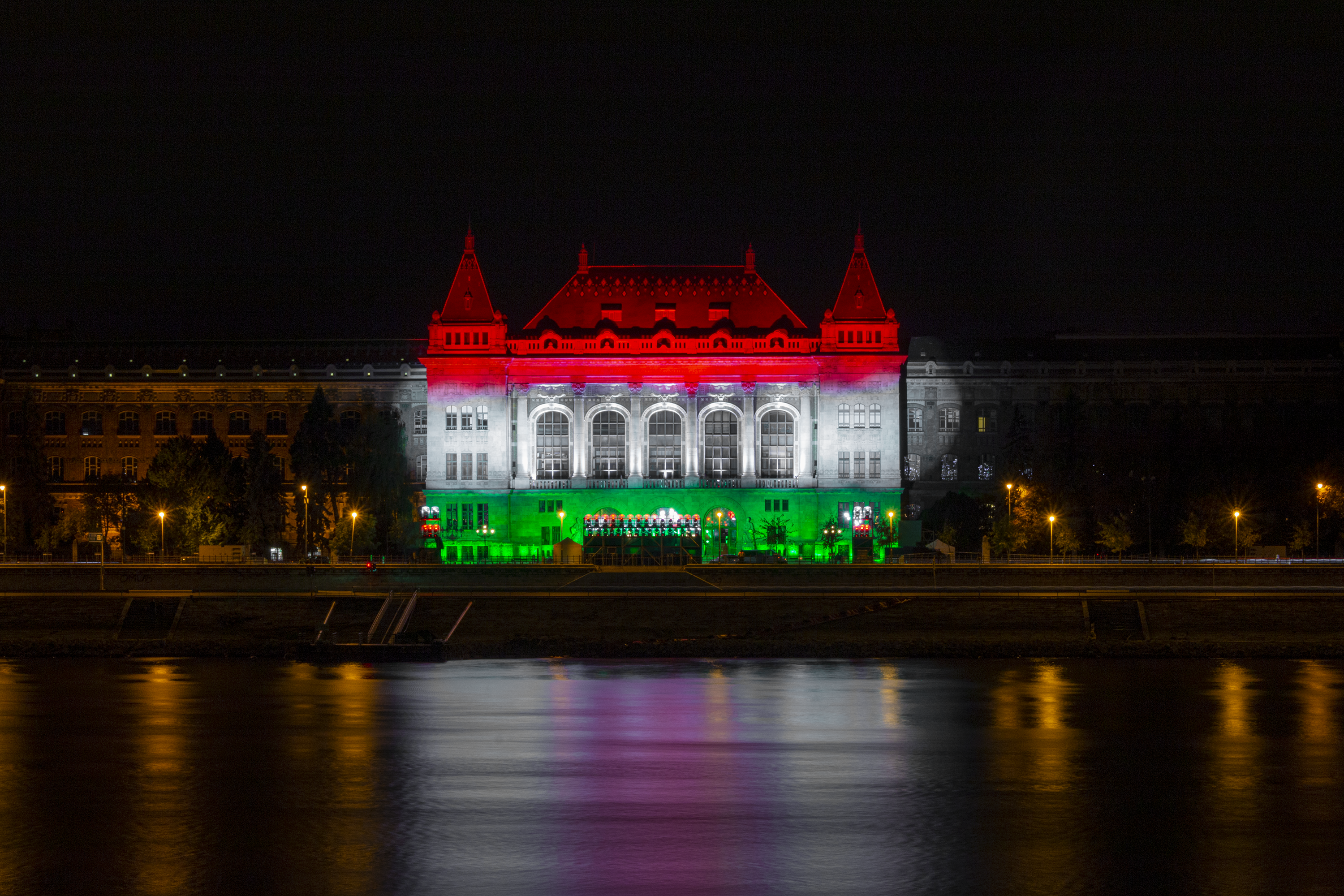
Every year on 23 October, Hungary remembers the people who stood up against dictatorship and Soviet domination.
Flags are raised, flowers are placed at memorials, and ceremonies honour those who fought and those who lost their lives. Schools, museums and cultural institutions help younger generations understand what happened.
But perhaps the most meaningful form of remembrance is something much simpler: keeping the stories alive.
As the number of people who personally experienced the revolution becomes smaller, the responsibility of preserving their memories increasingly belongs to later generations.
Seventy years may seem like a long time, but in historical terms, 1956 is still relatively close. Its consequences shaped the lives of our parents, grandparents and great-grandparents, and its influence can still be felt in Hungarian society.
The revolution did not achieve its immediate political goals. Soviet domination continued for more than three decades, and many of those who had fought for freedom never lived to see the democratic changes of 1989.
Yet the uprising demonstrated that the desire for national independence and personal liberty could survive even under a powerful dictatorship.
On this seventieth anniversary, we remember the students who marched through Budapest, the workers who organised protests, the families who offered help, and the freedom fighters who stood against an overwhelmingly stronger military force.
We remember those who died, those who were forced to leave their homeland, and those who carried their memories in silence for decades.
Above all, we remember that freedom has a human cost, and that the rights we enjoy today should never be taken for granted.
The Hungarian Revolution of 1956 lasted only a few weeks. Its courage, its sacrifices and its message, however, have survived for seventy years.

