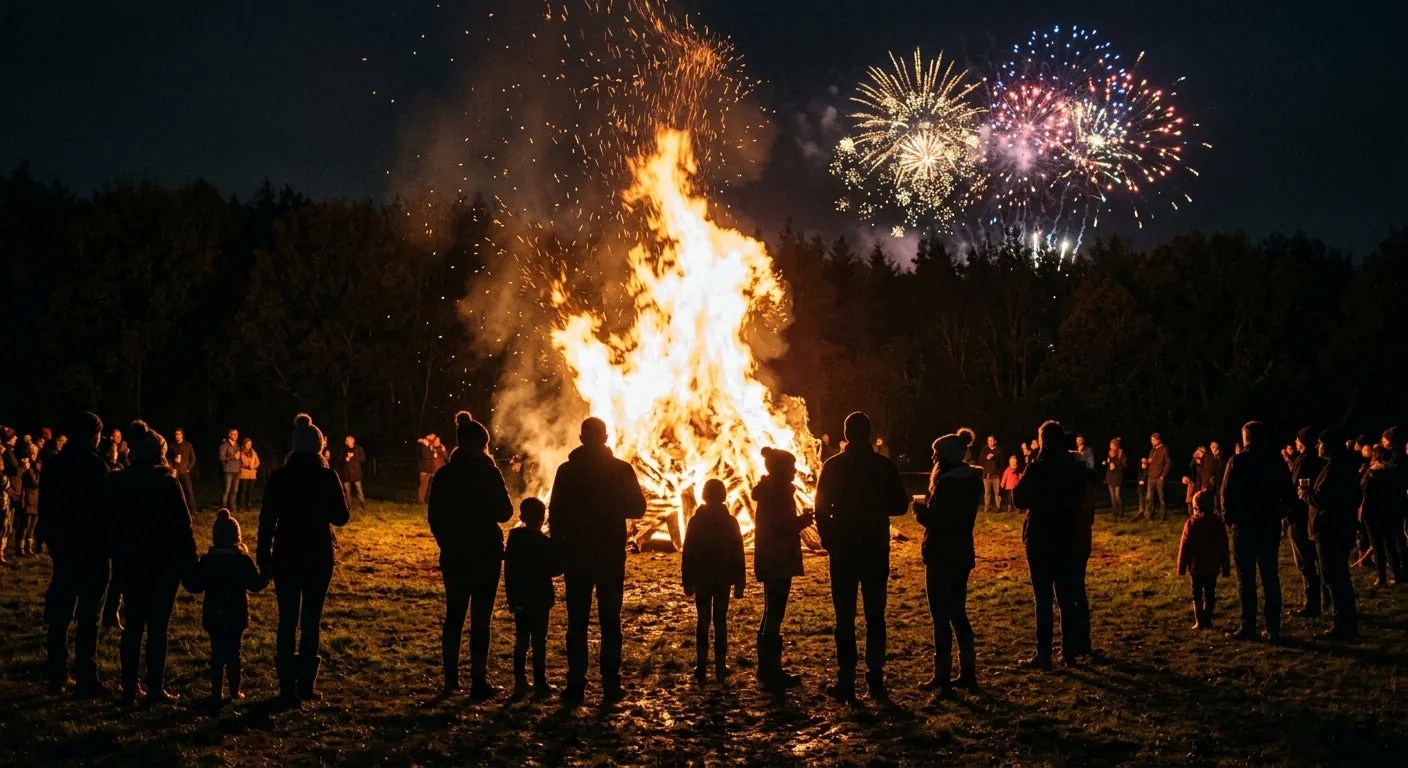
If you happen to be in Britain on 5 November, you might hear fireworks exploding in the sky, see huge bonfires burning in parks, and notice families gathering outside despite the cold autumn weather. At first, it might look like an early New Year’s Eve celebration. However, behind all those colourful fireworks lies a rather dark chapter of British history – a story of religious conflict, political conspiracy and a plan that could have changed the country forever.
Welcome to Guy Fawkes Night, also known as Bonfire Night.
An England Divided by Religion
To understand the story, we need to travel back to the beginning of the 17th century.
England was a Protestant country, but many people remained Catholic. During the reign of Elizabeth I, Catholics faced serious restrictions. They could be fined for refusing to attend Protestant church services, and Catholic priests were forbidden to practise their religion openly.
When James I became king in 1603, some Catholics hoped that life would become easier. Unfortunately for them, the new king continued many of the restrictions.
A small group of Catholic men eventually decided that peaceful change was impossible. Their solution was extreme: they wanted to kill the king and destroy the English Parliament.
The Gunpowder Plot
The leader of the conspiracy was a wealthy Catholic named Robert Catesby. Although Guy Fawkes became the most famous member of the group, he was not actually its leader.
The plan was simple but terrifying. On 5 November 1605, King James I was expected to attend the State Opening of Parliament in London. The conspirators planned to blow up the House of Lords during the ceremony, killing the king and many important political figures.
They managed to rent a storage space beneath the House of Lords, where they secretly placed 36 barrels of gunpowder.
Guy Fawkes was given the responsibility of guarding the explosives and setting them off. He had military experience and knew how to handle gunpowder.
If everything had gone according to plan, the explosion could have caused enormous destruction.
But things did not go according to plan.
The Mysterious Letter
On 26 October 1605, Lord Monteagle, a Catholic nobleman, received an anonymous letter warning him not to attend Parliament.
He passed the letter to the authorities, who began investigating the possible danger.
On the night of 4 November, officials searched the buildings beneath Parliament. They discovered Guy Fawkes, who was using the false name John Johnson, together with the hidden gunpowder.
He was immediately arrested.
Fawkes was taken to the Tower of London, where he was questioned and tortured. Eventually, he revealed information about the other conspirators.
Several members of the group were killed while trying to escape, while others were captured.
In January 1606, Fawkes and the surviving conspirators were found guilty of high treason and sentenced to death. Fawkes was executed on 31 January.
The Gunpowder Plot had failed, but its consequences were far from over. The discovery increased suspicion towards Catholics, making their lives even more difficult.
From Terror to Tradition
King James I had survived, and the government wanted the nation to remember the event.
In January 1606, Parliament passed a law establishing 5 November as an annual day of thanksgiving.
People attended special church services, rang bells and lit bonfires to celebrate the failure of the conspiracy.
Over time, fireworks became an important part of the celebrations. Another tradition developed: people began burning figures, or effigies, on bonfires. Earlier figures sometimes represented the Pope, reflecting the strong anti-Catholic feelings of the period. Eventually, Guy Fawkes became the usual figure.
Children also learned a famous traditional rhyme:
“Remember, remember the fifth of November,
Gunpowder, treason and plot.”
Although the law requiring the annual commemoration was repealed in 1859, the tradition survived.
Bonfire Night Today
More than four centuries later, Bonfire Night remains a familiar part of British autumn culture.
On or around 5 November, communities organise firework displays, public bonfires and family events. For many people, the evening is simply an opportunity to enjoy spectacular lights, spend time outdoors and celebrate with friends.
The religious meaning of the occasion has largely disappeared from modern celebrations. Many children know Guy Fawkes mainly as a historical character associated with fireworks rather than as a member of a dangerous conspiracy.
Interestingly, the British Parliament still maintains a connection with the events of 1605. Before the State Opening of Parliament, the Yeomen of the Guard traditionally carry out a ceremonial search of the cellars. Today, of course, this is a historical custom rather than a genuine security operation.
A Night with a Complicated History
There is something rather unusual about Guy Fawkes Night. Britain celebrates not a military victory or the birthday of a famous ruler, but the failure of an attempt to destroy its government.
The tradition has also changed considerably over the centuries. What began as a Protestant celebration of the king’s survival gradually became a popular autumn festival enjoyed by people from different backgrounds.
Yet the fireworks still remind us of a night in 1605 when a handful of men came dangerously close to changing British history.
And that is perhaps why, after more than 400 years, the fifth of November has never been forgotten.

