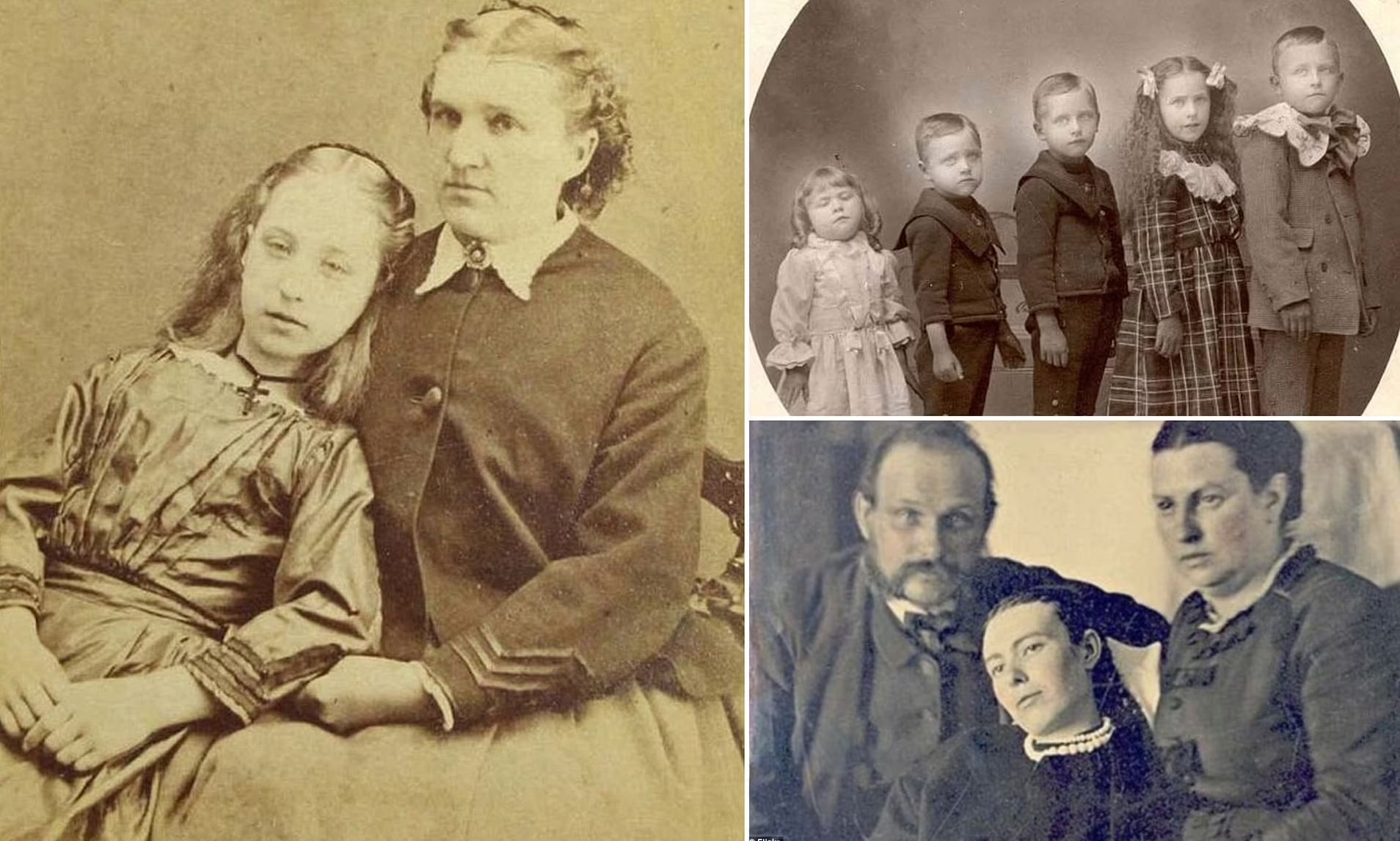
Imagine opening an old family photo album and finding a picture from the 19th century. A mother is sitting in a chair, holding her little daughter. Both are wearing beautiful clothes, and the scene looks like an ordinary family portrait. But there is something unusual about the child. Her eyes are closed, her body is completely still, and her mother has an expression of deep sadness.
The little girl is dead.
For many people today, the idea of photographing a deceased family member seems disturbing, perhaps even frightening. Yet during the 19th century, some families did exactly that. Parents posed with their dead children, brothers and sisters were photographed together for the last time, and deceased relatives were sometimes carefully arranged to look as though they were peacefully sleeping.
These pictures were not created to frighten anyone. In fact, their purpose was almost the opposite.
They were made out of love.
When Photography Was Still a Luxury
To understand this unusual custom, we need to imagine a world without smartphones, digital cameras or even ordinary family snapshots.
Photography became available to the public in 1839, but having a portrait taken was initially expensive. Many working-class families simply could not afford regular photographs, and some people went through their entire lives without ever being photographed.
This created a heartbreaking problem.
What happened when someone died before their family had managed to have their picture taken?
Today, we probably have hundreds or even thousands of photographs of the people we love. We can look at pictures from birthdays, holidays, weddings and everyday moments. But in the middle of the 19th century, a grieving family might suddenly realise that they had no visual memory of their loved one at all.
The solution was to call a photographer after the person’s death.
This practice became known as post-mortem photography, meaning photography carried out after death.
For some families, that final portrait was the first and only photograph ever taken of their relative.
A World Where Death Was Part of Everyday Life
Victorian society had a very different relationship with death.
During the 19th century, infectious diseases such as tuberculosis, cholera and scarlet fever were serious threats. Medical knowledge was limited, antibiotics did not exist, and infant mortality was much higher than it is today.
Losing a child was a tragedy that many families experienced.
Death was also more visible in everyday life. People often died at home, surrounded by relatives. Their bodies remained in the house before burial, and family members helped prepare them for the funeral.
The deceased might be dressed in their best clothes, placed on a bed and surrounded by flowers.
Against this background, taking a final photograph did not necessarily seem as strange as it does to modern eyes.
The photograph became another part of saying goodbye.
The Children Who Never Had a Portrait
Some of the most emotional examples of post-mortem photography involve babies and young children.
Parents sometimes asked photographers to take pictures of their deceased children dressed in white clothes, lying on pillows or surrounded by favourite toys.
In certain photographs, a mother is holding her dead baby in her arms. In others, a deceased child appears beside living brothers and sisters.
These pictures can be difficult to look at today, but their meaning becomes clearer when we consider the circumstances.
A mother who had lost her newborn baby might have no other photograph of the child. Without that final portrait, she would have nothing to show future generations what her baby had looked like.
There was also a more personal reason. The photograph allowed parents to preserve the child’s face, even as their memories of small details gradually faded.
For them, the picture was not primarily an image of death.
It was a reminder that their child had existed, had been loved and would always remain part of the family.
Making Death Look Like Sleep
Victorian photographers sometimes went to considerable lengths to make these final portraits appear peaceful.
The deceased person might be placed on a bed or sofa, dressed in carefully chosen clothes and photographed in soft light. Babies were sometimes held by their mothers, while older children could be arranged among blankets and flowers.
One common approach was to make the dead person look as though they were sleeping.
This reflected a popular Victorian idea of death as a peaceful final rest.
Photographers wanted to create an image that the family could keep without being constantly reminded of the most painful aspects of death.
Some photographs showed the person clearly lying in a coffin. Others looked remarkably similar to ordinary portraits.
There were even cases in which the deceased was photographed with living family members, creating what appeared to be a final family gathering.
However, not every Victorian family followed this custom, and it would be wrong to imagine that such photographs were found in every household.
Post-mortem photography was a recognised practice, but its popularity varied according to place, period, social background and personal beliefs.
The Strange Myths of Victorian Photography
If you search for Victorian post-mortem photographs on the internet today, you will probably find some very unusual pictures.
There are images of people standing in groups, sitting perfectly straight or staring directly into the camera. Online descriptions sometimes claim that one person in the photograph was already dead and had been supported by special metal equipment.
But many of these stories are misleading.
Victorian photographers did use posing stands to help people remain still during long photographic exposures. However, these devices were designed to support living subjects, not to hold dead bodies upright.
Many supposedly post-mortem photographs shared online are actually ordinary portraits of living people.
Another popular claim is that a person with unusually sharp facial features or open eyes must have been dead when the picture was taken. There is no reliable way to make such a judgement simply by looking at an unidentified photograph.
Genuine historical post-mortem photographs generally show the deceased lying down, resting in a chair, being held by relatives or placed in a coffin.
When historians identify these pictures, they rely on their historical background, original descriptions and other surviving evidence.
An old photograph may look frightening, but that does not make it a picture of a dead person.
Why Did Families Keep These Photographs?
The completed photographs could be placed in albums, displayed in the family home or kept in small cases.
Some were sent to relatives who lived too far away to attend the funeral.
As photographic technology improved, it became possible to produce several copies of the same image, allowing different family members to preserve their own memories.
These pictures were sometimes displayed alongside portraits of living relatives.
To modern viewers, this might seem uncomfortable. We usually prefer photographs that show people smiling, celebrating or enjoying life.
But Victorian mourning traditions were often much more public and visible.
Black clothing, mourning jewellery, memorial cards and locks of hair belonging to deceased relatives were all ways of remembering the dead.
Post-mortem photographs belonged to this wider culture of remembrance.
They helped grieving families maintain a connection with someone who was no longer physically present.
When Did the Custom Disappear?
Post-mortem photography became particularly important during the middle and later decades of the 19th century. It continued into the early 20th century, although its popularity gradually declined in many places.
Several developments contributed to this change.
First, photography became cheaper and more accessible. By the early 20th century, many more families owned cameras or had opportunities to visit professional photographers.
Consequently, people were more likely to have photographs taken during their lifetime.
Second, medical progress gradually reduced mortality, especially among children.
Finally, attitudes towards death began to change.
Professional funeral services became increasingly common, and death was gradually moved away from everyday family life and into hospitals, funeral homes and other specialised institutions.
The custom did not disappear everywhere at the same time. In some communities, photographing the deceased remained an accepted tradition well into the 20th century.
Even today, memorial photography has not completely vanished. Some families still choose to have photographs taken after the loss of a baby, for example, as a private way of remembering a child whose life was tragically short.
The circumstances and meanings vary, but the emotional need behind the photographs can be surprisingly similar.
A Final Picture, Not a Frightening One
Looking at Victorian post-mortem photographs today can be an uncomfortable experience.
We see the closed eyes, the carefully arranged clothes and the silent faces of grieving relatives. We know that the people in these pictures lived in a world without many of the medical and technological comforts we now take for granted.
But perhaps we are looking at them from the wrong perspective.
Instead of asking why a mother would want a photograph of her dead child, we might ask what she would have had left if that photograph had never been taken.
For some parents, that little picture was the only chance to preserve their child’s appearance. For a grieving husband or wife, a final portrait could be a way of keeping a familiar face close. For brothers and sisters, it might be the last image of a family before everything changed.
A century and a half later, we still take photographs for much the same reason.
We want to remember people, preserve important moments and hold on to something that time will eventually take away.
The difference is that today we usually have the opportunity to do this while our loved ones are still alive.
Victorian families were not always so fortunate.
And perhaps that is the most important thing to remember when looking at these unusual photographs.
They were not simply pictures of the dead. They were photographs taken by people who did not want to forget.

