Walking through Tallinn’s Old Town, it is easy to get used to medieval walls, narrow streets and church towers. Then you reach Toompea Hill, turn a corner, and suddenly something completely different appears in front of you: the dark onion domes of the Alexander Nevsky Cathedral. It feels almost unexpected in this part of the city, and that is probably one of the reasons why it stays in your memory.
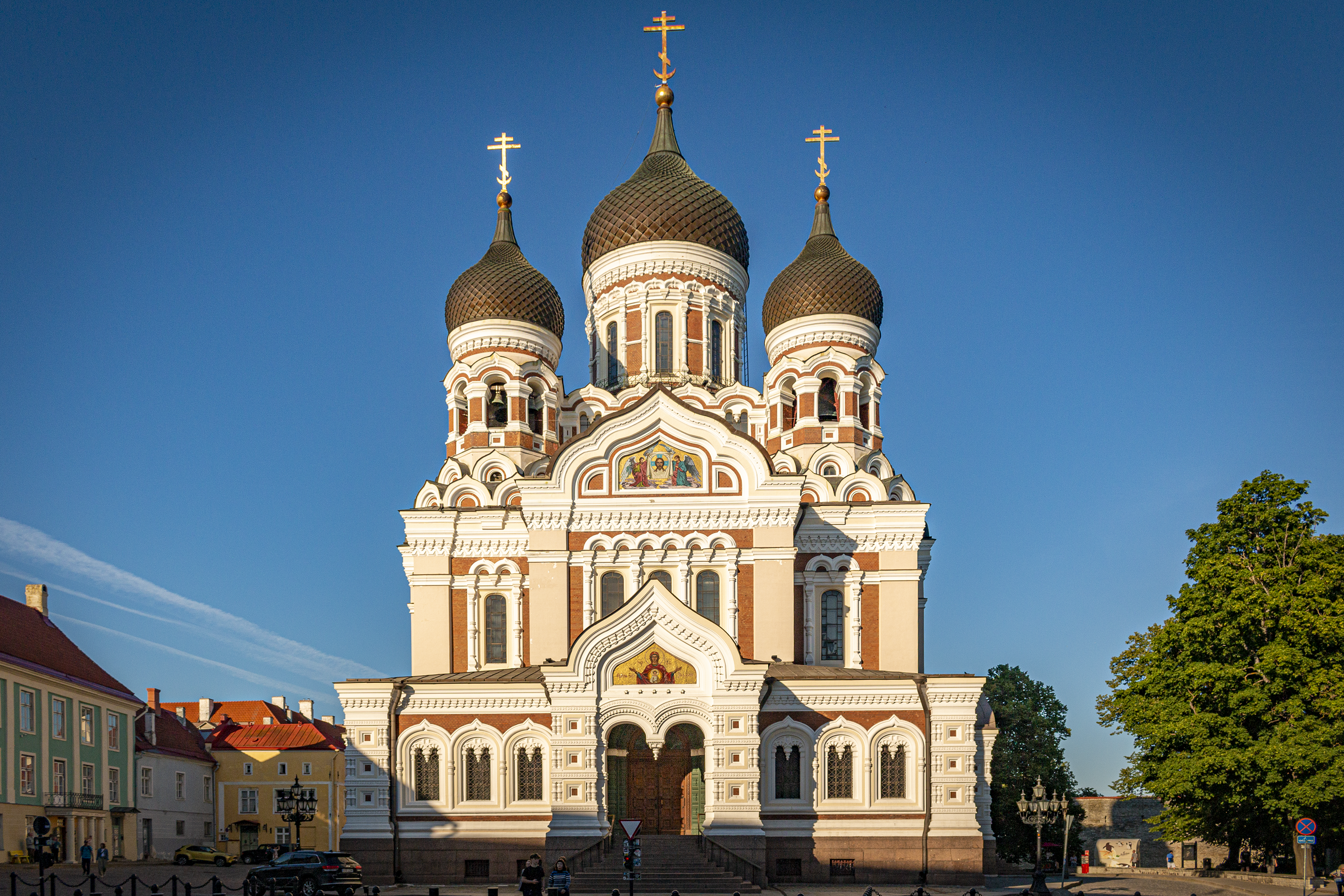
Standing on Lossi plats, directly opposite Toompea Castle, the cathedral is one of Tallinn’s most striking landmarks. Its black domes, golden crosses and richly decorated façade give it a very different character from the medieval buildings around it. But behind its impressive appearance there is also a complicated story – one that is closely connected to Estonia’s history under the Russian Empire.
The cathedral was built during the final years of the 19th century, when Estonia was still part of the Russian Empire, and it was completed in 1900. It was designed by the Russian architect Mikhail Preobrazhensky in the Russian Revival style, which explains its very different appearance compared with many of Tallinn’s medieval churches.
Its location was certainly not accidental. At the time, the Russian Empire was following a policy of Russification in Estonia and other parts of its territory. Building such a large Orthodox cathedral beside the centre of political power was therefore more than a religious decision. It was also a clear symbol of Russian imperial presence and authority. Because of this history, the cathedral has always been more complicated for Estonians than an ordinary tourist attraction.
And yet, whatever its political background, the architecture is difficult not to admire.
From the outside, the cathedral immediately attracts attention with its five black domes, detailed white-and-red walls and colourful mosaics above the entrances. The whole building has a very different character from the Lutheran churches and medieval architecture nearby. Walking around Toompea, you can move from Gothic Tallinn to something that feels almost completely Russian within just a few steps.
The interior creates another strong impression. It is darker and more mysterious than the bright exterior. Golden icons, religious paintings, candles and elaborate decorations fill the space. Unlike a museum, however, this is still an active Orthodox cathedral, so visitors are entering a real place of worship rather than simply another historical monument. That atmosphere makes the experience feel quite different from visiting many other famous sights in the Old Town.
The cathedral is also famous for its bells. There are eleven of them in its towers, including a huge bell weighing around 15 tonnes, which is the largest church bell in Tallinn. When the bells ring across Toompea, they add another layer to a part of the city already filled with centuries of history.
The story of the cathedral did not become simpler after Estonia gained independence. Because many people saw the building as a symbol of former Russian rule, there were serious discussions about removing it during the 1920s and 1930s. In 1928, a proposal to demolish the cathedral even reached the Estonian parliament. The building survived, however, and over time it became a permanent part of Tallinn’s complicated architectural and historical landscape.
Perhaps this is what makes the Alexander Nevsky Cathedral particularly interesting. It is beautiful, but its beauty comes with a difficult history. It can be admired as an architectural masterpiece while also being understood as a reminder of a period when Estonia did not control its own future. Both sides of the story belong to the building.
Today, the cathedral has become one of Tallinn’s most recognisable sights. Its domes appear in countless photographs of Toompea, and its unusual silhouette has become part of the cityscape. But it is worth doing more than simply taking a photo from the square. Step closer, look at the mosaics above the doors, notice the details of the façade and, if the cathedral is open, spend a few quiet minutes inside.
Tallinn is a city where different periods of history are often standing almost next door to each other. Few places show this better than Toompea Hill. Medieval walls, Lutheran churches, Estonia’s parliament and a grand Russian Orthodox cathedral all share the same small area.
The Alexander Nevsky Cathedral may not represent the easiest chapter of Tallinn’s past, but that is exactly why it deserves attention. Travel is not only about finding beautiful places. Sometimes the most interesting buildings are the ones that make us look a little deeper – and in Tallinn, those black onion domes have quite a story to tell.
 Gergő's English Club