Imagine growing up in Britain with Harry Potter and the Philosopher’s Stone, travelling to the United States, walking into a bookshop and suddenly finding Harry Potter and the Sorcerer’s Stone on the shelf. The boy on the cover is still Harry. Hogwarts is still Hogwarts. Voldemort is still looking for the same mysterious object. Yet somehow, the Stone has changed its name.
For people who discovered Harry Potter through the British editions, Sorcerer’s Stone can sound almost like an alternative version of the story. For many American fans, however, it is the only title they knew as children.
The reason behind the difference is a fascinating little chapter in publishing history. It involves marketing, the difficulties of introducing a completely unknown author to a new country, and an old legend that existed centuries before anyone had heard of Harry Potter.
And perhaps most surprisingly, the original title has much more history behind it than many readers realise.
Before Harry Potter became Harry Potter
It is difficult to imagine today, but there was a time when Harry Potter was simply an unpublished manuscript by a new British writer.
J. K. Rowling had spent years working on the story before Bloomsbury finally published Harry Potter and the Philosopher’s Stone in the United Kingdom on 26 June 1997. The first hardback printing was remarkably small: just 500 copies. Nobody could yet know that this modest children’s novel would eventually become the beginning of one of the biggest literary and film franchises in history.
The story soon attracted interest outside Britain. American publisher Scholastic acquired the US rights, with editor Arthur A. Levine becoming one of the key people responsible for bringing Harry Potter to American readers. Levine later remembered reading the early book on a flight home from the Bologna Children’s Book Fair and immediately feeling that he had found something special.
When Scholastic published the novel in the United States in September 1998, the difference in scale was already clear. The first American printing was around 50,000 copies – one hundred times the size of Bloomsbury’s original British hardback run.
But the American edition arrived with a new title: Harry Potter and the Sorcerer’s Stone.
So what had happened to the Philosopher?

A title that did not sound magical enough
The decision came from the American publishing process.
Arthur Levine was concerned that Harry Potter and the Philosopher’s Stone might not immediately tell young American readers what kind of book they were looking at. The word “philosopher” usually makes us think of people such as Plato, Aristotle or Socrates – serious thinkers asking questions about life, knowledge and human nature.
That was not exactly the atmosphere Scholastic wanted to communicate on the cover of a new children’s fantasy novel about witches, wizards, flying broomsticks and a magical school.
Rowling later explained that Levine originally suggested changing the title because he felt that the British version could give readers a misleading idea about the subject of the book. She and Levine discussed several possibilities before settling on a replacement.
One suggested title was Harry Potter and the School of Magic. Scholastic itself has confirmed that this was considered before the final decision was made.
Rowling was not enthusiastic about that option.
Instead, she suggested Harry Potter and the Sorcerer’s Stone.
The word sorcerer immediately gives a very different impression. It suggests magic, spells and supernatural power. From a marketing point of view, it certainly makes the genre of the book clearer.
Rowling herself later confirmed that the US title was changed at the request of her publisher.
It worked. American readers were introduced to Harry through the Sorcerer’s Stone, and the title became just as familiar in the United States as Philosopher’s Stone was in Britain.
But there was a problem.
The Philosopher’s Stone was not simply a fantasy name invented by J. K. Rowling.
The Philosopher’s Stone existed long before Harry Potter
This is where the story becomes much more interesting.
The philosopher’s stone is a legendary substance from the history of alchemy, a tradition that mixed early scientific experiments, philosophy, medicine, religion and mystical ideas.
For hundreds of years, alchemists tried to understand the nature of matter and how one substance could be changed into another. One of their most famous goals was transmutation – the idea that ordinary or “base” metals such as lead could somehow be transformed into precious metals such as gold.
The philosopher’s stone was believed to be the key to this process.
But gold was only part of the legend.
The stone also became connected with ideas about health and extremely long life. Some traditions described an elixir connected with the stone that could cure disease or extend human life. Historical alchemical writings therefore linked the philosopher’s stone with both material perfection and the dream of overcoming human mortality.
Suddenly, the plot of the first Harry Potter book starts to look rather different.

Rowling did not simply create a convenient magical object for Voldemort to steal. She borrowed one of the best-known ideas from the history of Western alchemy and built her story around it.
In the novel, the Stone can transform metal into gold and can also produce the Elixir of Life. The person who owns it has therefore achieved exactly the two things that alchemists traditionally connected with the legendary philosopher’s stone: enormous wealth and unnatural longevity.
And Rowling went one step further.
She gave the Stone to Nicolas Flamel.
Nicolas Flamel: where history meets fantasy
Nicolas Flamel sounds like the name of a character who belongs naturally beside Dumbledore, Snape and Voldemort.
But unlike them, Flamel was a real person.
Nicolas Flamel and his wife, Pernelle, lived in medieval Paris. Flamel was a scribe and manuscript seller, and centuries after his lifetime he became strongly connected with legends about alchemy and the philosopher’s stone.
The Bibliothèque nationale de France notes that Rowling used Nicolas and Pernelle Flamel to connect Harry Potter with the long Western tradition of alchemy.
In Rowling’s version of the story, Flamel did what generations of real alchemists could only dream of doing: he successfully created the Philosopher’s Stone.
By the time Harry starts his first year at Hogwarts, Flamel is more than six hundred years old because he and his wife have been using the Elixir of Life produced by the Stone.
This historical connection is one reason why the original British title is so clever.
Harry Potter and the Philosopher’s Stone does not simply sound mysterious. It tells us exactly what the magical object is and connects the fictional world of Hogwarts with real European legends about alchemy.
Sorcerer’s Stone, on the other hand, has no traditional alchemical meaning. There is no famous historical “sorcerer’s stone” that generations of alchemists were trying to create.
It sounds magical – which was exactly the point – but the historical reference disappears.
Rowling later had second thoughts
At the time, Rowling agreed to the change.
Her position as an author then was completely different from the one she would have only a few years later. She was publishing her first novel internationally and was working with a major American publisher that had invested heavily in introducing the book to a new market.
Later, however, Rowling said that she wished she had not agreed to the new title.
During an online BBC Red Nose Day conversation in 2001, she explained that the title had been changed with her permission, but that she regretted accepting the decision. At the time, she said, she was simply extremely grateful that someone wanted to publish her book and wanted to keep the publishers happy.
It is a revealing comment.
Today, it is almost impossible to imagine a publisher telling J. K. Rowling that a Harry Potter title needs changing for marketing reasons. But in 1997 and 1998, the power relationship was very different.
Harry Potter was not yet a global brand. Rowling was a new writer whose first novel had originally appeared in only 500 hardback copies.
Nobody yet knew what was coming.
It was not the only change made for America
The title was the most obvious difference between the British and American editions, but it was not the only one.
Publishers have long adapted books slightly when they move between British and American markets. Vocabulary, spelling and punctuation can differ, and children’s books in particular have sometimes been changed to make unfamiliar expressions easier for young readers.
Rowling explained that she and Arthur Levine tried to make such changes only when they believed an American child genuinely might not understand a British expression from the context.
Some British words and phrases were therefore replaced by more familiar American equivalents.
This process is often called localisation. The story is not translated into another language, but certain words are adjusted for another version of the same language.
The Harry Potter books are, of course, deeply British. Hogwarts, the humour, the food, the school system and much of the vocabulary are all connected with British culture. Because of this, even relatively small changes have become an interesting topic for fans who compare different editions.
The title change remains by far the most famous example.
Then Hollywood had a problem
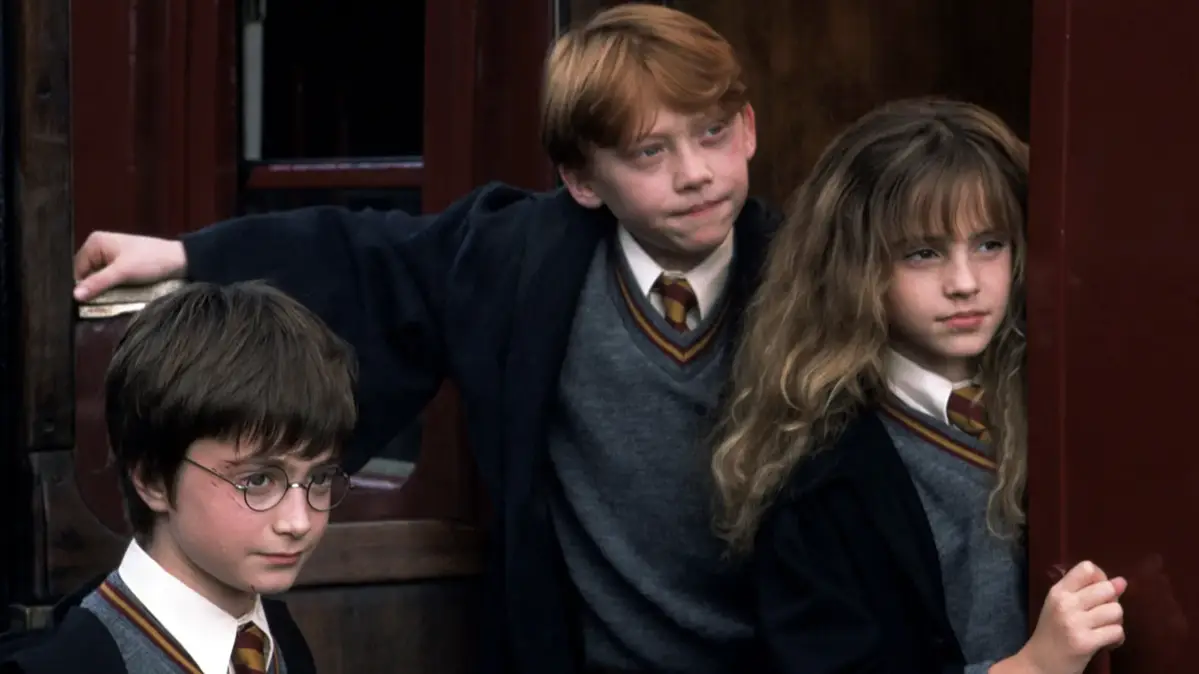
Three years after the American book appeared, Harry Potter and the Philosopher’s Stone became a film.
And suddenly the different titles created a new difficulty.
Warner Bros. wanted the film to match the title audiences already knew. In Britain and many other countries, that meant Harry Potter and the Philosopher’s Stone. In the United States, it meant Harry Potter and the Sorcerer’s Stone.
Changing a book cover is easy.
Changing spoken dialogue is not.
The filmmakers therefore created two versions of the necessary scenes. Whenever a character actually said the name of the Stone, the scene had to work for both markets. Contemporary reporting from The Guardian confirmed that scenes mentioning the object were filmed twice, once using “Philosopher’s Stone” and once using “Sorcerer’s Stone”.
This means that American viewers were not simply watching the British version with a different title placed at the beginning.
Daniel Radcliffe, Emma Watson, Rupert Grint and the other actors actually performed lines using the American name.
It is one of those tiny filmmaking details that is easy to miss unless you place the two versions next to each other.
Why “Philosopher’s Stone” matters more than it seems
From a business point of view, Scholastic’s decision is easy to understand.
Imagine that it is 1998. Nobody in America knows whether Harry Potter will become successful. You are trying to persuade children to pick up a book by an unknown British author. A title containing the word “sorcerer” instantly promises magic.
“Philosopher” does not.
But from a storytelling point of view, the original title has an important advantage.
Harry Potter’s world often works because Rowling mixes completely invented magic with pieces of real folklore, mythology, history and old magical traditions.
Basilisks were not invented for Chamber of Secrets. The phoenix existed in mythology long before Fawkes. Centaurs, werewolves, unicorns and dragons all have much older cultural histories.
The Philosopher’s Stone belongs to the same tradition.
It makes the magical world feel as though it has roots stretching far beyond Harry’s own story. Hogwarts may be fictional, but some of the ideas inside it have been fascinating people for centuries.
Replacing “Philosopher” with “Sorcerer” makes the title easier to recognise as fantasy, but it hides that deeper connection.
One Harry, two Stones
In the end, neither title prevented Harry Potter from becoming a phenomenon.
The American edition helped introduce millions of readers to Harry Potter and the Sorcerer’s Stone, while British readers and much of the rest of the world continued to know the story as Harry Potter and the Philosopher’s Stone.
The rest of the series did not repeat the experiment. Chamber of Secrets, Prisoner of Azkaban, Goblet of Fire and the later novels kept the same basic titles across the English-speaking world.
That makes the first book a curious exception.
It also gives us a small glimpse of Harry Potter before the fame, before the midnight book launches, before the films and before Hogwarts became one of the most recognisable fictional places in popular culture.
Back then, publishers were still trying to work out how to introduce this strange new world to readers.
And for American audiences, they decided that a sorcerer sounded more magical than a philosopher.
The irony is that the Philosopher’s Stone was already magical hundreds of years before Harry Potter was born.
 Gergő's English Club