It was late at night in Manhattan, but the street around Lexington Avenue was anything but quiet. A large crowd had gathered, photographers were waiting with their cameras, and in the middle of it all stood Marilyn Monroe in a simple white dress.
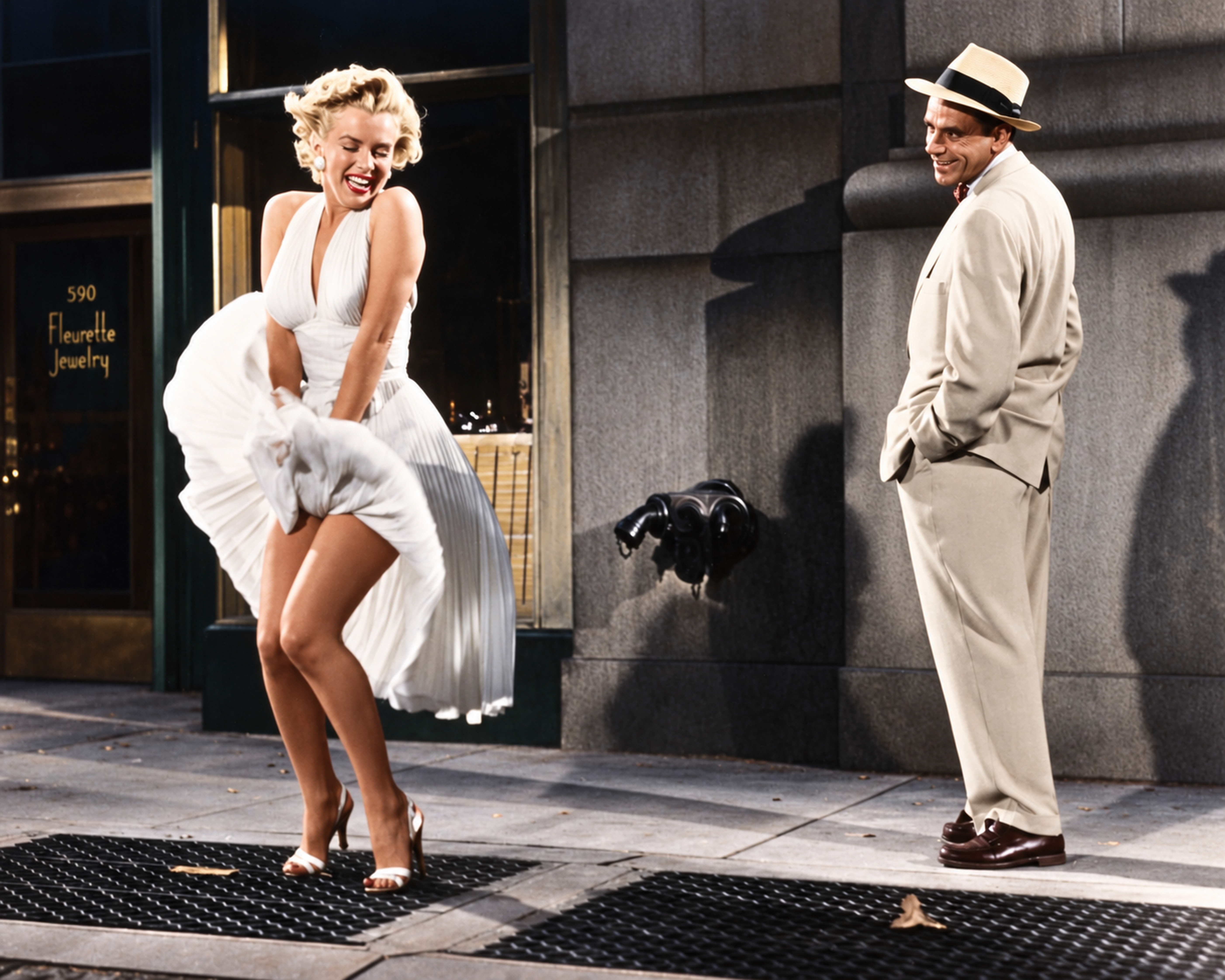
She was there to film a short scene for The Seven Year Itch. When a subway train passed underneath the street, air came up through a ventilation grate and lifted her skirt. Marilyn laughed and tried to hold it down while the photographers kept shooting.
At the time, it was simply part of a film. But the photographs taken that night, on 15 September 1954, soon became something much bigger. Today, even people who have never watched The Seven Year Itch probably recognise the image. Marilyn, the white dress and the New York subway grate have become part of Hollywood history.
Marilyn at the top of Hollywood
By the mid-1950s, Marilyn Monroe was already much more than a successful actress. She had become a celebrity whose face appeared on magazine covers around the world.
Her rise had been fast. After smaller film roles in the late 1940s and early 1950s, she attracted attention in films such as Niagara. Then came Gentlemen Prefer Blondes and How to Marry a Millionaire, and suddenly Marilyn was one of the biggest stars in Hollywood.
Studios often presented her as the beautiful blonde who was not always aware of the effect she had on men. But Monroe was much more intelligent and ambitious than this image suggested. She took acting seriously and wanted people to see her as more than just a glamorous face.
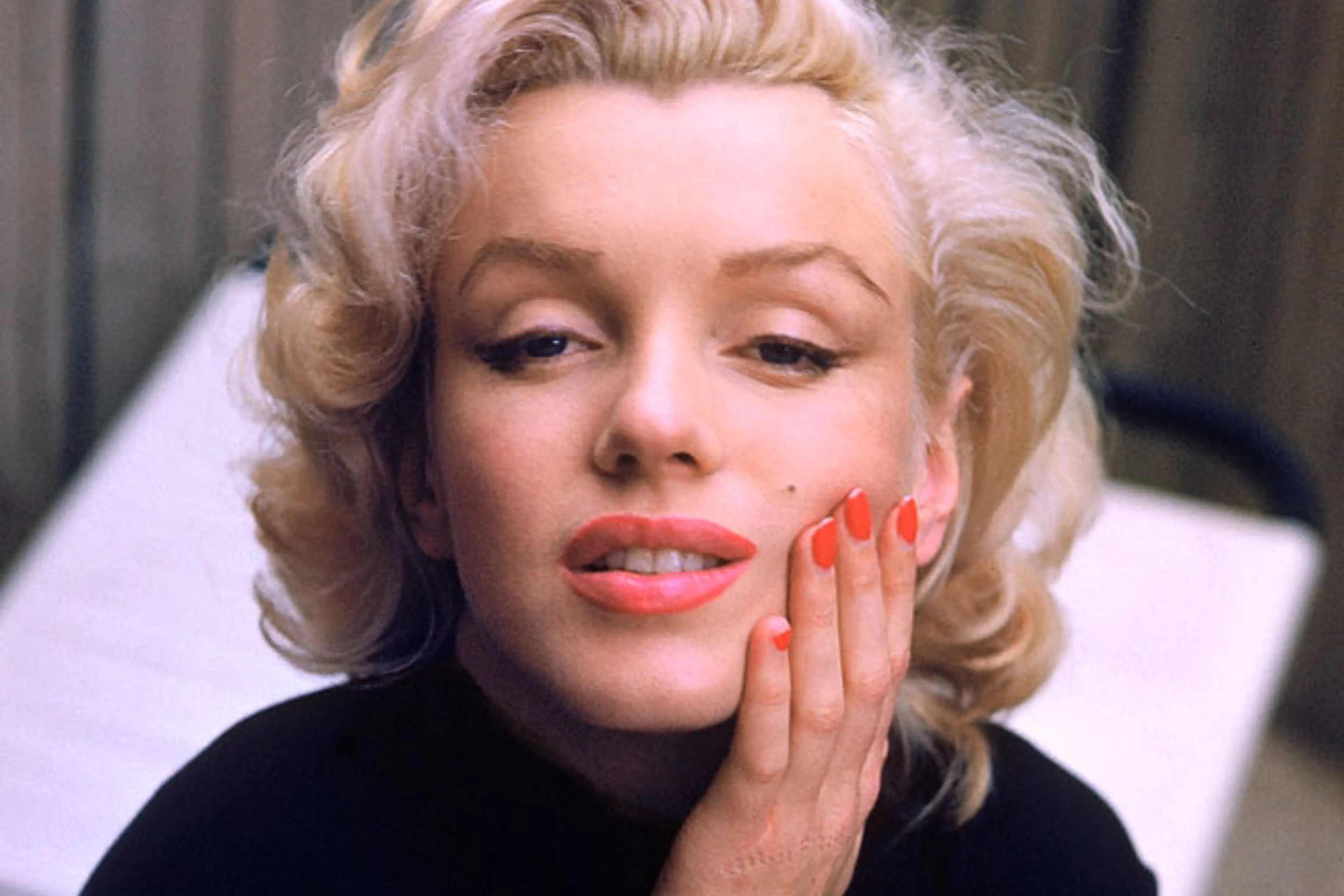
Comedy was also one of her greatest strengths. She had excellent timing and knew how to make a character seem innocent, confident and slightly confused all at the same time.
That made her a perfect choice for Billy Wilder’s The Seven Year Itch.
The girl upstairs
The film tells the story of Richard Sherman, played by Tom Ewell, a married man who stays alone in New York while his wife and son leave the city for the summer.
Then a new neighbour moves into the apartment upstairs.
Marilyn’s character is never given a proper name. She is simply called “The Girl”. She is friendly, charming and completely unaware of the chaos she creates in Richard’s imagination.
Much of the comedy comes from Richard’s fantasies and his attempts to convince himself that he is an irresistible man. Marilyn’s character, meanwhile, behaves naturally and often seems to have no idea what he is thinking.
One evening, the two go to the cinema. After the film, they walk outside and stop above a subway ventilation grate.
A train passes below.
Marilyn suddenly feels the cool air coming up through the grate and enjoys the relief from the summer heat. Her white skirt flies into the air, and she laughs as she tries to hold it down.
Today, it sounds like a scene that could have been filmed quietly on a closed set.
That was not what happened.
A New York night turns into a public show
The filmmakers decided to shoot part of the scene on location in Manhattan, near Lexington Avenue.
Word quickly spread that Marilyn Monroe would be filming there.
By the time the cameras were ready, the area was packed with spectators, photographers and reporters. Estimates vary, but well over a thousand people are believed to have gathered to watch.
Imagine being Marilyn Monroe for a moment. It is late at night, you are standing in the middle of New York, hundreds of cameras are pointing at you, and you have to repeat the same scene while your dress is blown into the air.
Again.
And again.
The crowd reacted loudly each time the skirt rose, while photographers tried to catch the perfect picture.
Ironically, the publicity was almost too successful. The noise from the spectators made the original footage difficult to use, so director Billy Wilder later recreated the scene on a studio set in Hollywood. The version we see in the finished film was therefore not simply the famous street performance that produced all those photographs.
But by then, it almost did not matter.
The photographs had already created a legend.
The white dress
The famous dress was designed by William Travilla, one of Hollywood’s major costume designers and someone who worked with Monroe on several films.
At first sight, the dress is quite simple. It is white, sleeveless and tied around the neck, with a wide skirt that could easily move in the air.
There are no diamonds, no complicated decorations and no bright colours.
And yet it became one of the most famous costumes ever worn on screen.
Part of the reason is the way it moved. The dress was perfect for the scene because the light skirt could rise dramatically when air came through the subway grate.
But, of course, the dress alone would never have become famous without Marilyn.
Her expression made the moment work. She was not standing there like a serious fashion model. She was laughing. She looked surprised and amused by what was happening.
That mixture of glamour and humour was very much part of Marilyn Monroe’s screen personality.
The picture was sexy, certainly, but it was also playful.
That combination helped make it unforgettable.
Not such a happy evening
Behind the famous smile, however, things were more complicated.
At the time, Marilyn was married to former baseball star Joe DiMaggio. Their relationship had attracted enormous public attention from the beginning. They had married earlier that year, and together they looked like one of America’s great celebrity couples.
In private, the marriage was much less simple.
DiMaggio was reportedly uncomfortable with Marilyn’s public image, especially scenes that presented her as a sex symbol. According to several accounts, he was present during the New York shoot and was not happy about the crowd’s reaction as Marilyn’s dress repeatedly flew into the air.
The evening later became one of the most famous stories connected to their difficult marriage.
It would be unfair to say that the subway scene alone ended their relationship. Their problems were much deeper than one night on a film set. Still, only a few weeks later, Marilyn announced that she was filing for divorce.
Suddenly, that joyful photograph had a rather sad story behind it.
Marilyn wanted something more
The strange thing about Marilyn’s career is that the more famous she became for her appearance, the more she tried to prove that she could do more.
She was frustrated with the roles Hollywood offered her and with the way the studio system controlled her career. She wanted stronger parts and greater respect as an actress.
Not long after The Seven Year Itch, she moved to New York and studied acting more seriously. She later created her own production company, something that was unusual for a female star at the time.
Her later work in films such as Bus Stop and Some Like It Hot showed that she could be much more than the stereotype people often associated with her.
This makes the white-dress photograph interesting in another way.
It represents the version of Marilyn Monroe that Hollywood sold to the public: beautiful, playful, glamorous and slightly innocent.
But behind that image was a woman who was constantly trying to take more control of her own career.
When a movie scene becomes bigger than the movie
The Seven Year Itch was successful, but today the subway scene is probably much better known than the story of the film itself.
That does not happen very often.
Over the years, the picture of Marilyn in the white dress has been recreated countless times. Actors, singers, models and cartoon characters have copied the pose. Statues have been made of it. Posters still decorate walls. The image appears whenever people want to represent the glamour of 1950s Hollywood.
It has almost become separate from Marilyn herself.
And perhaps that explains why it is still so powerful.
You do not need to know the plot of The Seven Year Itch. You do not need to know who Richard Sherman is. You do not even need to know exactly what happens in the scene.
You see the white dress, the subway grate and Marilyn Monroe, and you already know what you are looking at.
One night that never disappeared
On 15 September 1954, the people standing on that New York street probably knew they were watching a major movie star.
What they could not know was that they were watching the creation of one of the most recognisable images in cinema history.
For Marilyn, it was one more night of work. For Billy Wilder, it was one scene in a comedy. For the photographers, it was a chance to get a good picture.
But sometimes popular culture works in strange ways.
A few seconds of film can become more famous than an entire movie. A simple white dress can become part of cinema history. And an ordinary subway grate can become a place that people still connect with Marilyn Monroe more than seventy years later.
The train that created the rush of air was gone in seconds.
The image it helped create never really disappeared.
 Gergő's English Club