Tallinn’s Town Hall is one of those buildings that seems to belong so naturally to the Old Town that it is easy to forget how unusual it really is. It has stood on Raekoja plats for centuries, watching the square change from a busy medieval marketplace into one of the city’s best-known meeting places. Today, cafés and visitors fill the area, but the Town Hall still gives the square its unmistakable character.
At first glance, it may simply look like the perfect medieval backdrop. But the building is much more than that. Tallinn Town Hall is the only surviving Gothic town hall in Northern Europe, and its history goes back more than 700 years. It was first mentioned in written records in 1322, although a town government building had already stood on the site earlier.
The Town Hall we see today mostly took shape between 1402 and 1404, when Tallinn was growing into an important trading city. At the time, it belonged to the Hanseatic League, a powerful network of towns and merchants that connected large parts of Northern Europe. Trade brought money, influence and confidence, and the new Town Hall reflected all of that. It was not just a practical building – it was meant to show that Tallinn was a city that mattered.
For centuries, some of the most important decisions in the city were made here. The town council met inside, taxes and finances were discussed, legal cases were handled, and the daily running of Tallinn was organised from these rooms. In many ways, this was the centre of city power. Even more surprisingly, the city administration continued to work here until 1970, long after the medieval world outside had disappeared.
The inside of the Town Hall is just as fascinating as the exterior. The Citizens’ Hall, with its high Gothic arches, immediately gives the building a ceremonial feeling. The Council Chamber feels more intimate, but it contains some of the Town Hall’s most interesting details, including beautifully carved medieval wooden benches. Their decorations show scenes from famous stories such as Tristan and Isolde, together with biblical and classical figures.
What makes the interior especially interesting is that it does not belong to just one period. Different generations changed and decorated the building, so the rooms slowly collected layers of history. Medieval Gothic architecture sits next to later paintings, woodwork and decorative details. Instead of feeling frozen in time, the Town Hall feels like a building that has actually lived through the centuries.
Then there is the tower.
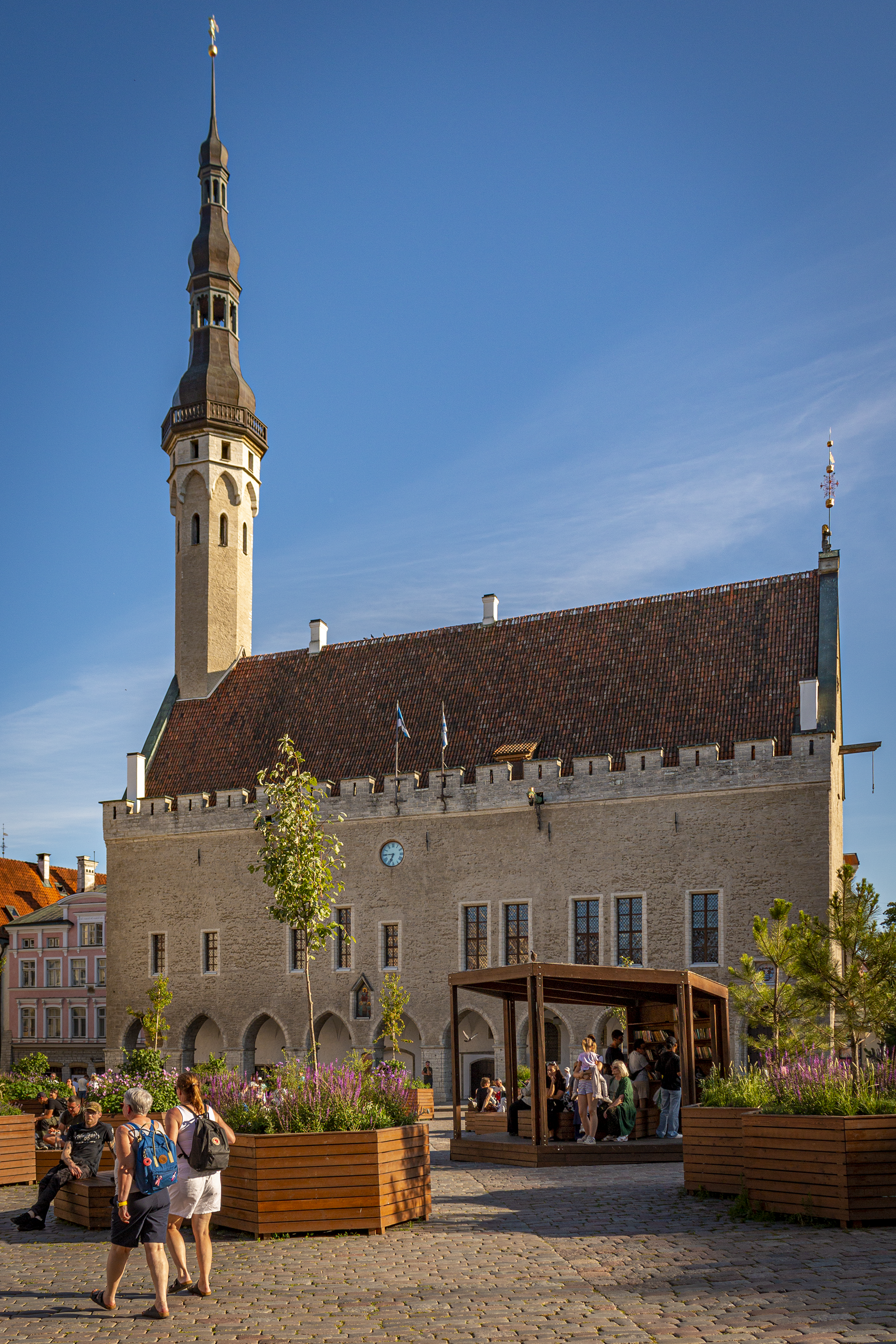
Rising 64 metres above the square, it is one of the most recognisable parts of the Tallinn skyline. In earlier times, guards could watch the city from above, keeping an eye out for fires and other dangers. Today, during the summer season, visitors can climb part of the tower. The staircase is narrow and steep, but after 115 steps, the view over the red rooftops, church towers and the distant harbour makes the effort worthwhile.
And of course, no story about Tallinn Town Hall would be complete without Old Thomas – Vana Toomas.
The small warrior figure standing at the top of the tower first appeared there in 1530. Over time, he became one of the best-known symbols of Tallinn. The original weather vane remained on the tower for centuries, surviving wars, changing rulers and countless Baltic storms. After the tower was damaged during the Soviet bombing of Tallinn in March 1944, the original Old Thomas was eventually replaced. Today, he is kept safely inside the Town Hall, while copies have continued watching over the city from above.
Still, the real charm of the Town Hall is not only in its dates, architecture or famous weather vane. It is in the way the building still feels connected to everyday life around it.
Hundreds of years ago, merchants crossed this square, officials walked through the Town Hall doors, and people gathered outside to trade, talk and hear news. Today, the clothes are different, the languages are more international and many of the market stalls have been replaced by café tables – but the square is still full of life.
That is something Tallinn does particularly well. History is everywhere, but it rarely feels distant. You can sit in Raekoja plats with a coffee, watch people passing by and look up at a building that was already old long before the modern city existed.
Tallinn Town Hall may be one of the most important medieval buildings in Estonia, but it never feels like a monument that belongs only to the past. It is still part of the rhythm of the Old Town – quietly standing there while Tallinn continues to change around it.
 Gergő's English Club