The story of a school that survived two world wars, educated generations of children, and still operates in one of Budapest’s most beautiful historic buildings. For two years, I had the privilege of being part of this historic school’s 120-year story as a teacher. Since last school year, however, I have only returned to the building as a visitor.
In Budapest’s seventh district, at 85 Dob Street, stands a building that thousands of people walk past every day, perhaps without realising how much history lies behind its walls. Its beautifully decorated Art Nouveau façade, colourful mosaics and unusual windows immediately catch the eye. However, those who step through its entrance discover much more than an architectural masterpiece. They enter a place that has been part of Budapest’s educational history for well over a century.
The school we know today as Dobsuli traces its history back to 1890, although its present building was officially opened on 14 October 1906. During the following 120 years, thousands of children learned to read, write, count and speak foreign languages within its walls. The building served as a military hospital, suffered damage during the Second World War, and later came back to life. Over the decades, teaching methods, classroom equipment, subjects and even the school’s name changed. Yet one thing remained the same: 85 Dob Street continued to be a place of learning.
In 2026, as the building celebrates its 120th anniversary, it is worth looking back at the remarkable story of this extraordinary Budapest school.
When Erzsébetváros Was a Rapidly Growing Neighbourhood
To understand the history of Dobsuli, we need to travel back to Budapest at the end of the 19th century.
After the unification of Buda, Pest and Óbuda in 1873, the Hungarian capital developed at an extraordinary speed. New residential buildings, public institutions, roads and schools appeared throughout the city, while its population continued to grow.
Erzsébetváros, Budapest’s seventh district, became one of the most densely populated parts of the capital. Naturally, the increasing number of families created a growing demand for schools.
It was in this environment that Dobsuli’s predecessor opened in 1890. At that time, the school was located at 95 Dob Street and operated as a municipal elementary school.
However, the building soon became too small for the increasing number of pupils.
The school’s headteacher, János Székely, encouraged the city authorities to build a new school. As a result, Budapest announced an architectural competition for a plot of approximately 300 square fathoms at 85 Dob Street.
Designing a modern school for such a location was not an easy task. Dob Street was relatively narrow, and the neighbouring buildings stood close together. Nevertheless, the new school needed bright classrooms, suitable corridors, communal spaces and a healthy learning environment.
The winning solution came from Hungarian architect Ármin Hegedűs.
A School Building Ahead of Its Time
Ármin Hegedűs was an important Hungarian architect of the early 20th century. He was involved in designing several public buildings and schools in Budapest.
His work also included the former Török Bank building in Szervita Square, while he was one of the architects responsible for the famous Gellért Hotel and Baths.
Construction of the new Dob Street school began in the autumn of 1905 and was completed the following year.
Hegedűs designed the building in the Hungarian Art Nouveau style, which was extremely popular at the time. His work was influenced by Ödön Lechner, one of the most important figures in Hungarian architecture, who wanted to create a unique national architectural style.
However, Hegedűs did not simply want to design a beautiful building. He also considered modern educational ideas and the health of the children who would study there.
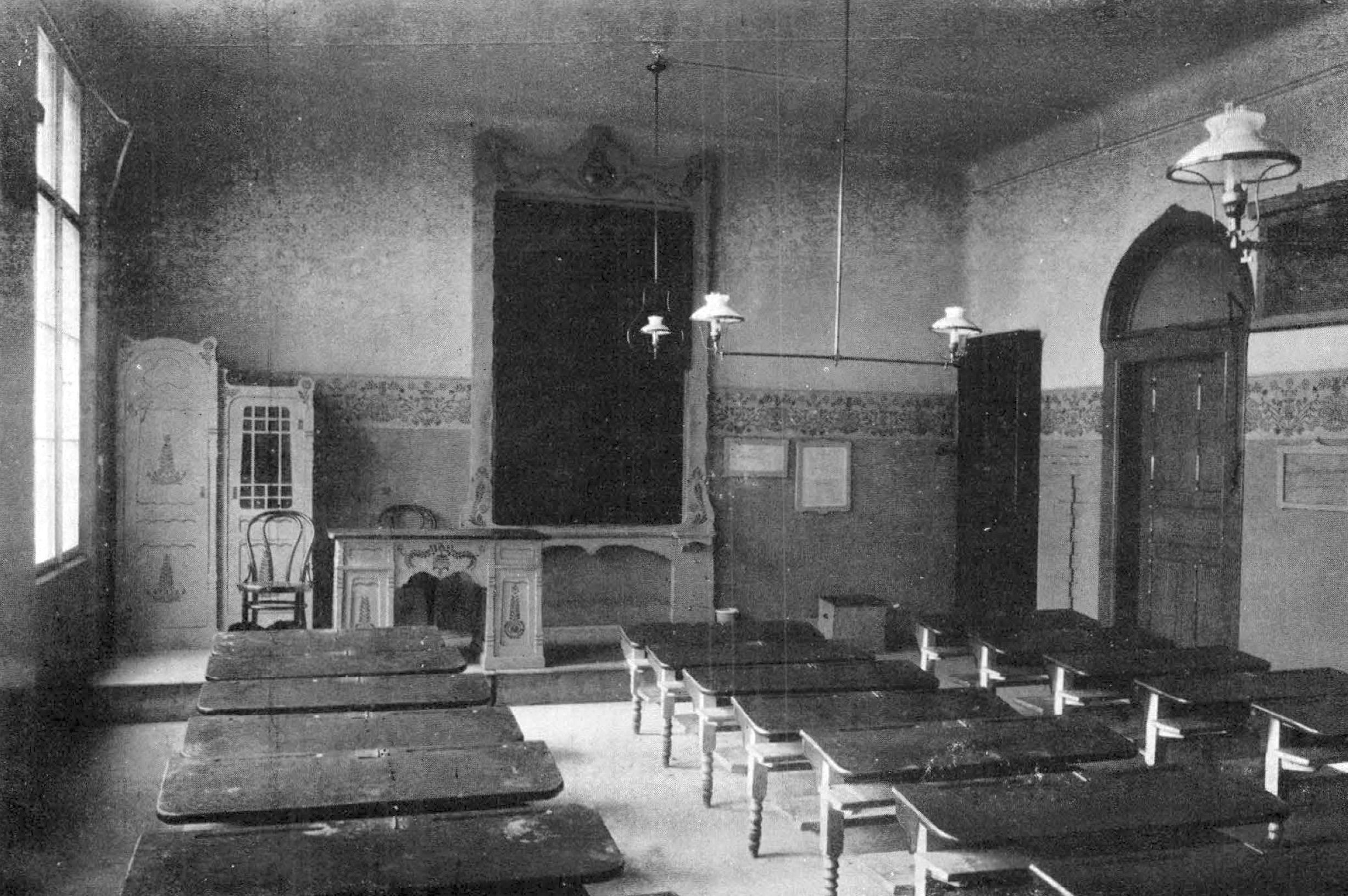
Classrooms needed enough natural light and fresh air. Physical education was becoming increasingly important, and schools were expected to provide a comfortable and healthy environment for their pupils.
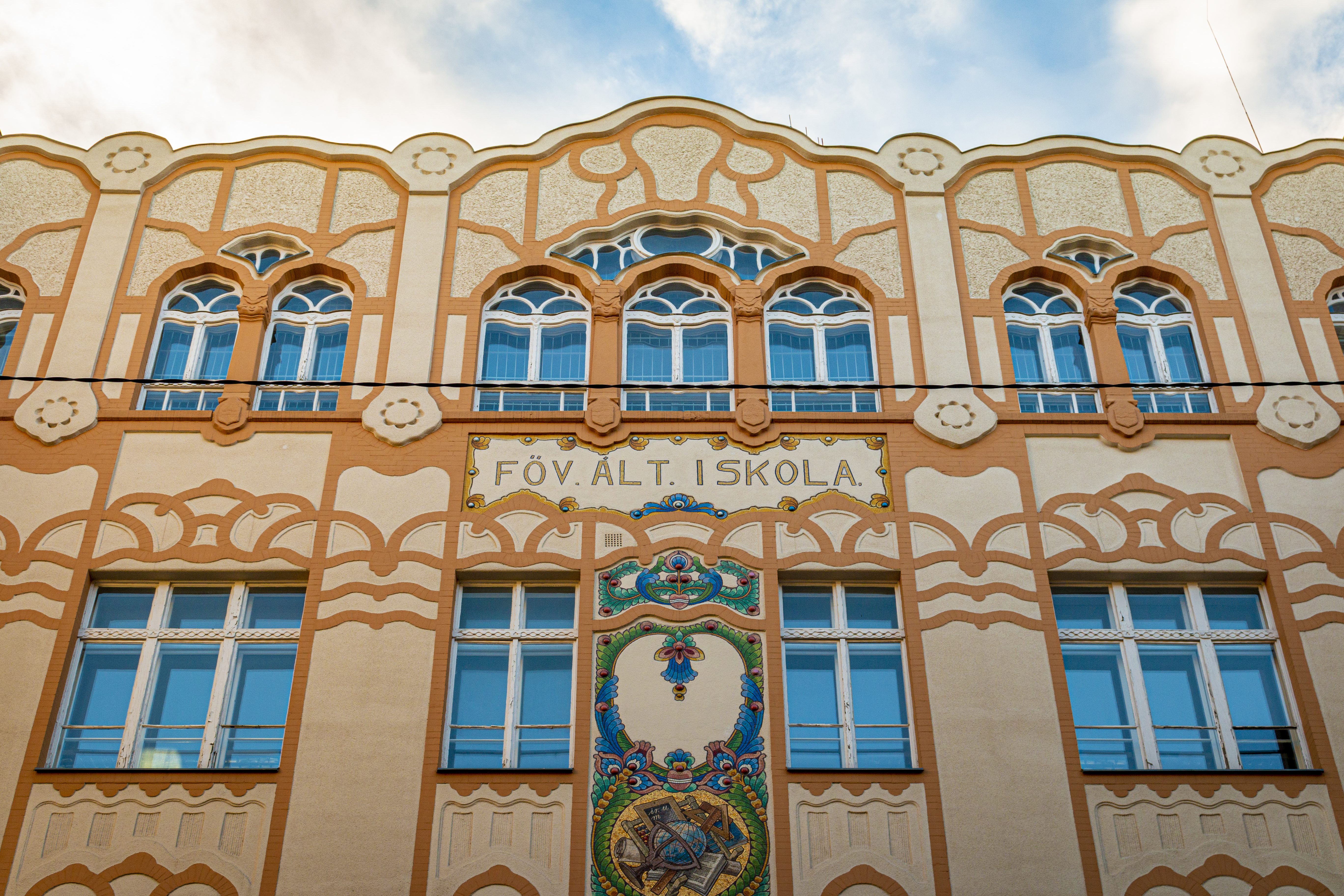
One of the architect’s cleverest solutions was the unusual shape of the street-facing façade.
The two outer sections of the building were positioned closer to the street, while the central section was set further back. This created a small open space in front of the entrance and allowed more daylight to reach the building.
It also made the relatively narrow street feel less crowded.
Inside, the school was equipped with spacious classrooms, modern sanitary facilities and a special gymnasium on the third floor.
The original building had three floors above the ground level, and its roof included a terrace where children could spend time outdoors.
Today, these features might not sound particularly unusual. At the beginning of the 20th century, however, they represented a modern approach to school design.
The building demonstrated that children’s physical well-being was becoming an important part of educational planning.
The Mosaics That Tell the Story of Childhood
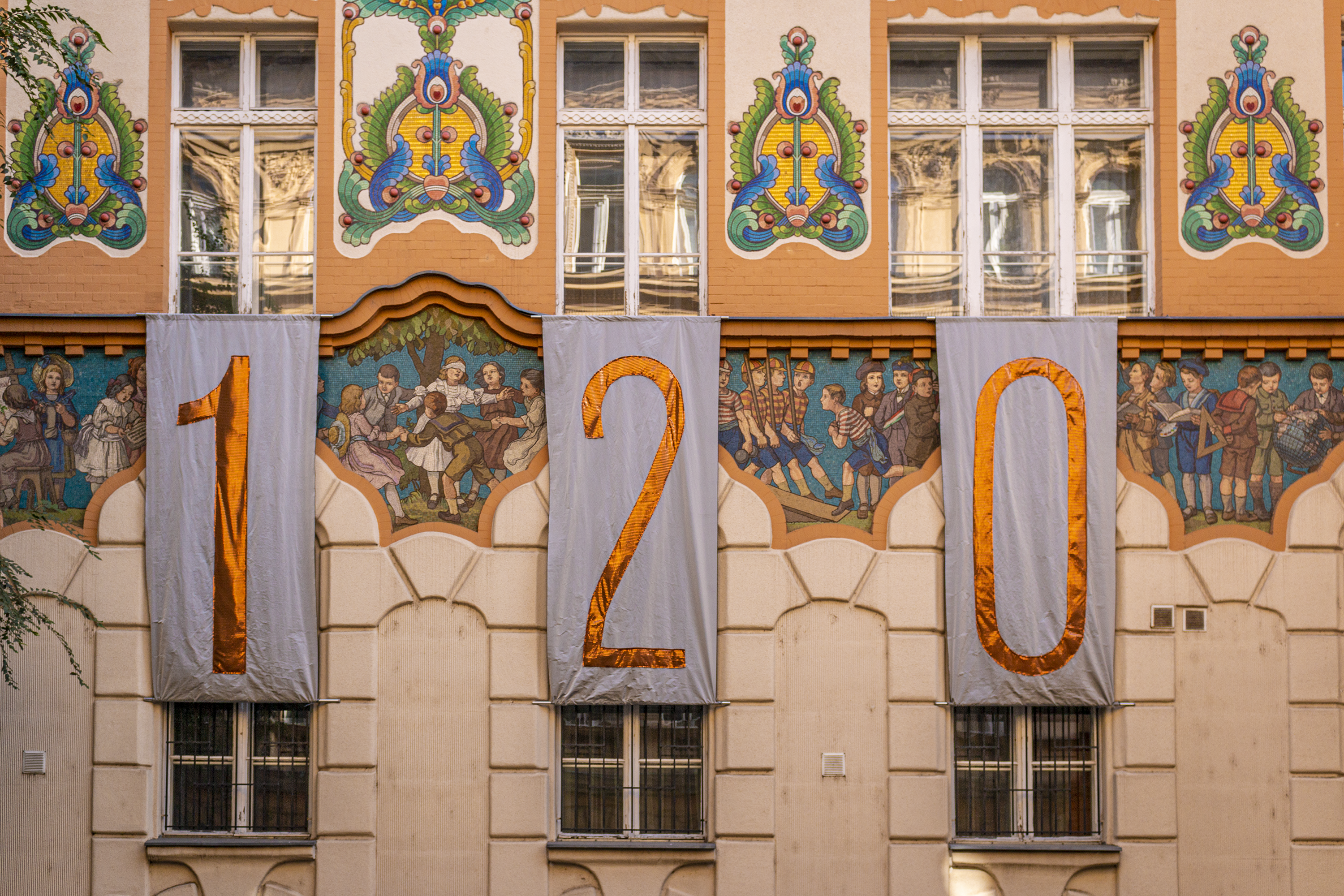
One of the most remarkable features of the Dob Street school is undoubtedly its façade.
Its decoration combines the rich floral patterns of Art Nouveau with curved architectural forms, unusual windows and colourful works of art.
The mosaic decorations were designed by Hungarian painter Zsigmond Vajda and produced by Miksa Róth, the internationally recognised Hungarian stained-glass and mosaic artist.
These mosaics are much more than simple decorations. They show different scenes from children’s everyday lives and offer a fascinating glimpse into educational ideas at the beginning of the 20th century.
The images connected with girls show activities such as singing, embroidery, spinning and working with flowers.
On the boys’ side, the mosaics represent studying, sport, military-style games and activities connected with geography and technical knowledge.
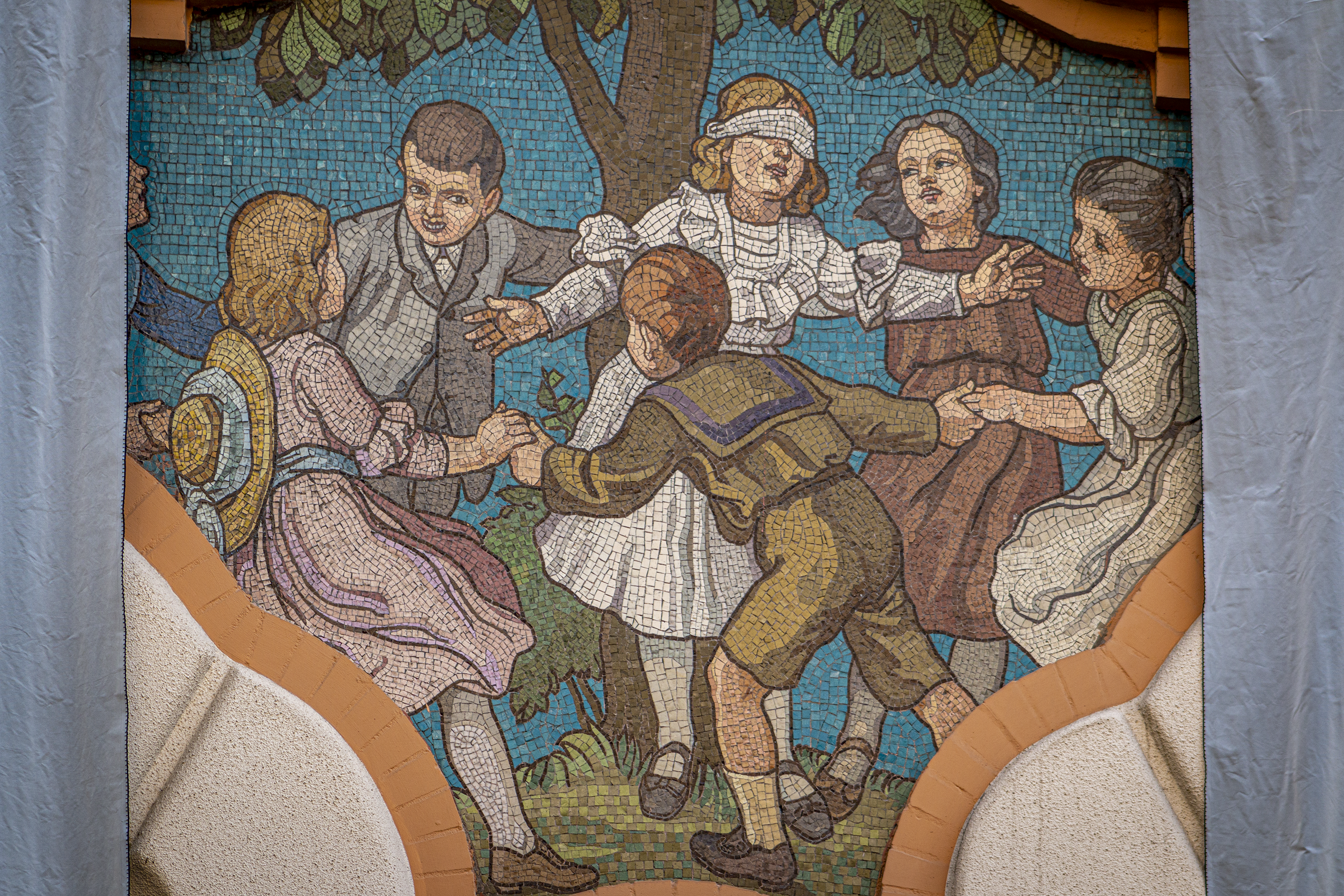
One particularly charming scene shows boys and girls playing together while holding hands.
These pictures also reveal an important detail about the school’s original organisation.
When the building first opened, boys and girls were educated separately. They had different entrances and attended lessons in different parts of the building.
This separation was common in the educational system of the period.
For this reason, the mosaic showing boys and girls playing together is especially interesting. Although their education was separated, the artists still included a scene of children enjoying a shared activity.
The inside of the building is just as impressive.
Visitors can discover walls decorated with Zsolnay ceramics, beautifully designed staircases, ornamental columns and original Art Nouveau doors.
Some of the carved capitals feature small animals, including pigeons and squirrels.
Original terrazzo floors, unusual windows and several other decorative details have also survived.
Dobsuli is therefore more than a functioning school. It is a remarkable example of Hungarian Art Nouveau architecture that continues to serve its original purpose.
14 October 1906 – A New School Opens Its Doors
The new school building was officially opened on 14 October 1906.
The opening ceremony was attended by István Bárczy, who was Budapest’s mayor at the time.
Bárczy later became one of the most important figures in the development of the capital’s educational infrastructure. His ambitious school-building programme helped create modern educational institutions throughout Budapest.
The opening of the Dob Street school therefore took place at the beginning of an important period in the history of public education in the Hungarian capital.
When the building first opened, it welcomed 621 pupils, divided into ten classes.
Twenty teachers were responsible for their education.
Boys and girls attended lessons separately, under the leadership of János Székely and Ferenc Czike.
The building was not used exclusively for elementary education. A domestic science school and an industrial school also operated there.
This meant that the institution was already serving several educational purposes during its earliest years.
The new school was considered modern and well equipped for its time.
However, the optimism and confidence in progress that characterised the beginning of the century would soon be interrupted by one of the greatest tragedies in European history.
From Classrooms to Hospital Wards – The First World War
In 1914, the First World War broke out, bringing enormous changes to everyday life in Budapest.
For the Dob Street school, the war had a particularly dramatic consequence.
The school building was converted into a military hospital.
The children had to leave their familiar classrooms and continue their education at a school in nearby Wesselényi Street.
The relocation created difficult conditions. Classrooms became overcrowded, and the shortage of suitable learning spaces affected the quality of education.
According to the school’s own historical account, academic standards also declined during this period.
Even after the war ended in 1918, the pupils were unable to return immediately.
They finally moved back to their original building in 1921.
However, returning did not mean that everything was the same as before.
The building had suffered damage, and some of its facilities needed modernisation.
In 1927, renovation work was carried out, and the school’s equipment was updated.
During the following years, under headteacher Gyula Lathwesen, the institution entered another period of development.
The school had survived its first major historical crisis and returned to its original purpose.
Unfortunately, peace would not last forever.
The Second World War and the Siege of Budapest
The Second World War brought another difficult chapter in the school’s history.
During the war, the ground floor of the building was used for military purposes.
The school also suffered direct damage during the Siege of Budapest in 1944–1945.
It was hit by a bomb and several artillery shells.
For a building originally designed to provide children with a safe and healthy learning environment, the destruction of war represented a tragic contrast to its original purpose.
However, reconstruction began soon after the fighting ended.
In 1945, the school’s teachers took an active part in repairing the damaged building, and lessons gradually resumed.
The return to education was not simply a matter of repairing walls and replacing damaged equipment.
Hungary’s entire educational system was undergoing major changes.
In 1946, a parents’ association and a Pioneer youth organisation were established at the school.
In 1947, the formerly separate boys’ and girls’ elementary schools were reorganised into general schools.
During the 1950s, the building also provided education for adults through a school for working people.
These developments reflected the beginning of a very different social and educational system from the one in which the institution had originally been founded.
New Classrooms, New Traditions – The Socialist Decades
During the 1955–1956 school year, the Dob Street building celebrated its 50th anniversary.
According to the school’s historical records, 244 teachers and eighteen headteachers had worked at the institution during its first half-century.
Thousands of children had received their education there.
The following decades brought further changes.
In 1960, the school became coeducational, meaning boys and girls began attending lessons together.
This was a particularly significant development for a building originally designed with separate entrances and teaching areas for the two sexes.
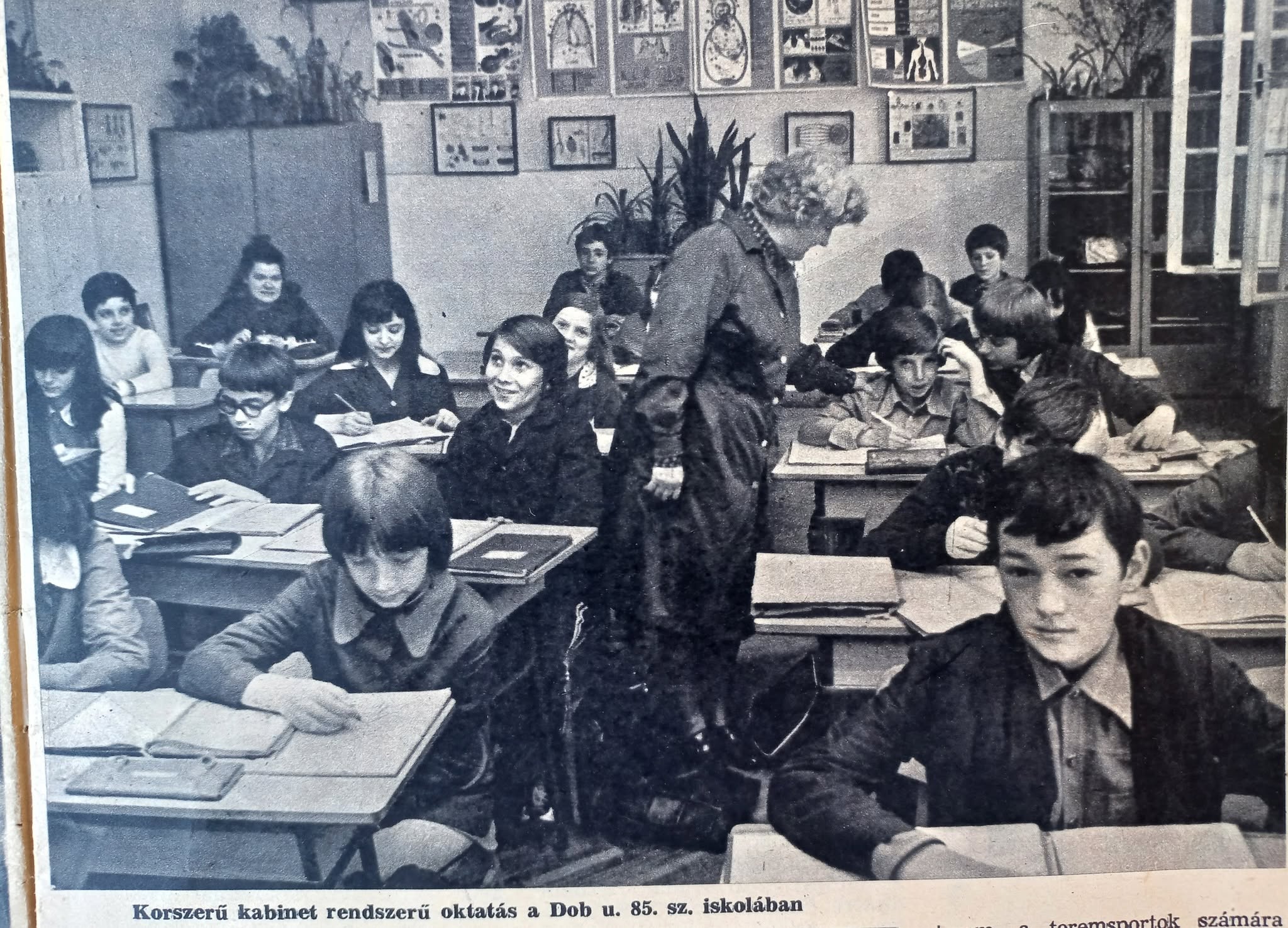
The number of pupils was extremely high during the 1960s.
According to the school’s historical account, there were periods when a single year group had eight parallel classes, from A to H.
The increasing number of children created a need for additional classroom space.
As a result, a fourth floor was added to the courtyard-facing section of the building. The original appearance of the street façade was preserved as far as possible.
Classroom equipment also changed considerably.
Traditional wooden desks, once equipped with inkwells and compartments for writing materials, were gradually replaced by more modern school furniture.
Old coal- and wood-burning tiled stoves gave way to central heating.
For several decades, the old and the new existed side by side at 85 Dob Street.
While everyday teaching conditions gradually became more modern, many original architectural details survived.
The decorative staircases, beautiful wall tiles, ornamental columns and Art Nouveau doors continued to connect the school with its early history.
Famous Pupils and Remarkable Teachers
Of course, the history of Dobsuli is not only about its building or the changes in the educational system.
It is also about the people who studied and worked there.
Over the years, several well-known Hungarian artists attended the school.
According to the institution’s historical overview, former pupils included the celebrated actors Éva Ruttkai, Dezső Garas and István Somló.
Later generations of pupils included actor János Gálvölgyi and journalist György Bernáth.
The teaching staff also included several remarkable figures.
Linguist Sándor Hernádi and cultural historian István Mészáros both taught at the institution.
Another person worth mentioning is Zoltánné Koritsánszky, a Hungarian language and history teacher who worked at the Dob Street school from 1953 until 1995.
Her career lasted more than four decades.
During those years, she witnessed enormous changes in Hungarian society and education, from the political atmosphere of the 1950s through the decades of socialism to the democratic transition and the beginning of the 1990s.
However, the school’s story is not limited to famous former pupils or outstanding teachers.
Just as important are the thousands of ordinary children who learned their first lessons here, made friendships, discovered their interests and later found their own paths in life.
After all, the history of a school is also the collection of countless personal stories.
The 1980s and 1990s – New Directions in Education
Another important period of change began during the 1980s and 1990s.
Dr Istvánné Füzesi served as deputy headteacher from 1979 and later as headteacher between 1985 and 1997.
Under her leadership, several older traditions were revived, while new forms of education were introduced.
During the 1991–1992 school year, the institution launched a domestic science training programme.
After this programme ended, vocational education in hospitality was introduced, offering training for waiters and cooks.
This development demonstrated that the school had once again expanded beyond the traditional role of elementary education.
However, one of the most significant changes involved the teaching of English.
English language education already had a long tradition at the school.
Building on this experience, the institution introduced Hungarian–English bilingual education during the 1995–1996 school year.
According to the school’s historical account, this was one of the first initiatives of its kind among Hungarian general schools.
The introduction of bilingual education had a lasting influence on the school’s identity.
Over time, the name Dobsuli became closely associated with Hungarian–English bilingual teaching.
This educational approach remains one of the institution’s defining characteristics today.
2011 – A New Chapter in the School’s Organisation
The beginning of the 21st century brought another major administrative change.
On 1 July 2011, two educational institutions were merged to create a new school organisation.
One of its predecessors was the Hungarian–English Bilingual General School and Hospitality Vocational School at 85 Dob Street.
The other was the Erzsébetváros General School and Information Technology Secondary School.
The latter had itself been established in 2003 through the merger of the former teacher-training school in Dohány Street and the art-oriented general school in Kertész Street.
The 2011 reorganisation therefore brought together several educational institutions with their own separate histories and traditions.
It is important to distinguish between these different schools.
The institutions in Dohány Street and Kertész Street have their own historical backgrounds, which should not be confused with the history of Dobsuli.
For example, some official documents of the merged institution mention an establishment date going back to 1873.
However, this refers to another predecessor institution, not to the Dob Street school itself.
Following the merger, the Dob Street school continued operating in its original building from 1906.
Today, the institution’s official Hungarian name is Erzsébetvárosi Magyar-Angol Két Tanítási Nyelvű Általános Iskola és Művészeti Szakgimnázium.
Its administrative headquarters are located at 30 Kertész Street, while the building at 85 Dob Street operates as one of its school sites.
Nevertheless, generations of pupils, parents and teachers continue to use its familiar nickname: Dobsuli.
2016–2017 – The Art Nouveau School Comes Back to Life
One of the most important events in the building’s recent history was its extensive renovation.
In 2016, the local government of Erzsébetváros began a major restoration project.
The aim was not only to preserve the building’s architectural treasures but also to create a more comfortable and modern learning environment.
The renovation was badly needed.
Although several smaller repairs and improvements had been carried out during the decades following the Second World War, the building had not undergone such extensive restoration for a long time.
The work included the restoration of both the street-facing and courtyard façades.
Special attention was given to the beautiful mosaics, which were carefully restored.
The roof structure was renovated, and improvements were made to classrooms, corridors and several parts of the building’s technical systems.
The toilets and washing facilities were modernised, and energy-efficient equipment was installed.
The third-floor gymnasium also received considerable attention.
Its sports flooring was replaced, the walls and ceiling were renovated, and the changing rooms and showers were modernised.
At the same time, great care was taken to preserve the building’s historical details.
The original Zsolnay ceramic decorations, ornamental columns, distinctive doors and other Art Nouveau elements were protected or restored where necessary.
In January 2017, the local newspaper Erzsébetváros Újság published a detailed report about the project.
The importance of the renovation went far beyond the school community.
One of Budapest’s remarkable architectural treasures regained much of its former beauty, while the building continued serving the purpose for which it had originally been designed.
An Extraordinary School in the 21st Century
Today, Dobsuli remains an active educational institution where modern teaching meets more than a century of history.
Hungarian–English bilingual education continues to be an important part of the school’s identity, while artistic education also plays a significant role within the wider institution.
The building itself has become an interesting destination for people who want to explore the architectural history of Budapest.
On 10 June 2026, World Art Nouveau Day, a local historical walking tour in Erzsébetváros began at the Dob Street school.
The event was later featured in Erzsébetváros Újság in August 2026.
Visitors were guided through the building by headteacher Hajnalka Harangozó, who introduced them to some of its remarkable original architectural details.
The group had the opportunity to see the historic staircase, the Zsolnay ceramic decorations, the original railings and the unusual gymnasium.
According to the headteacher, the third-floor gymnasium has such excellent acoustics that it was once also used for concerts.
The 2026 article mentioned another particularly interesting feature of the school: an art classroom known as Sziszi.
The creation of this classroom was made possible through funding connected to a historical bequest associated with Empress Elisabeth of Austria, who was also Queen of Hungary.
According to the report, the school received €8,000 to support the artistic education of children from different language backgrounds.
This is another example of how the school’s past and present remain connected.
An institution originally created according to the modern educational ideas of the early 20th century continues to find new ways to support children’s learning and development.
A 120-Year-Old Building and 136 Years of Educational Tradition
On 14 October 2026, exactly 120 years will have passed since the school building at 85 Dob Street was officially opened.
The educational history of the institution goes back even further.
If we count from the establishment of its predecessor in 1890, the school’s story now covers 136 years.
During this time, Budapest and Hungary have changed beyond recognition.
What began as a municipal elementary school during the Austro-Hungarian Monarchy later became an institution that survived two world wars, adapted to several different political systems and developed an increasingly varied educational programme.
Teaching methods changed.
School rules changed.
Subjects and classroom equipment changed.
Traditional wooden desks with inkwells were replaced by modern furniture. Separate education for boys and girls gave way to mixed classes. English developed into one of the school’s most important educational features.
Yet the building has preserved much of its original character.
The colourful mosaics still show children from the early 20th century studying, singing and playing.
The staircases are still the same ones used by generations of pupils, including several people who would later become famous artists.
And children still enter the very same building that opened in October 1906 as one of Budapest’s modern educational institutions.
For this reason, 85 Dob Street is much more than an ordinary school address.
It represents a small but important part of Budapest’s history, where architecture, education and the memories of generations come together.
Perhaps the most remarkable thing about Dobsuli is that its history is not something that exists only in museums, old photographs or historical documents.
The 120-year-old building is still a school. And its story continues.

